Terrain VLM
← previous: Mars on GPU Physics · next: Long Traverse →
The plain words boxes like this one carry the whole story; the technical detail around them is there if you want it.
The one line version: we showed an AI that understands images and language a picture of the ground and asked it, in words, whether to climb over or walk around. It scores 52.9%. A one-line rule that ignores the picture entirely scores 55%.
Abstract
Lab 5 part 3 measured something uncomfortable. Its robot told climbable landforms from impassable ones about 3:1 — and so did a policy fed six constant zeros. The discrimination came from having a body, not from perception: you learn a scarp is impassable by walking into one.
This lab gives a model eyes and asks whether that helps. A vision-language model is fine-tuned on rendered Martian views whose labels come from the terrain's own geometry, and scored against the robot that never saw anything.
At this budget the answer is no. Seeing contributes something measurable — and still loses to walking into things.
Baseline: three, because one would not be readable. Majority class (always answer OVER) 55.0%; a blind control with an identical pipeline and a uniform grey image 45.0%; lab 5's robot, by contact, ~75%. Budget: Qwen2.5-VL-3B, LoRA r=16 (7.4 M trainable, 0.196%), 2 epochs over 1657 views, 208 steps, ~23 min on one RTX 3080 Ti Laptop (11.5 GB of 16 GB). Scored on 429 views from surfaces never seen in training. Falsifier: a model that sees should beat lab 5's contact-only 3:1. Result 52.9% — FAILS.
How this lab works
A vision-language model is shown the terrain ahead and asked, in words, whether to go over or around. Three baselines, because one would not have been readable.
Sight helps — McNemar p = 0.006 against the blind arm — and still loses to the one-line heuristic. Reporting only the first comparison would have been a true sentence and a false impression. Meanwhile the robot that only feels scores around 75%.
A working no-information control emits one constant: the blind arm answered AROUND for all 429 items, which is what licenses the comparison. A blind control with varied answers means information is leaking.
The result
The model that can see the ground scores 52.9%. A one-line rule that always gives the same answer and never looks at the picture scores 55%. Seeing genuinely helps compared to a blindfolded version of the same model — and still loses to the rule.
| arm | accuracy | 95% CI |
|---|---|---|
| zero-shot Qwen2.5-VL-3B | 45.0% | [40.3%, 49.7%] |
| blind control (LoRA, grey image) | 45.0% | [40.3%, 49.7%] |
| sighted (LoRA, real terrain) | 52.9% | [48.2%, 57.6%] |
| majority class (always OVER) | 55.0% | — |
| lab 5's robot, by contact | ~75% | — |
Two tests, because they answer different questions:
- Did the camera contribute? Yes. On the same 429 paired items, 89 flipped right and 55 flipped wrong — McNemar exact p = 0.0058.
- Is the result good? No. Against always answering OVER, p = 0.82. It does not beat a one-line heuristic, let alone the robot.
Both are true simultaneously. Reporting only the first would be the kind of claim this course exists to avoid.
The control, drawn
To prove the model is really using the picture, we ran it again with the picture replaced by a blank grey rectangle. If the score had stayed the same, the model was never looking.
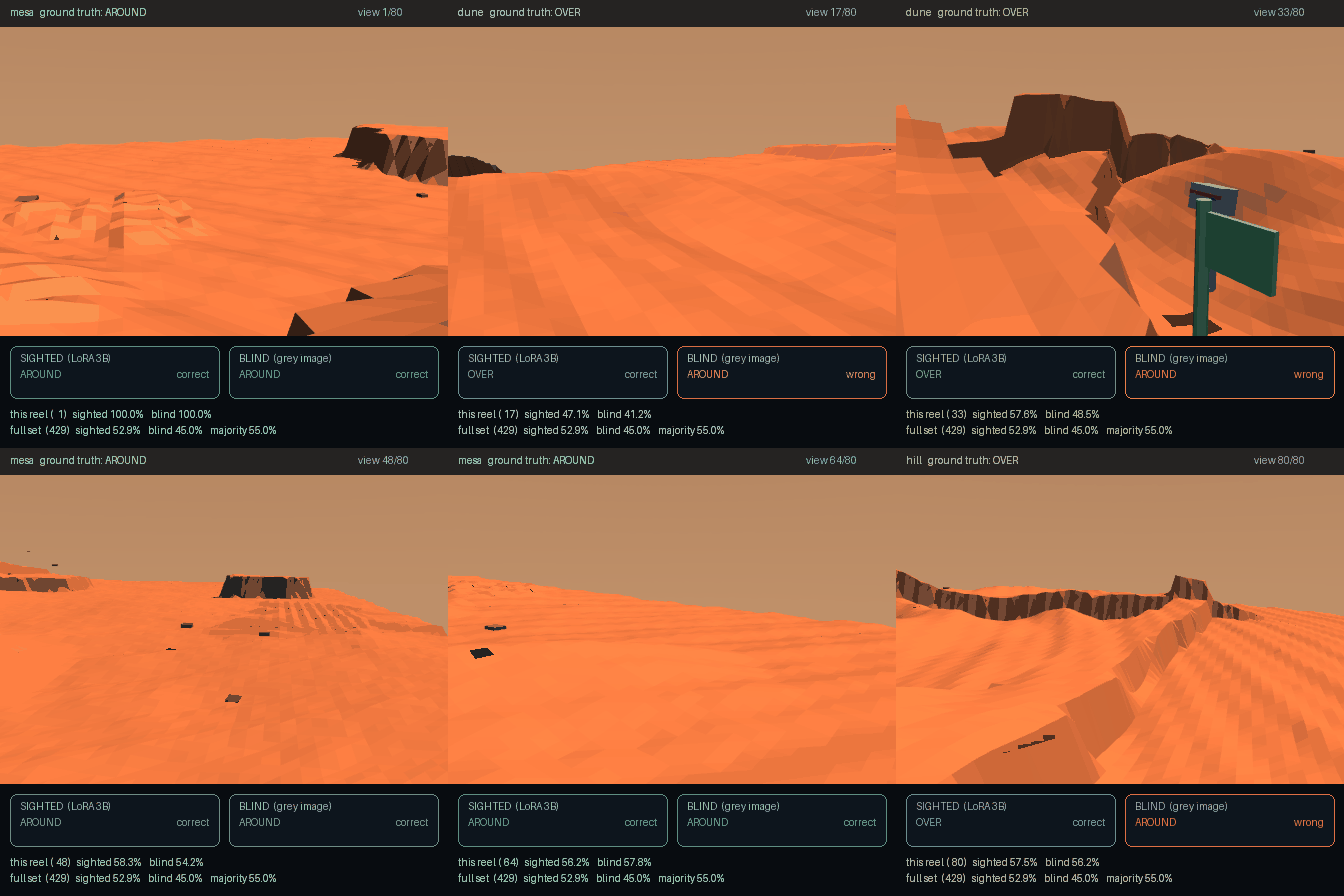
Each frame is one view neither model saw in training. Left badge is the sighted arm's verdict, right is the blind control's — same architecture, same training, same token count, a uniform grey image instead of terrain.
The footer carries two different quantities deliberately. This reel is the running tally over the ~80 frames shown and wanders by several points; full set is the published result over all 429. A reader who watched the reel settle on a number contradicting the page would be right to distrust both.
How you can tell the control worked
The blindfolded model gave the same answer every single time — all 429 of them. That is exactly what a model with no information should do, and it is what makes the comparison trustworthy. A blindfolded model that still varied its answers would mean information was leaking in somewhere.
The blind arm answered AROUND for all 429 items — one constant, no variation. That is exactly what a model with no information must do under greedy decoding, and seeing it is what licenses the comparison. A blind control producing varied answers would mean information was leaking through the pipeline.
It also produced a coincidence worth naming, because it briefly looked like a bug: the zero-shot model is also a constant-AROUND predictor, so the two arms matched down to the per-landform breakdown. Identical numbers from two different models normally means one of them never ran. Here it is two models arriving independently at the same degenerate strategy — checked by diffing the saved predictions rather than assumed either way.
Where the model loses
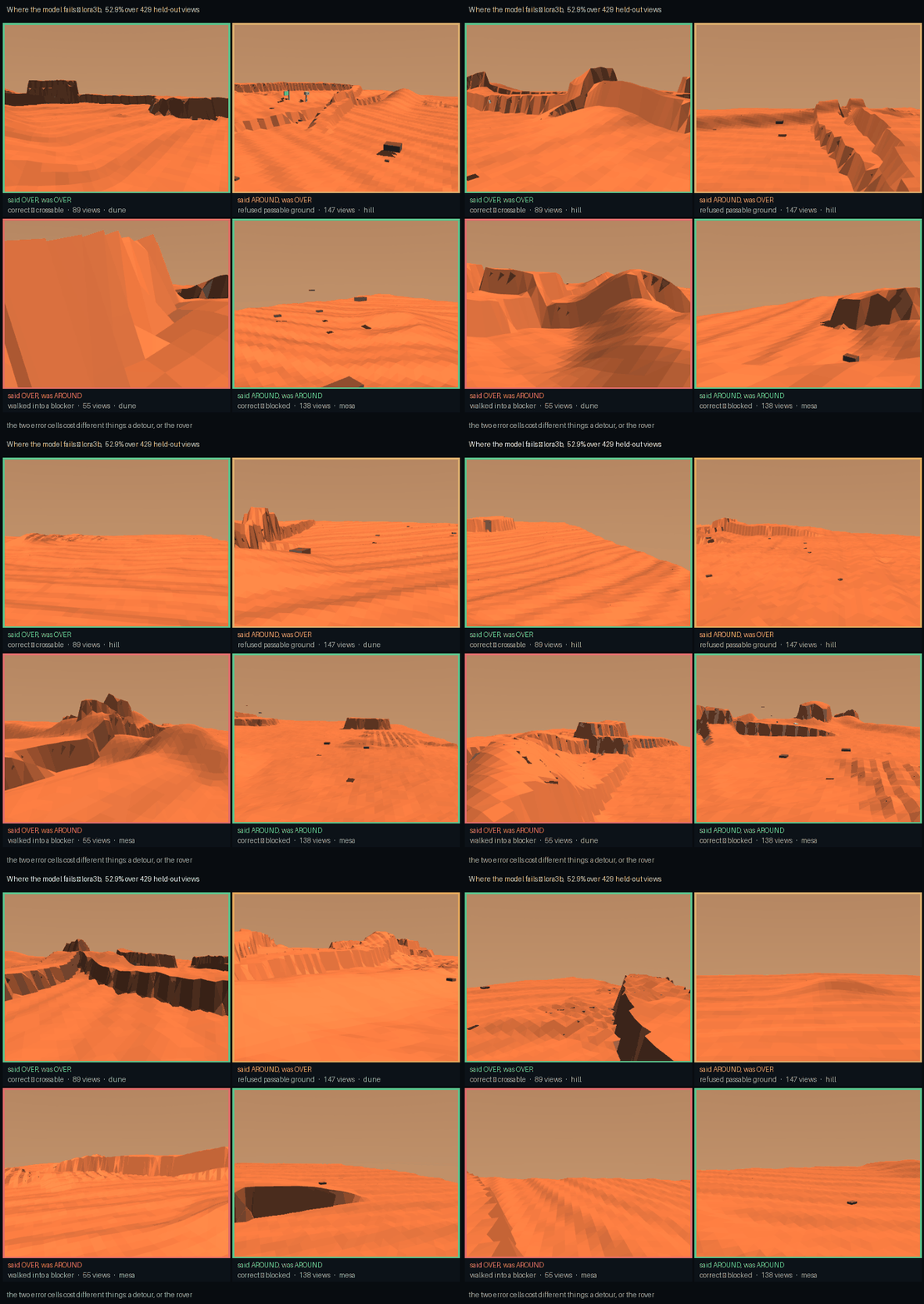
52.9% is one number covering two different behaviours, and the four cells separate them. The largest is not a correct one: 147 views (34.3%) are ground the robot could have walked straight over, refused. Against 55 (12.8%) in the opposite corner.
The two errors are not symmetric in consequence, which is worth saying even though this lab scores them equally. Refusing passable ground costs a detour; calling a scarp passable costs the rover. An accuracy figure prices them the same and a real mission would not.
| landform | sighted | what the truth is |
|---|---|---|
| hill | 46.2% | almost always OVER |
| dune | 34.6% | mostly OVER |
| mesa | 71.3% | always AROUND |
| scarp | 72.2% | almost always AROUND |
The model is biased toward AROUND: good on blockers, bad on crossable ground. It has learned "Martian terrain looks impassable" rather than the difference between a smooth shoulder and a sharp one — which is precisely the distinction lab 5's terrain was built to pose.
The signal is there to be extracted. A classifier given only the landform's name scores 92.3%, and the geometry defining the label separates the classes cleanly. So this is a model failing to read something it was shown, not an unlearnable task.
Where the labels come from
Not from a human, and not from the landform's name — predicting the
name the generator chose would measure nothing. The label is the
fraction of a ring at the landform's own radius that a
step-limited gait cannot cross, the same measurement lab 5's
classes_differ was eventually forced into after an earlier version
averaged over a bounding box and reported mesas as 86% walkable.
Two choices that decide whether the dataset means anything:
- Samples in the ambiguous middle are discarded, not rounded to the nearest class — 46% of candidates. A label the oracle itself is unsure of is noise that later looks like a model ceiling.
- The split is by surface, not by sample. Two views of one surface share its landforms, so a sample-level split leaks the answer across the boundary and inflates validation accuracy for free.
The thresholds come from the measured distribution, and the first attempt shows why that matters. It used round numbers — 0.45 and 0.10 — and 0.45 turned out to sit above the maximum a mesa ever reaches. Every blocker fell into the discard band, and the generator produced 945 samples of which 100% were labelled OVER, including 207 scarps. It looked like a working dataset. The property check caught it.
Why this is the first 07_physical_ai lab that uses DeepSpeed
Because it is the first where sharding is load-bearing, and that was
checked rather than assumed. From verify_arch.py, weights plus
optimizer, per card:
| Qwen2.5-VL-7B | 1 card | 2 | 4 | 8 |
|---|---|---|---|---|
| LoRA r=16 | 15.3 GB | 7.6 | 3.8 | 1.9 |
| full fine-tune | 119.7 GB | 59.9 | 29.9 | 15.0 GB |
LoRA already fits one card, so running it under ZeRO-3 would shard
15.3 GB that needed no sharding. The LoRA arm therefore runs plain
python with no launcher, and ds_config.json is reserved for the
full fine-tune — the only regime here that cannot run any other way.
That restraint is inherited from measurement. Lab 5 found the GPU 1.7× slower for its policy update; lab 6 found GPU physics at 1.50× against a 5× bar and recommended not renting. Reaching for ZeRO-3 because this is a DeepSpeed course would be the same error pointing the other way.
The table is arithmetic over a config, so it is checked against the
code: --build instantiates the real module tree on torch's meta
device — no weights, no download — and compares. Derived 3.816 B
against an implementation reporting 3.755 B, +1.6%, reported rather
than quietly absorbed.
And measured against reality: the 3B LoRA arm used 11.5 GB where the table predicts 7.3 GB. The ~4 GB gap is activations, which the table excludes and ZeRO-3 does not shard. That is the caveat the table carries, now with a number on it.
What is not here
The full fine-tune of Qwen2.5-VL-7B under ZeRO-3 across 8 GPUs is implemented and registered, and has not been run. It needs hardware this lab was developed on — one 16 GB laptop card — and cannot provide. No number from it appears on this page, and none should until someone runs it.
It is also the obvious next question. The signal is present, a 3B adapter does not extract it, and whether capacity fixes that or the framing is wrong is exactly what the untested arm would settle.
Three things that cost time
AutoModelForVision2Seqdoes not exist in transformers 5.x — it isAutoModelForImageTextToText. The vanished symbol class of API drift: it fails at import, before anything runs, socompileallnever sees it.- torchvision is mandatory and must come from torch's index.
transformers routes Qwen2.5-VL's processor through
Qwen2VLVideoProcessor, which hard-requires it even for still images. Mismatched, it fails withoperator torchvision::nms does not exist— which reads like a torch bug and is not one. - Supervise the answer, not the prompt. Masking only padding left the model learning to reproduce a 30-token instruction identical on every example: training loss 15.7. Masking everything before the answer: 0.467.
What transfers
| Build the control first | the blind arm is not a robustness check, it is what makes 52.9% readable |
| Two tests for two questions | "did vision help" and "is it any good" have different answers here |
| Labels from geometry, never from the generator's names | otherwise you measure the name |
| Split by surface, not by sample | shared landforms leak the answer |
| Check whether the hardware is needed | the capacity table is why ZeRO-3 is here and why LoRA runs without it |
| Never report the arm you did not run | the 7B ZeRO-3 arm has no number on this page |
This is where the thread currently stops. Seven labs in, the robot crosses open Martian ground about one episode in seven, tells cliffs from hills roughly 3:1 by bumping into them — and the first model given actual eyes does measurably use them and still cannot match it.
References
- Driess et al., PaLM-E: An Embodied Multimodal Language Model, ICML 2023 — continuous sensor data folded into a language model for embodied reasoning
- Brohan et al., RT-2: Vision-Language-Action Models Transfer Web Knowledge to Robotic Control, 2023 — actions as text tokens, trained alongside web-scale vision-language data
- Bai et al., Qwen2.5-VL Technical Report, 2025 — the model this lab fine-tunes
- Hu et al., LoRA: Low-Rank Adaptation of Large Language Models, ICLR 2022 — the r=16 adapter that lets the 3B arm fit on one card
- Rajbhandari et al., ZeRO: Memory Optimizations Toward Training Trillion Parameter Models, SC 2020 — and the measurement showing only the full fine-tune arm needs it
Using a vision-language model for embodied decisions is the subject of a large and fast-moving literature. What this lab adds is the control structure: a blind arm (same model, grey image, same token count) and a majority-class heuristic, measured alongside. The sighted model scores 52.9%, beats the blind arm at p = 0.006, and still loses to the one-line heuristic at 55.0% — reporting only the first comparison would have been true and misleading. A working no-information control emits ONE constant, which is what licenses the comparison at all.