A limb, or a constraint?
← previous: Obstacle Hopper · next: Terrain Vision →
The plain words boxes like this one carry the whole story; the technical detail around them is there if you want it.
The one line version: we gave the robot a second leg and a staircase, and measured exactly how deep a step it can climb before it cannot. Every later lab in this topic uses that number.
Lab 1 built a one-legged hopper with its torso locked upright, and justified the lock in passing: free the torso and the task becomes the bipedal-balance problem, which is a different and much harder thing. That was an assertion, not a measurement.
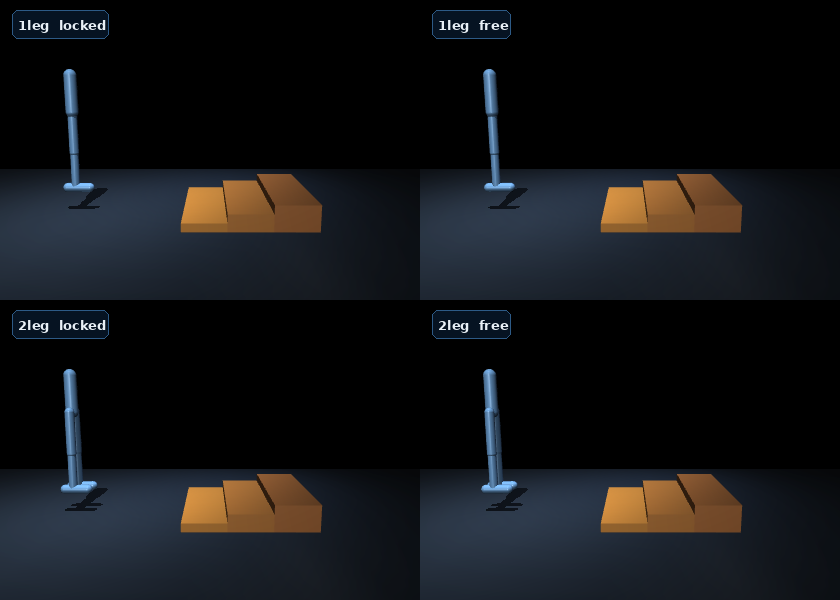
This lab measures it, against the obvious rival explanation — that difficulty comes from having more joints to coordinate. Two switches, crossed, on one staircase:
| torso locked | torso free | |
|---|---|---|
| 1 leg | 3 actuators, cannot tip | 3 actuators, must balance |
| 2 legs | 6 actuators, cannot tip | 6 actuators, must balance |
Everything else is byte-identical — link lengths, gear ratios, friction, reward, episode length, and the staircase itself. A test asserts that, because a 2×2 whose cells differ in some uncontrolled way is not a 2×2.
How this lab works
Four bodies, one staircase, and a sweep over tread depth — how deep each step is. The question is where a two-legged walker stops being able to climb.
That ceiling is the most reused number in the topic: every later lab's
STEP_MAX = 0.12 comes from here. A limb is not automatically a
capability — the lab's title asks whether a second leg is a limb or a
constraint, and the answer depends on the terrain it is asked to cross.
The staircase
A flight of stairs where we can dial how deep each step is. Deep shallow steps are easy; short steep ones are not. We sweep across the range to find where the robot stops coping.
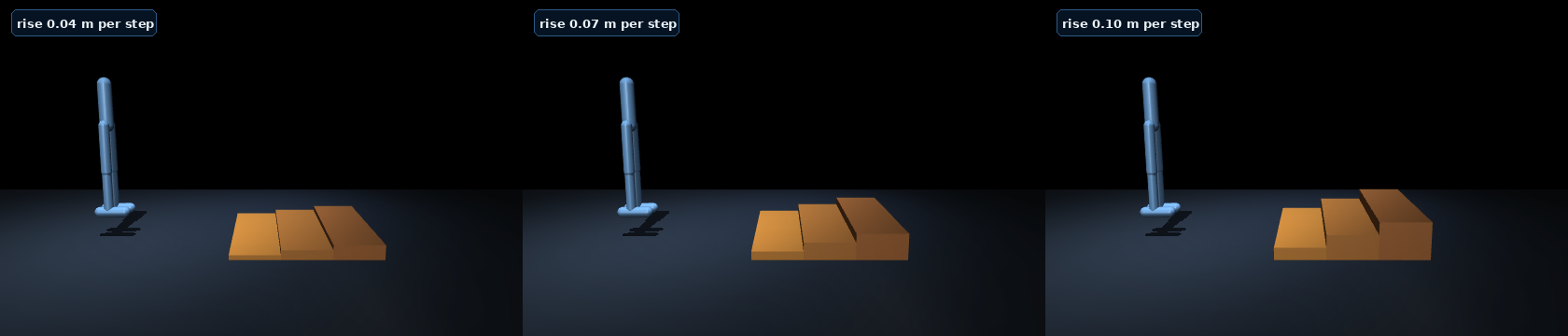
Three treads instead of lab 1's single box, with the rise redrawn every episode from 0.04 m to 0.10 m. One obstacle can be cleared by a single lucky lunge; three cannot. The robot has to do the same thing from three different heights, which is a much poorer fit for a memorised trajectory.
The falsifier
If the leg count changes performance more than the torso constraint does, lab 1's explanation was wrong and joint count is the real difficulty axis.
It lost — and then the result got more interesting than either hypothesis.
The result
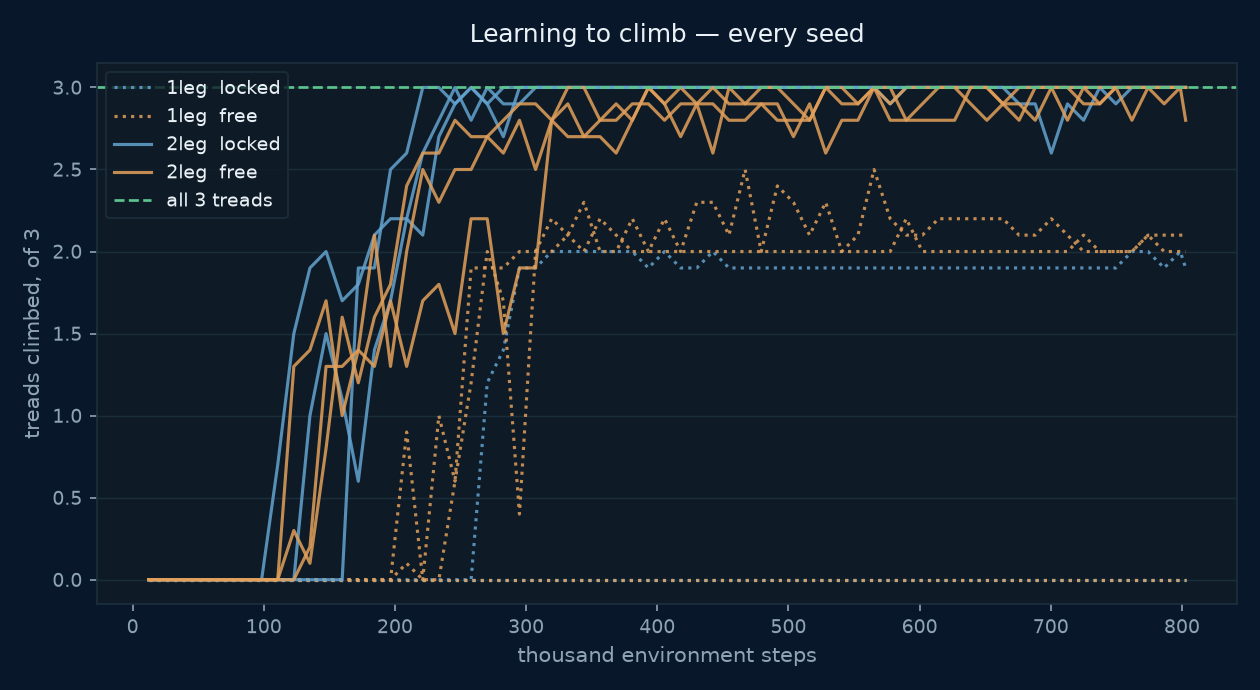
Baseline: a random policy, measured per cell before every run. No cell ever reaches the top. Budget: 800k steps, three seeds, four cells.
| cell | return (3 seeds) | treads climbed /3 | summit |
|---|---|---|---|
| 1 leg, locked | 788 · 875 · 771 | 0.0 · 1.9 · 0.0 | 0% · 10% · 0% |
| 1 leg, free | 377 · 361 · 224 | 2.0 · 2.1 · 0.0 | 20% · 30% · 0% |
| 2 legs, locked | 1884 · 2277 · 2449 | 3.0 · 3.0 · 3.0 | 100% |
| 2 legs, free | 645 · 1559 · 750 | 3.0 · 3.0 · 2.8 | 100% · 100% · 80% |
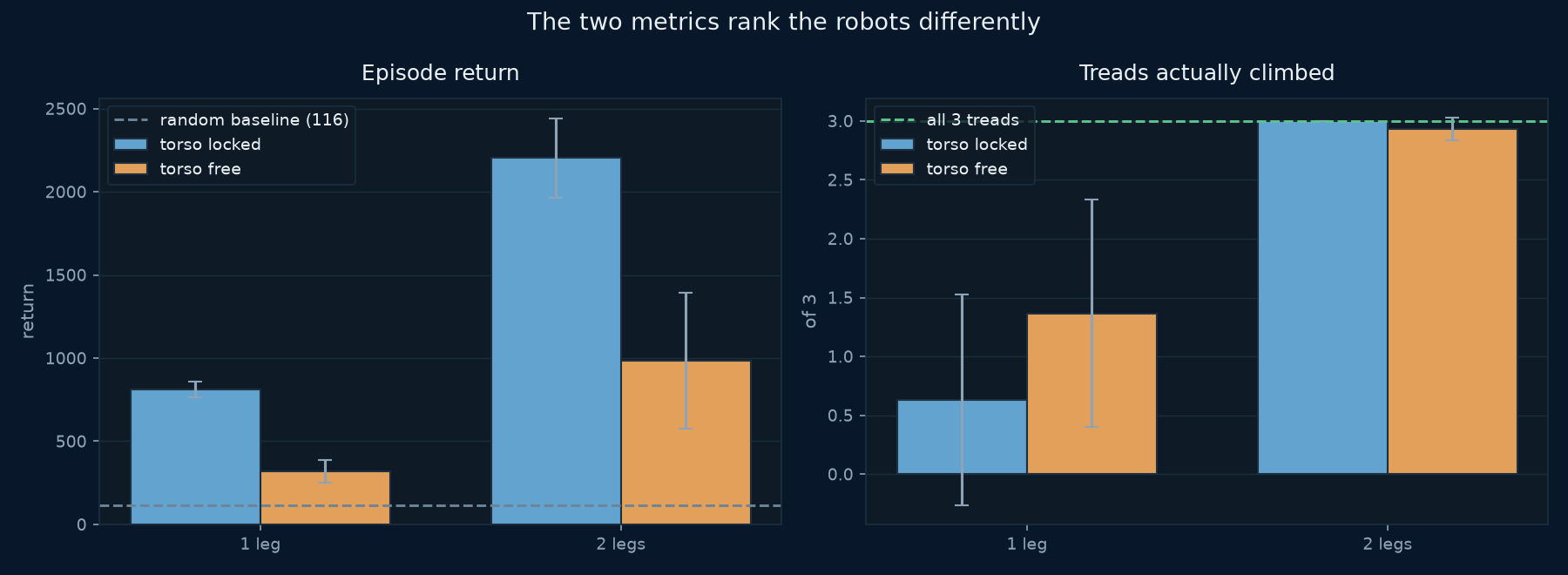
The limb dominates. Mean treads climbed goes 0.63 → 3.00 with a locked torso and 1.37 → 2.93 with a free one. Every two-legged seed summits; no one-legged seed ever does.
But the switches interact
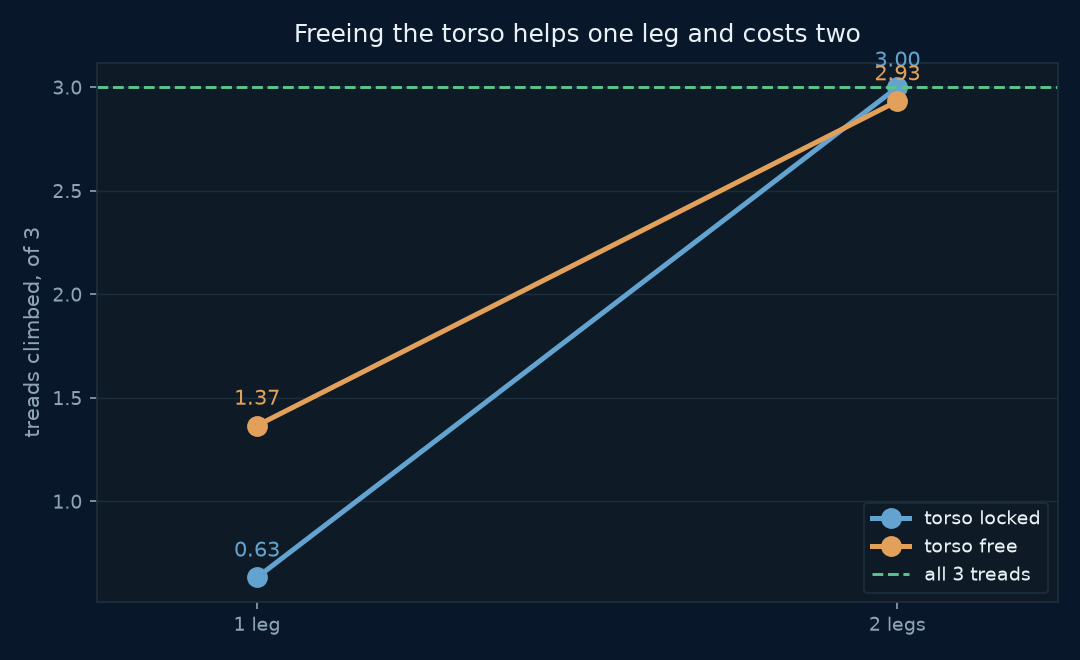
With one leg, freeing the torso helps: 0.63 → 1.37 treads. With two, it costs a lot of return and nothing measurable in climbing: 2203 → 985 return (p = 0.022), against 3.00 → 2.93 treads (p = 0.37, i.e. one seed landing at 2.8 — noise).
The interaction is carried by the return metric and by the one-legged side. An earlier version of this paragraph also claimed the torso cost "a little climbing"; three seeds do not support that, and the claim has been withdrawn.
The lines are not parallel, so no main-effects summary of this experiment is honest. You cannot say "freeing the torso costs X" — it depends on what else the robot has.
The mechanism is visible in the animations below. With a single leg the only way onto a step is to lean into it, and leaning requires a torso that rotates — so the constraint lab 1 imposed for stability was also quietly removing the one strategy available for climbing. With two legs you can just put a foot up, the lean stops being necessary, and torso freedom becomes pure instability.
An ablation that reverses sign across another variable is common and under-reported, because the usual way to run one is to fix everything else at a default. Had this lab tested the torso switch only on the two-legged robot — the obvious choice, since it is the better robot — it would have concluded that freeing the torso is simply bad, and missed that it is the only thing that makes a one-legged robot climb at all.
The whole job, end to end
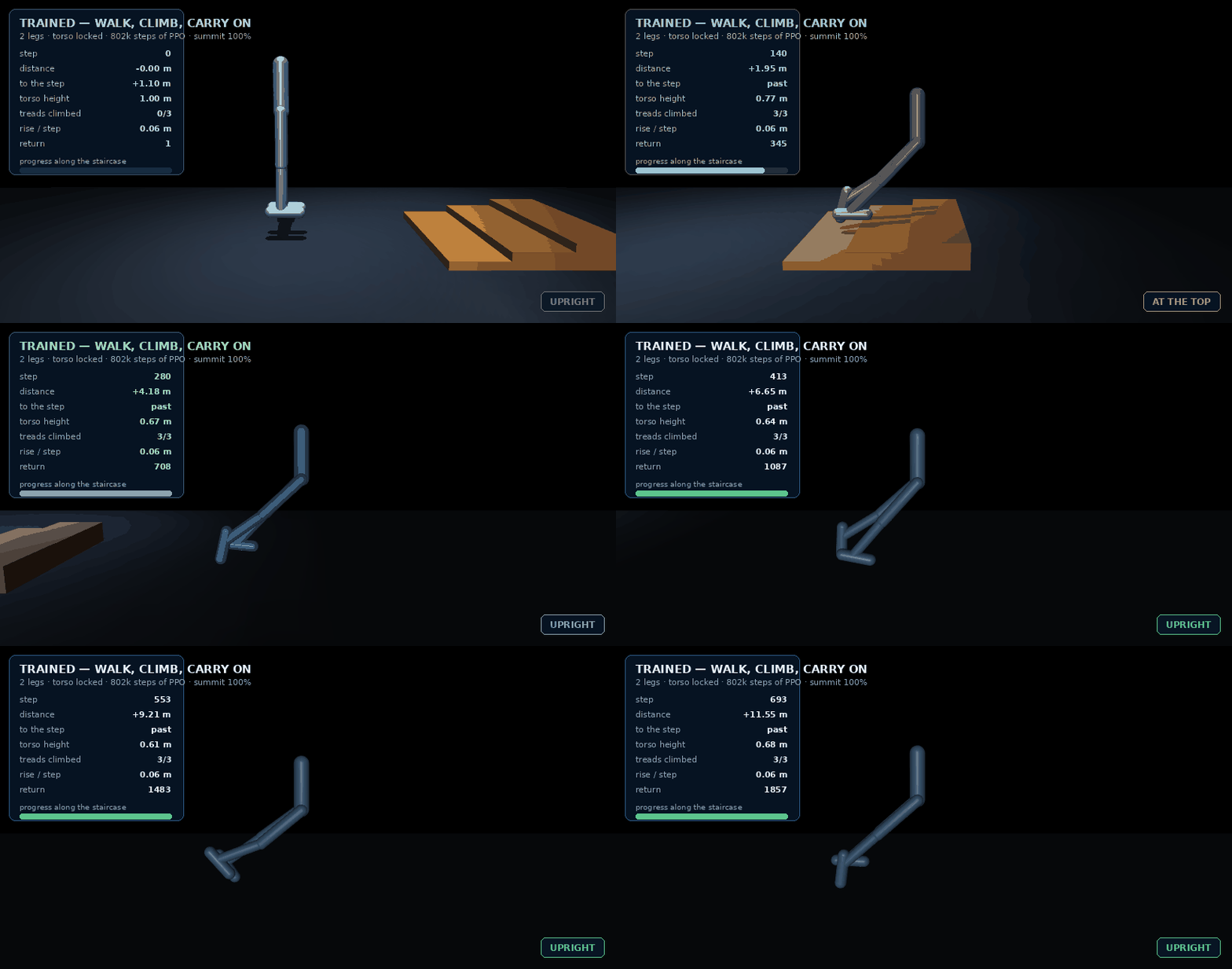
One uninterrupted 700-step episode of the strongest cell. It walks on the flat, reaches the staircase, takes all three treads, and keeps going — 11.3 m in total, still upright when the episode times out.
The panel is read from the live simulation every frame. Watch treads climbed reach 3/3 and the status chip turn AT THE TOP around step
150, then the distance keep climbing long after.
Watch the difference
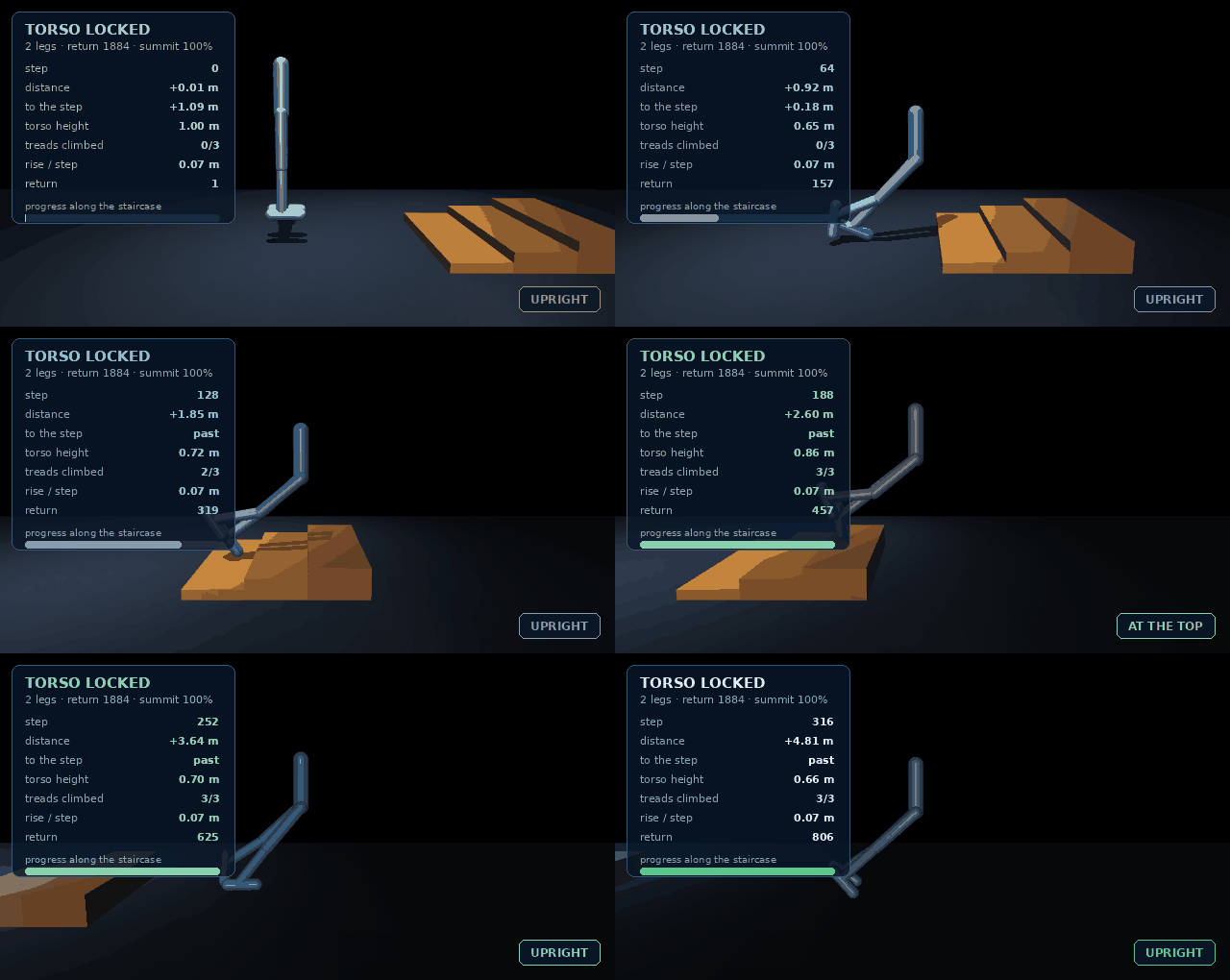
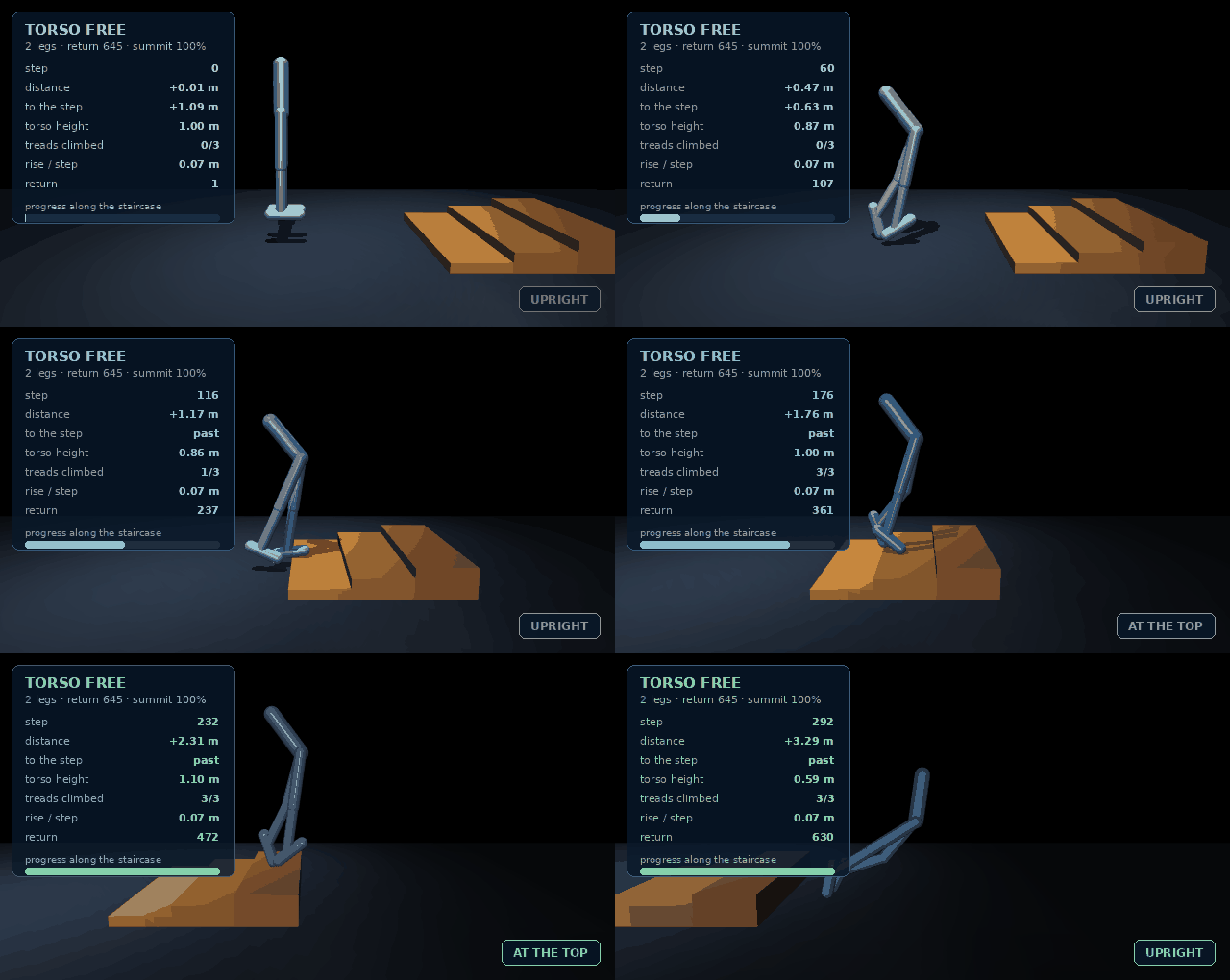
Both are two-legged, same staircase, same seed. The panel is read from the
live simulation every frame — watch treads climbed and the status chip.
Three wrong answers before the right one
The metric this entire lab rests on — how many treads is the robot standing on — took three attempts. Every wrong version was quietly plausible, and each produced a confident, publishable-looking table.
- Torso height against the absolute tread height. The robot rests at
qpos[1] = -0.196on flat ground, so standing on the 0.24 m top tread reads+0.045, not+0.24. The threshold was+0.124. A policy that walked 14.5 m past the entire staircase reportedclimbed 0.00. - Torso lift above its own resting height. Better — but a robot
standing on a tread with bent legs sits lower than one standing
straight on the floor. Measured crouched on a 0.07 m tread:
+0.032against a0.042threshold. Missed. - Raw foot height. The foot capsule has a 0.045 m radius, so a foot
flat on the ground already clears tread one. A robot that never left
the floor read
1/3.
The working version measures the foot's lift above its own flat-ground height, self-calibrated at construction so it cannot rot if a link length changes.
The same expression gated the +3.0 per tread reward, so the first two
sweeps trained robots that were never paid for climbing. Both produced
clean, consistent, completely wrong tables — the second one even had a
tidy story attached about locked torsos being unable to lean.
Every number on this page is from the third sweep. The first two are not reported because they measured the detector, not the robot.
The same bug existed in lab 1's on_box. There it was invisible: that
lab's reward and headline metric both use x-position, so its published
findings stand and only a reported statistic was wrong. Fixed in both.
Where DeepSpeed is, and is not
The largest policy here is 11,597 parameters. Nothing for ZeRO to
shard, so this is the eighth declared launcher="python" exception, and a
test fails if any cell exceeds 1M parameters.
The useful parallelism is --jobs: a sweep is twelve independent
processes, and twelve cores beat any GPU for this shape of work. That
remains true until the policy itself is large, which is where
lab 1's Next Step section
picks up. Lab 3 is where a GPU first wins in this
category — a 193k-parameter vision student at 13.6× — and even that is
not a sharding problem.
Run it
git clone https://github.com/yiqiao-yin/deepspeed-course.git
cd deepspeed-course/07_physical_ai/02_biped_stairs
uv sync

uv run morphology.py                            # the four robots
uv run stairs_env.py                            # random baselines
uv run ../../tests/test_biped_stairs.py         # 42 property checks

uv run train_ppo.py --dry-run                   # 30 s
uv run train_ppo.py --sweep --seeds 3 --jobs 6  # the whole 2x2, ~10 min
uv run make_figures.py
uv run render.py