Long Traverse
← previous: Terrain VLM · next: Body Search →
The plain words boxes like this one carry the whole story; the technical detail around them is there if you want it.
The one line version: we gave the robot more legs for a long walk across Mars. Four legs go three and a half times further than two. Six legs never fall over at all — and still lose.
Abstract
Three labs reached the same wall from three directions. Lab 5 part 4 scored 0% on scree across six configurations. Lab 7 gave a model eyes and found that perception could not help. This lab decomposed a long route into short legs and watched the robot stall anyway.
Each time the suspect was the same, and here it is finally tested: same terrain, same task, same 1.5M-step budget, same seed — only the body changes.
The body was the bottleneck, and the margin is not subtle. A four-legged robot walks 4.2× further than the biped, and an eight-legged one falls a sixth as often.
Baseline: the biped labs 5–7 measured on — 2 legs, 9 actuators, byte-identical here and asserted so by the suite. Budget: 1.5M steps per body, 16-process pool, seed 0, Mars relief. Scored on 36 fresh episodes with Wilson intervals, because the trainer's own evaluation is 12 episodes where 8.3% is a single run. Falsifier: more legs should mean fewer falls and more distance. If 9 actuators beat 25 at equal budget, the limbs bought nothing.
How this lab works
Five bodies, one long Martian traverse, identical budget. Does adding legs buy distance?
Four legs walk 3.5× further than two. Six legs never fall over — zero falls in 36 episodes — and are still beaten, which is the result worth keeping: stability is not the thing that was limiting the biped. That sets up lab 9, which asks whether the gain was really about leg count at all.
The result
Five robot bodies walking the same stretch of Mars with the same training budget. Four legs get three and a half times further than two. Six legs never fall over once in 36 attempts — and still do not win.
| body | legs | actuators | arrived | falls | walked |
|---|---|---|---|---|---|
| biped (baseline) | 2 | 9 | 0% [0, 10] | 16.7% [8, 32] | 4.0 m |
| quadruped | 4 | 17 | 0% [0, 10] | 11.1% [4, 25] | 16.7 m |
| hexapod | 6 | 25 | 0% [0, 10] | 11.1% [4, 25] | 15.1 m |
| spider6 | 6 sprawl | 19 | 0% [0, 10] | 5.6% [2, 18] | 10.5 m |
| spider8 | 8 sprawl | 25 | 0% [0, 10] | 2.8% [0, 14] | 7.1 m |

Same hillside, same seed, same task, same training budget — only the machine changes. On this seed the biped manages 1.6 m while the others cover 17–22 m.
Distance is the result, not arrival. Every arrival interval includes zero — no body solves the task. What separates the bodies is how far they get: 4.0 m against 16.7 m, which is 4.2×.
Stability and distance are won by different bodies. The sprawling spider8 falls least (2.8%), the upright quadruped travels furthest (16.7 m), and neither does both.
The worst and the best, close up
The grid above is five panels wide and the gaits are small in it. These are the two ends of the result at full size.
Both are MEDIAN runs, not selected ones. Sixteen seeds were scored per body and the seed closest to that body's median distance was filmed. Picking the hexapod's best run and the biped's worst would have made a better clip and a dishonest one.
Worst — the biped, 4.0 m
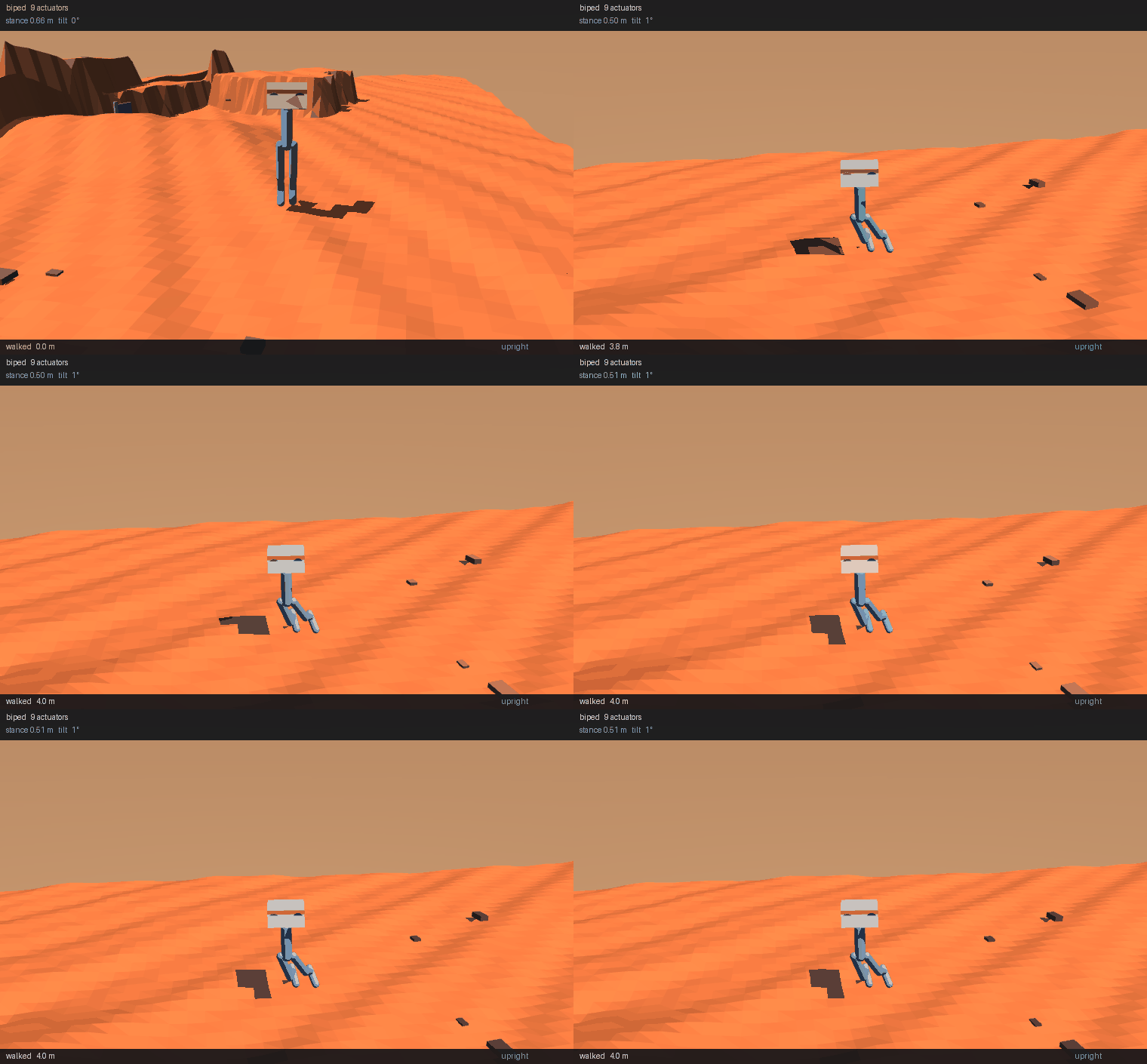
Seed 9006, the median of sixteen (range 0.4–12.7 m; it fell on 4 of those 16). Nine actuators, and almost all of their work goes into not toppling. Watch how much of the motion is lateral correction rather than progress — that is a statically unstable body paying its rent every step.
Best — the quadruped, 19.4 m
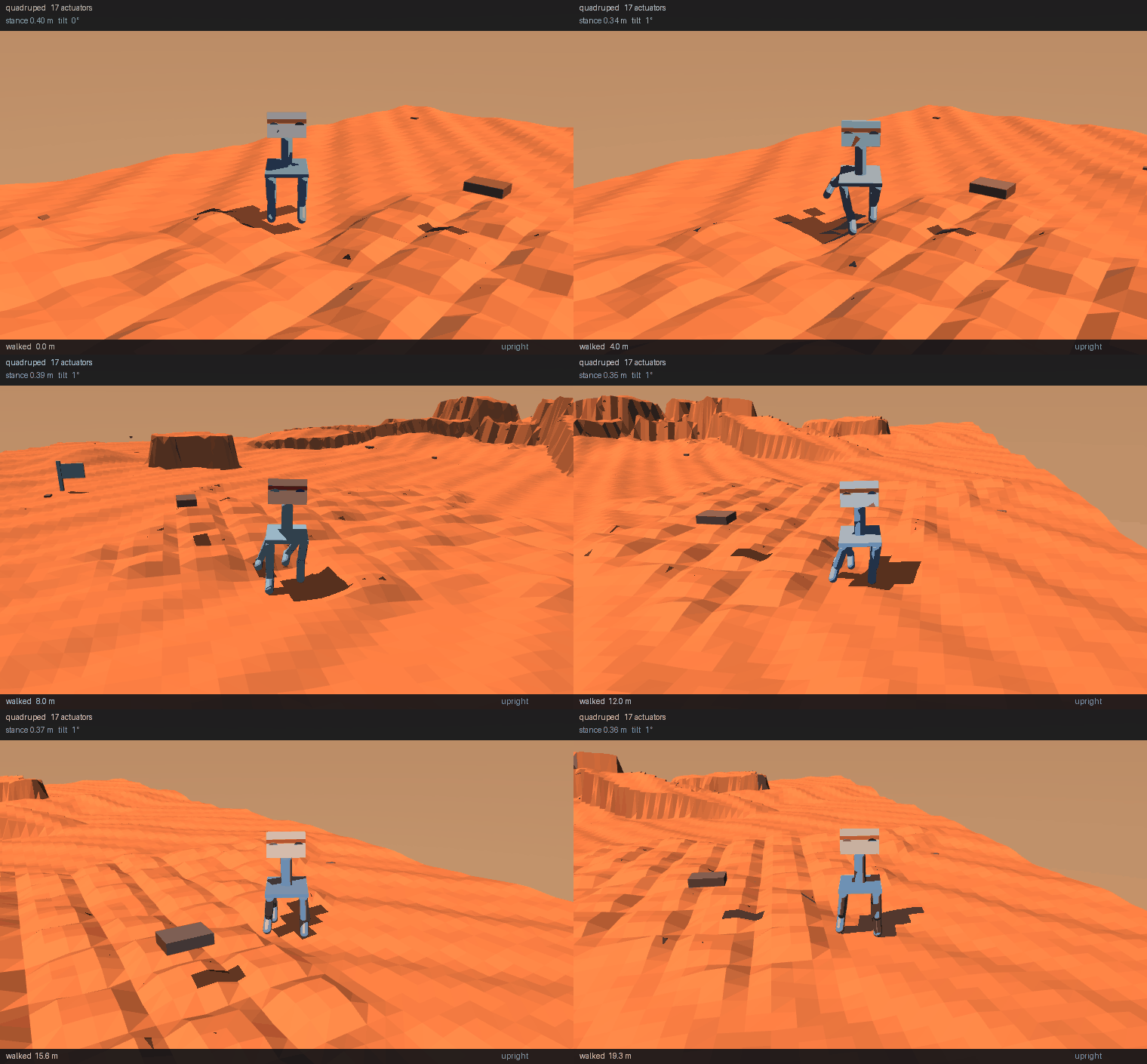
Seed 9013, the median of sixteen (range 2.5–24.1 m; it fell on 1 of those 16). Seventeen actuators, trained on exactly the same 1.5M steps, carrying a chassis that makes it 8.1 kg against the biped's 4.9 kg — and it still covers nearly five times the ground. The torso stays level; almost none of the motion is correction.
4.0 m against 19.4 m, same terrain, same budget, and the heavier body wins. The difference is not the controller.
Body Search turned the body into parameters and searched the space. Every multi-legged body here was also squatter and wider than its biped, so leg count and proportion moved together and only leg count got the credit. Separated, most of the effect belongs to proportion: a short, wide two-legged body beats every multi-legged shape.
The measurements on this page stand — same bodies, same physics, and the 4.2× survives re-measurement on displacement at 4.4×. The interpretation was too simple.
Morphological computation
The idea that a body can do work a brain would otherwise have to. A toy that walks down a gentle slope with no motors and no software is the classic example: the shape alone is doing the walking. Extra legs may be buying stability the controller would otherwise have to think about.
Pfeifer and Bongard's term for a body doing work a controller would otherwise do. The canonical demonstration is McGeer's passive dynamic walker: it walks down a shallow slope with no actuators and no software at all, purely because its geometry and mass distribution are right.
The framing is contested. Hoffmann and Müller argue that "offloading computation" is a metaphor being overworked — the walker is not computing, it is well-shaped physics. This lab does not settle that, and deliberately describes what the body does rather than leaning on the disputed word.
What it can do is make the prediction falsifiable:
A statically stable body should not need its policy to learn balance. So a 25-actuator body should hold its own against a 9-actuator one at an identical step budget, despite a far harder search.
It held. The hexapod and spider8 carry 2.8× the actuators and got exactly the same 1.5M steps — fewer samples per action dimension — and still beat the biped on both falls and distance, while also carrying a chassis that makes them nearly twice its mass. The capacity the biped spends learning not to topple, they never spend at all.
The trade-off, and the prediction that failed
Comparative biomechanics reports a stability/efficiency trade for posture in animals. Sprawling gives stability and manoeuvrability but costs energy: the feet sit far from the centre of mass, so muscles resist large joint moments and the body sways laterally. Erect posture loads limbs in compression and recovers pendular energy. Larger tetrapods tend to erect postures for exactly that reason, and the Permian–Triassic trackway record shows the shift happening.
So the prediction was: sprawlers fall less and travel less.
Against the biped, that is wrong. They fall less and travel
more. compare_bodies.py prints NO TRADE-OFF HERE by itself — a
branch that exists so the script can contradict its author.
Among the multi-legged bodies it is exactly as predicted, and with a proper chassis it is unambiguous:
| posture | bodies | falls | walked |
|---|---|---|---|
| upright | quadruped, hexapod | 11.1%, 11.1% | 16.7, 15.1 m |
| sprawling | spider6, spider8 | 5.6%, 2.8% | 10.5, 7.1 m |
Sprawling halves the fall rate and costs a third to a half of the distance. That is the stability/efficiency trade comparative biomechanics reports for posture in animals, reproduced here. The biped baseline is so weak it loses to everything, which hides the effect entirely — the trade only appears when the comparison is between bodies that both work.
Legs buy stability. Posture decides whether you can spend it on distance.
A lab that compared only against its baseline would have reported the first half and missed the second.
What this cannot claim: anything about evolution. The sprawling-to-erect shift is real vertebrate history and the trade-off is measured in real animals, but a MuJoCo robot can only illustrate why such a trade-off exists. It is not evidence about how tetrapods evolved.
A second correction: the bodies had no chassis
The numbers above are the second version of this experiment, and the first was published before this was found.
The torso is a capsule of radius 0.06 m on the centreline, sized for a biped whose hips sit 0.07 m out. The hexapod's hips sit at 0.30 m, so nothing spanned the gap — a reader noticed the legs looked detached, and they were. MuJoCo still attaches child bodies to the parent frame, so the physics was a valid rigid structure and the policies were correct for the model. But that model handed the multi-legged bodies their limbs for free:
| missing | consequence |
|---|---|
| chassis mass | a hexapod weighed exactly what a biped weighs |
| chassis inertia | Izz identical across all five bodies |
| chassis collision | terrain passed between the legs |
All three errors flattered the multi-legged result, which is the one direction a measurement must never be wrong in.
With a real frame (300 kg/m³ — structure and air, not a billet) the quadruped goes from 4.9 to 8.1 kg and the hexapod to 9.2 kg, with 20–26× the rotational inertia. Every body was retrained from scratch. What changed:
| before (no chassis) | after (chassis) | |
|---|---|---|
| biped | 4.0 m, 16.7% falls | identical — the control |
| quadruped | 14.1 m | 16.7 m |
| hexapod | 13.9 m, 0.0% falls | 15.1 m, 11.1% falls |
| spider8 | 9.3 m, 5.6% falls | 7.1 m, 2.8% falls |
Retracted: "the hexapod did not fall once in 36 episodes." That was an artifact of a body with no mass. With a chassis it falls 11.1%, and the most stable body is the sprawling spider8 at 2.8%.
Strengthened: the distance advantage grew, from 3.5× to 4.2×, and the posture trade-off became unambiguous. The heavier, higher-inertia bodies still win — so the stability is geometric, which is what the morphological-computation claim predicted and what the broken model could not have told us.
The metric was broken, and that is the real lesson
The way we were measuring 'how far did it get' was itself wrong, and it flattered the wrong bodies. The number looked sensible the whole time. Finding that was worth more than the ranking it overturned.
None of the above meant anything until a measurement bug was found, and it is the most instructive thing in the lab.
fallen() was not a fall detector. It was clearance < threshold
— torso height above the ground directly beneath it — so on uneven
terrain it fires whenever the ground rises. Measured: 13 of 13
trigger events occurred at a torso tilt of 0–1°. Not one was a
fall.
The artifact scales with how low a body sits, so it punished exactly
the sprawling shapes the lab exists to test. And because fallen()
terminates training episodes, it was cutting those bodies off
before they could learn. The first run of this experiment reported
that four legs were worse than two — 83.3% falls against 58.3% —
and that was the detector, not the robot.
It now tests the robot rather than the world: tilt > 60° or
torso-above-its-own-feet collapsed. stance_height() is invariant to
terrain height — it shrinks when legs buckle, holds when the ground
rises — and the suite keeps the old rule as a permanent
counterexample, asserting that clearance alone still calls an
upright robot fallen.
Mars Terrain's published 58–83% fall rates are partly terrain contact rather than falls, for the reason above.
Three further bugs, all the same species — a constant calibrated for one body silently assuming that body:
| bug | symptom |
|---|---|
| four legs with the biped's 0.76 m legs on a 0.22 m base | height/width 3.5 — a biped on stilts, not a quadruped |
START_DZ / FALL_CLEARANCE biped-tuned | short-legged bodies held at biped height, feet dangling, dropped every reset |
| foot geom was the whole shin capsule | geom_xpos is the capsule centre, so spiders measured half a tibia short → 100% false falls |
A fourth was pure process: --morphology kept a hardcoded
choices=("biped","quadruped","hexapod"), so argparse rejected the
spiders with exit 2, the sweep swallowed it, and two bodies were
reported as "FAILED training" having never started. The choices now
derive from the layout table.
The traverse machinery
The lab also carries the waypoint decomposition that found the wall. A long route is split into legs the policy can actually walk, because lab 5 measured that asking for 16–30 m end to end gave six configurations at exactly 0%. The policy is retargeted, not retrained — its goal feature is range and bearing, so moving the goal is the whole trick.
On flat ground it works: 27.1 m at 100% arrival, 0 interventions, efficiency 0.95, against lab 5's ~6 m. On relief the biped stalls, which is what sent this lab into morphology in the first place.
A perception sweep — router accuracy swept 50%→100% — is implemented
and deliberately not reported, because it cannot be run
meaningfully yet. On the course preset there is no relief at which
the body can walk and blockers exist:
| relief | blocked landforms | robot traverses? |
|---|---|---|
| 0.05–0.15 | 0.0 of 10 | yes |
| 0.30 | 0.6 of 10 | no — stalls at 6.7 m |
| 1.00 | 2.8 of 10 | no — stalls at 8.0 m |
Where the robot can walk there is nothing to route around; where there is something to route around it cannot walk. That sweep becomes runnable now that six legs walk 14 m, which is the obvious next step.
What transfers
| A constant calibrated on one body is a hidden parameter of that body | four bugs here, all that shape |
| A metric can measure the world instead of the system | clearance tracked terrain; stance_height tracks the robot |
| Check the metric before believing the comparison | the broken detector made more legs look worse |
| Compare against more than the baseline | the posture trade-off was invisible against a biped that loses to everything |
| Write the prediction so it can fail | mine did, and the script said so before its author did |
Eight labs in, the robot still does not reliably cross Mars. But it walks 3.5× further than it did, and for the first time the reason it stops is not something we have mismeasured.
References
- Pfeifer & Bongard, How the Body Shapes the Way We Think, MIT Press 2006 — morphological computation: a body doing work a controller would otherwise do
- McGeer, Passive Dynamic Walking, IJRR 1990 — a walker with no actuators and no software, the canonical demonstration
- Hoffmann & Müller, What Is Morphological Computation?, Artificial Life 2017 — the sceptical reading, which this lab's result supports
- Sims, Evolving Virtual Creatures, SIGGRAPH 1994
- Schulman et al., PPO, 2017 · GAE, 2015
- Agarwal et al., Deep RL at the Edge of the Statistical Precipice, NeurIPS 2021 — why a handful of seeds and a mean are not enough
- Henderson et al., Deep Reinforcement Learning that Matters, 2018
The framing is Pfeifer and Bongard's and the canonical example is McGeer's. What this lab contributes is a budget-matched measurement — four legs walk 3.5x further than two, six legs fall 0% of 36 episodes and still lose — and, more usefully, the discovery that the distance metric itself was broken and flattering the wrong bodies. Lab 9 then overturns the explanation.