Terrain Vision
← previous: Biped Stairs · next: Terrain Navigation →
The plain words boxes like this one carry the whole story; the technical detail around them is there if you want it.
The one line version: we gave the robot a depth camera. It helps going uphill and not at all going downhill, because coming down a slope is something you feel through your legs rather than something you look at.
Abstract
A two-legged robot walks a raised plateau that either stays flat, climbs three steps, or drops three. From its own joints it cannot tell which is coming. We gave it a depth camera and asked what the camera is worth — and the first answer we published was wrong, because the comparison changed two things at once. Corrected, the camera buys a large gain on ascent only, makes performance far more reliable across seeds, and is worth nothing on descent, which a blind policy already solves perfectly. Part 2 then asks what kind of task would make vision indispensable, and across five designs fails to build one — which is itself the finding.
This lab originally reported that a depth camera took a robot from 12.5% to 79% on a staircase, and concluded that vision was necessary because "you cannot feel for a descent."
An audit found the comparison varied two things at once. The missing control has now been run. The camera is real but smaller than claimed, and the thesis pointed the wrong way: descent is the one terrain solved perfectly without a camera.
The original claim, the error, and the corrected numbers are all below. Nothing has been quietly edited.
How this lab works
A depth camera against no depth camera, on the same terrain, with the teacher held fixed so only the student's eyes change.
The camera pays on the way up and nowhere else. Descent is solved perfectly blind, because falling correctly is a matter of what you feel through your legs rather than what you can see ahead. The first version of this comparison varied two things at once and had to be withdrawn — see the page for what that cost.
Problem Statement
Can a robot climb better if it can see the ground ahead? We give one version a depth camera, keep everything else identical, and compare.
The task
A two-legged robot walks along a raised plateau. Partway along the ground stays flat, climbs three steps, or drops three steps. The approach slab is identical in all three, so from its own joints the robot cannot tell which is coming.
Solution
Four arms, three seeds each
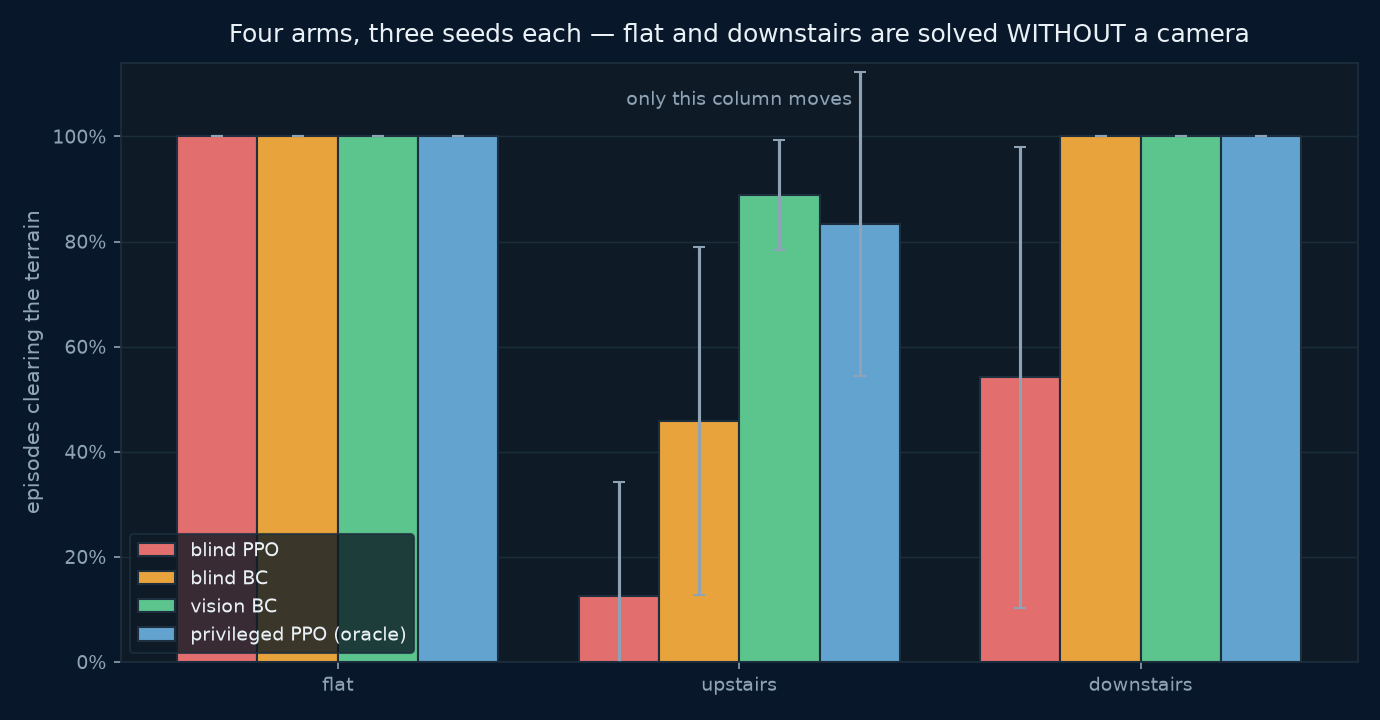
Fraction of 24 evaluation episodes clearing the terrain, mean of three seeds.
| arm | flat | upstairs | downstairs |
|---|---|---|---|
| blind PPO (the original baseline) | 100% | 12.5% | 54.2% |
| blind BC — distilled, no camera | 100% | 45.8% | 100% |
| vision BC — distilled, with camera | 100% | 88.9% | 100% |
| privileged PPO (oracle, undeployable) | 100% | 83.3% | 100% |
Read the flat and downstairs columns first. Every arm scores 100%,
including the one with no camera. Whatever the camera is worth, it is
worth nothing there.
Experiments and Results
Decomposing the original headline
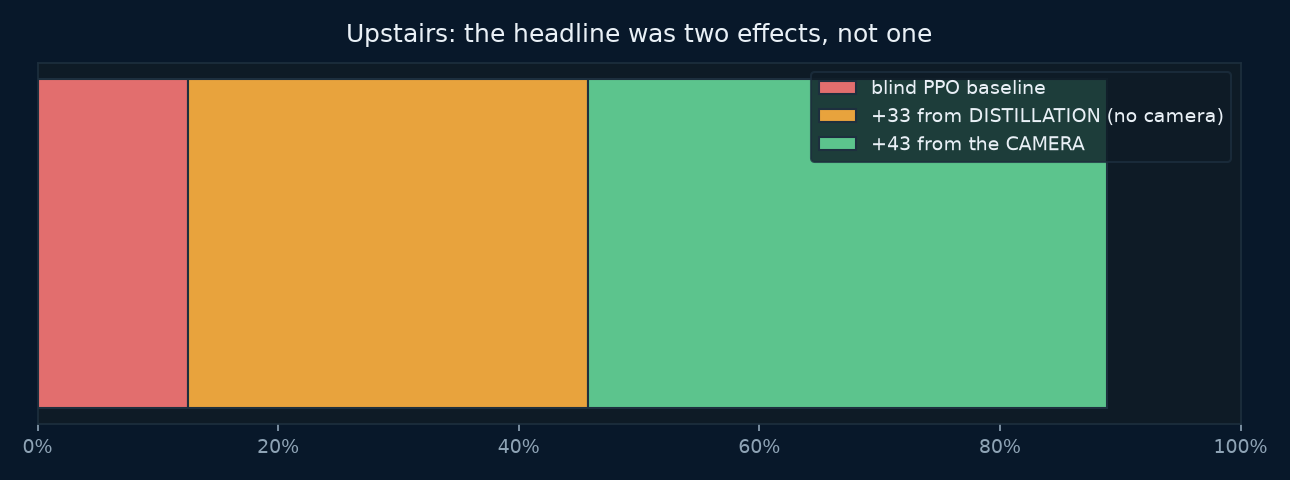
On upstairs, the published 12.5% → 89% was two effects stacked:
- +33 points from distillation alone (12.5% → 45.8%), no camera involved
- +43 points from the camera (45.8% → 88.9%)
The camera is the larger single contributor — but the original page credited it with all 76, and roughly 33 of those belonged to the training method.
Camera: p = 0.098. Distillation: p = 0.221. Both look real and neither is established. The seed spread is large enough that three runs cannot separate them — the same lesson lab 1 learned the hard way.
Reliability
arm, upstairs | seeds | mean | sd |
|---|---|---|---|
| blind BC | 71% · 8% · 58% | 45.8% | 0.331 |
| vision BC | 79% · 88% · 100% | 88.9% | 0.105 |
The blind student's worst seed is 8%. The vision student's worst is 79%. Vision is 3.2× more consistent, and its worst run beats the blind arm's mean.
"Vision makes climbing reliable" is better supported here than "vision makes climbing better" — and it is the more useful claim anyway. A locomotion policy that works on one training run in three is not a policy.
The thesis was backwards
The original page argued the lab existed because you cannot feel for a descent. Good intuition; not what the data says.
Descending is solved at 100% by every arm, on every seed, at every geometry tested — including a student with no camera at all. The camera's entire measurable value is in ascent, where the foot must be lifted before contact rather than after it.
The intuition fails on the reward's structure rather than the physics: falling ends the episode, so stepping down cautiously and absorbing the drop is already near-optimal. Nothing forces anticipation.
A second ablation that proved less than it looked
The original page's strongest-sounding evidence was: blank the camera, and performance collapses to 0% on every terrain.
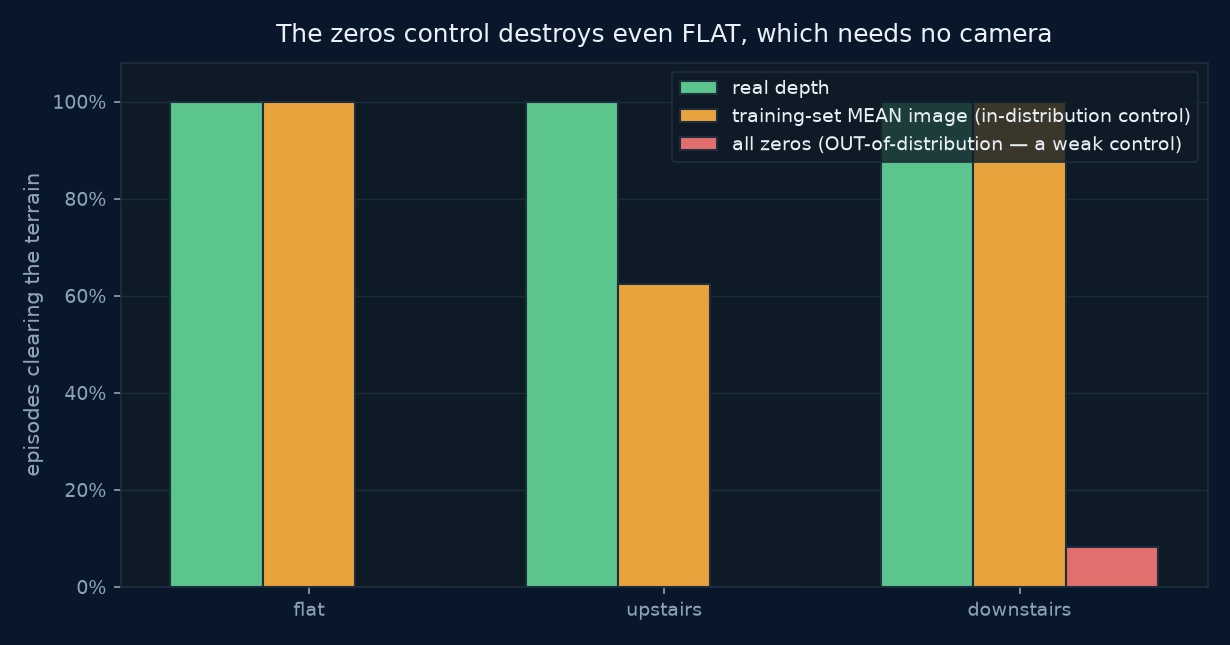
That control is invalid, and the figure shows why: the zeros condition
destroys flat too — a terrain a camera-less student clears 100% of
the time. A control that breaks a task solvable without the input is
not measuring information.
The cause is in the encoding. Depth is normalised so 0.0 means 0.8 m,
the near clip. An all-zeros frame does not say "no information"; it says
"a wall 80 cm from your face" — a confident reading, in a configuration
the network never saw across 43,102 training frames. It broke the model
rather than starving it.
The right control is the pixelwise mean of the training set: in-distribution by construction, carrying no per-episode information.
| terrain | real depth | training mean | zeros |
|---|---|---|---|
| flat | 100% | 100% | 0% |
| upstairs | 100% | 62% | 0% |
| downstairs | 100% | 100% | 8% |
The mean-image control lands at 62–71% on upstairs, which is where the separately trained blind student lands too. Two different constructions of "no usable camera" agreeing is the consistency check that says the control measures what it claims.
Watch it
One clip per scenario, because the terrains do not behave alike and an average over them hides the result. Every clip carries the 64×64 depth image the policy is actually driving on, from the same call that feeds the network.
The controlled comparison
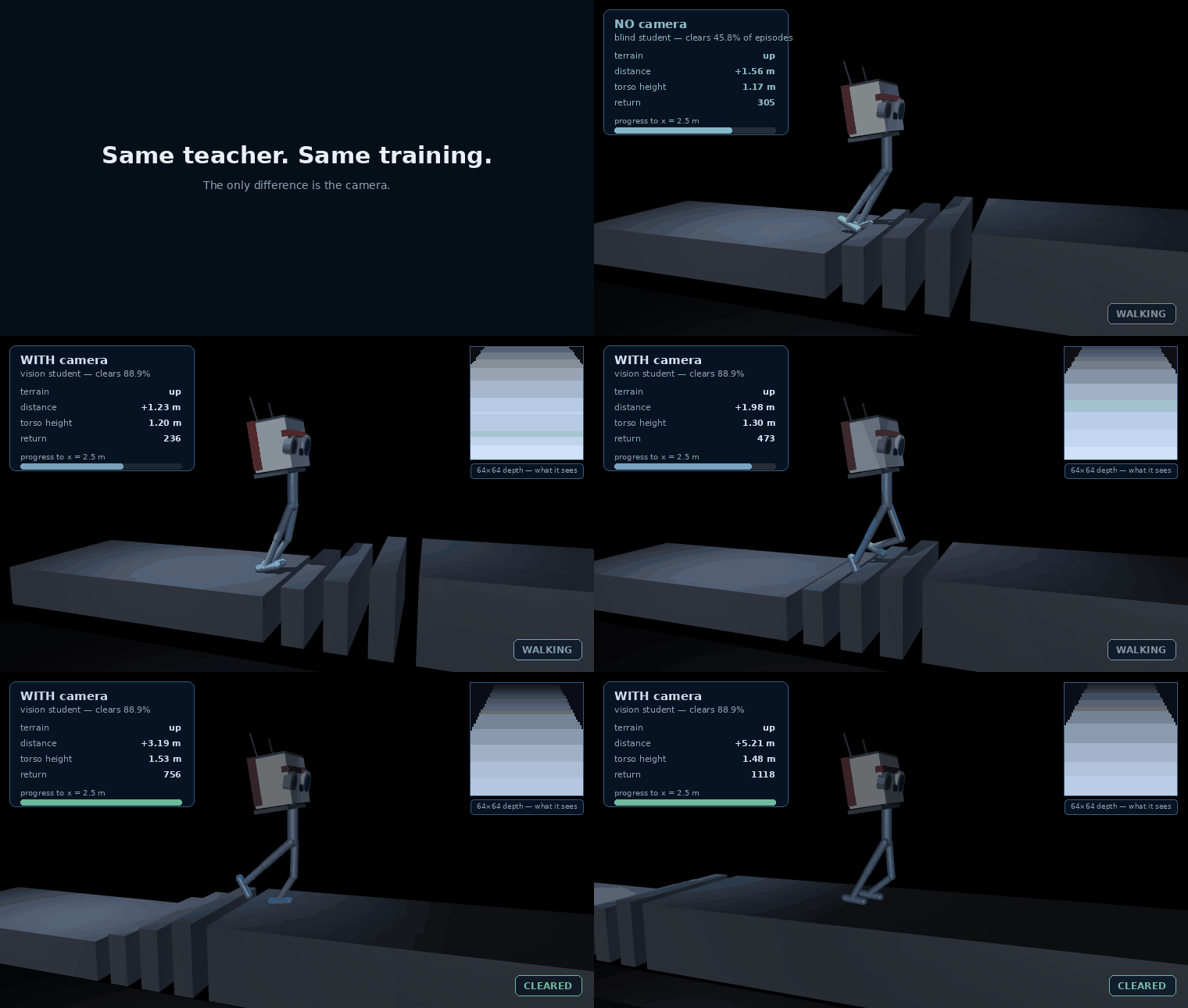
Two behaviour-cloned students, same teacher, same objective. The only difference is the camera. This is a selected episode — across seeds the blind arm clears 45.8% and the vision arm 88.9%, so this is one of the roughly half the blind student misses, chosen because it shows the effect. It is not a typical episode and the clip says so.
The three terrains
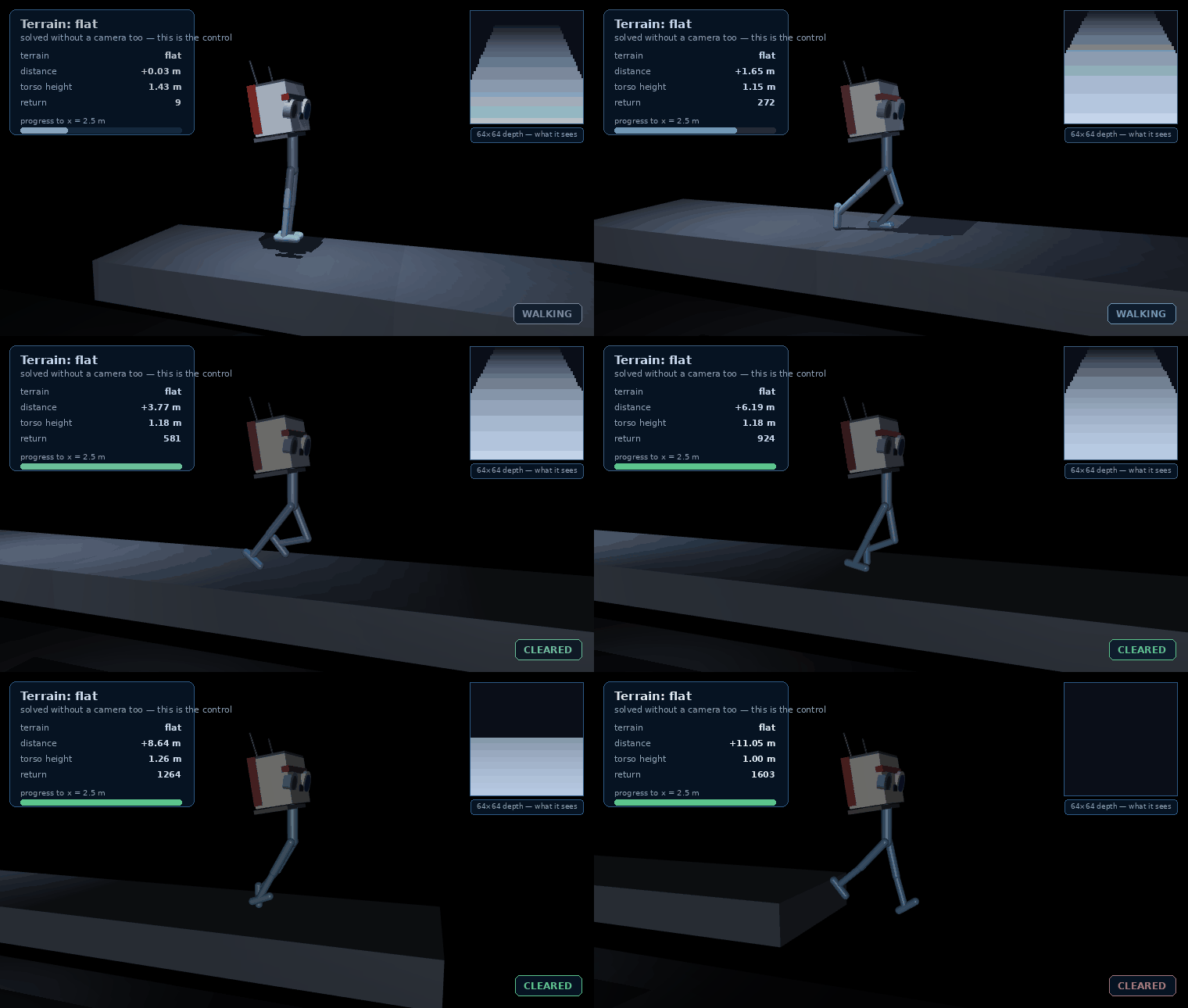
flat is the control. A student with no camera clears it 100% of the
time too.
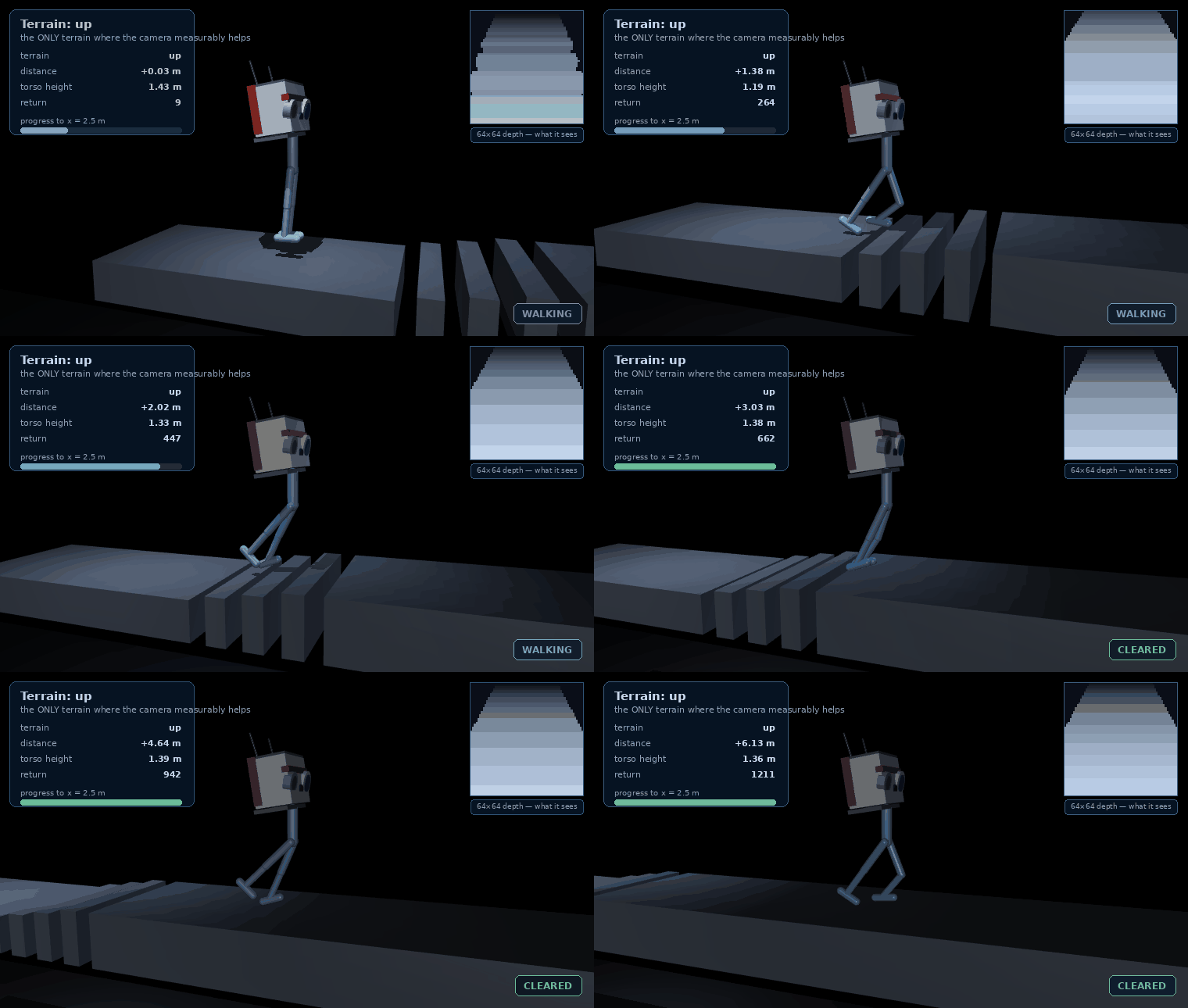
upstairs is the only terrain where the camera measurably helps — the
foot has to be lifted before contact.
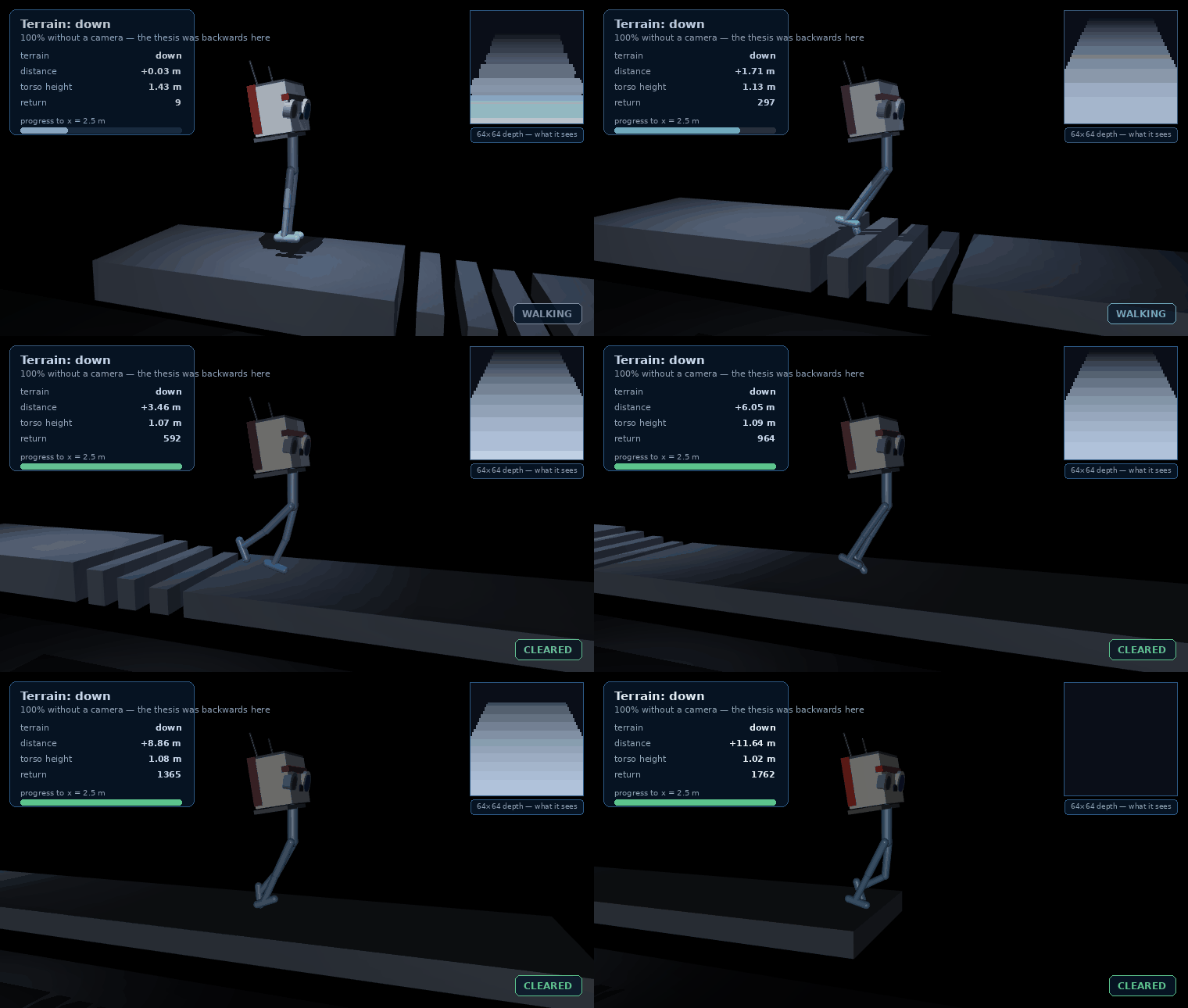
downstairs is where the original thesis said vision was essential.
Every arm clears it 100% of the time, camera or not.
Where it breaks
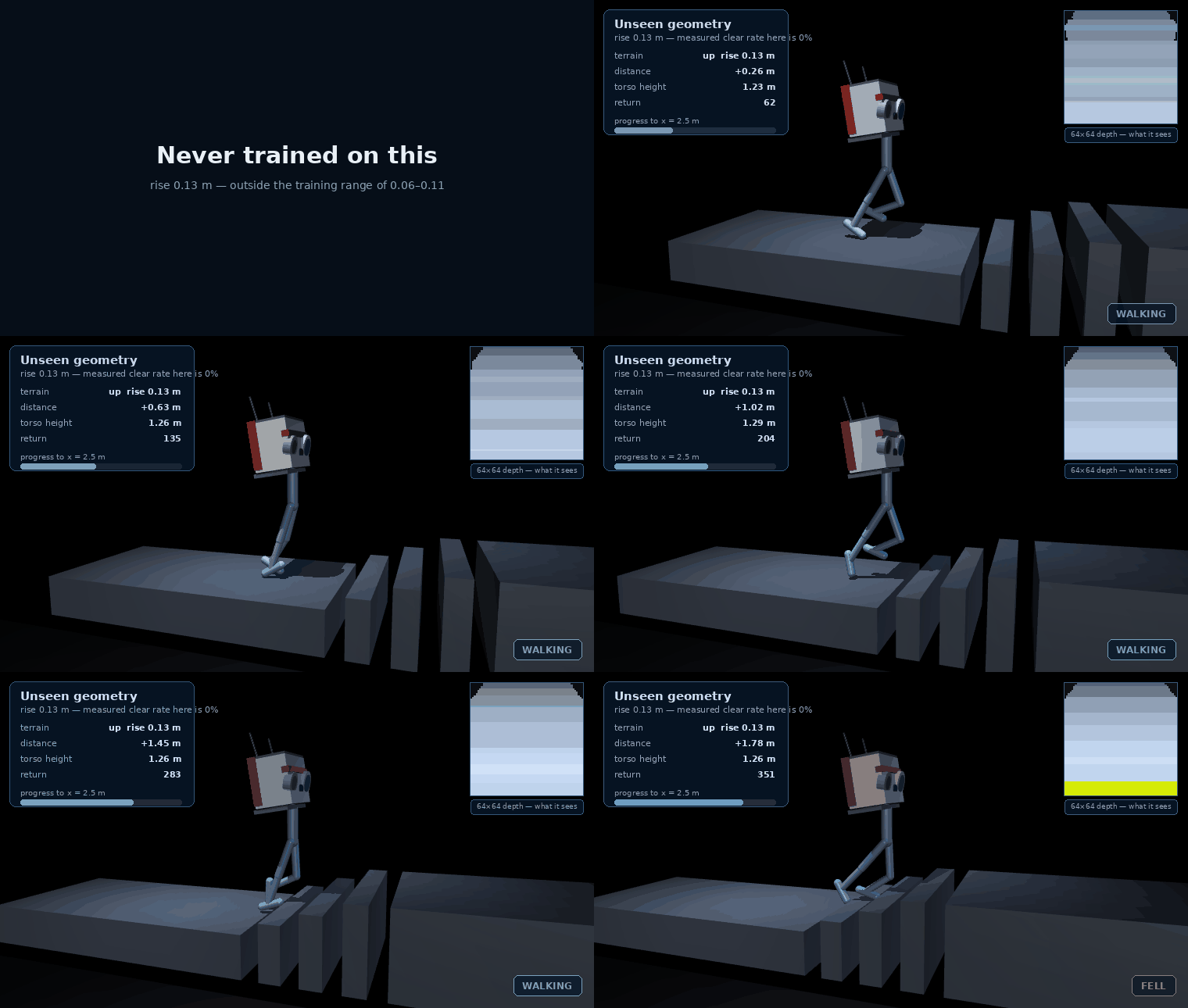
Rise 0.13 m, outside the training range of 0.06–0.11. The measured clear rate here is 0%, and the failure is not a stumble — the gait simply does not reach the first tread.
All three, one set of weights
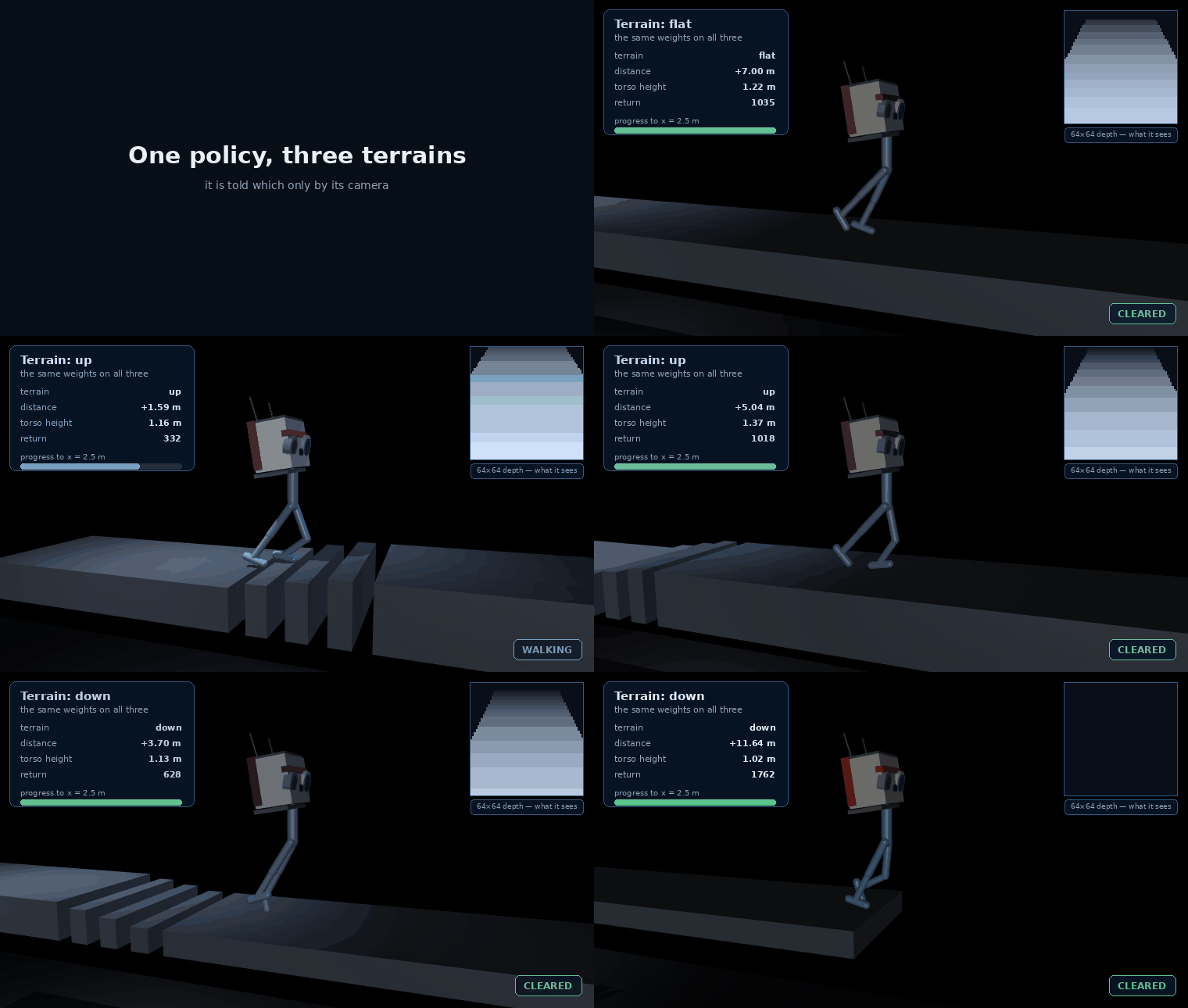
uv run render.py --all
Does it generalise?
Training drew the stair rise from [0.06, 0.11] m. This walks it outside that range:
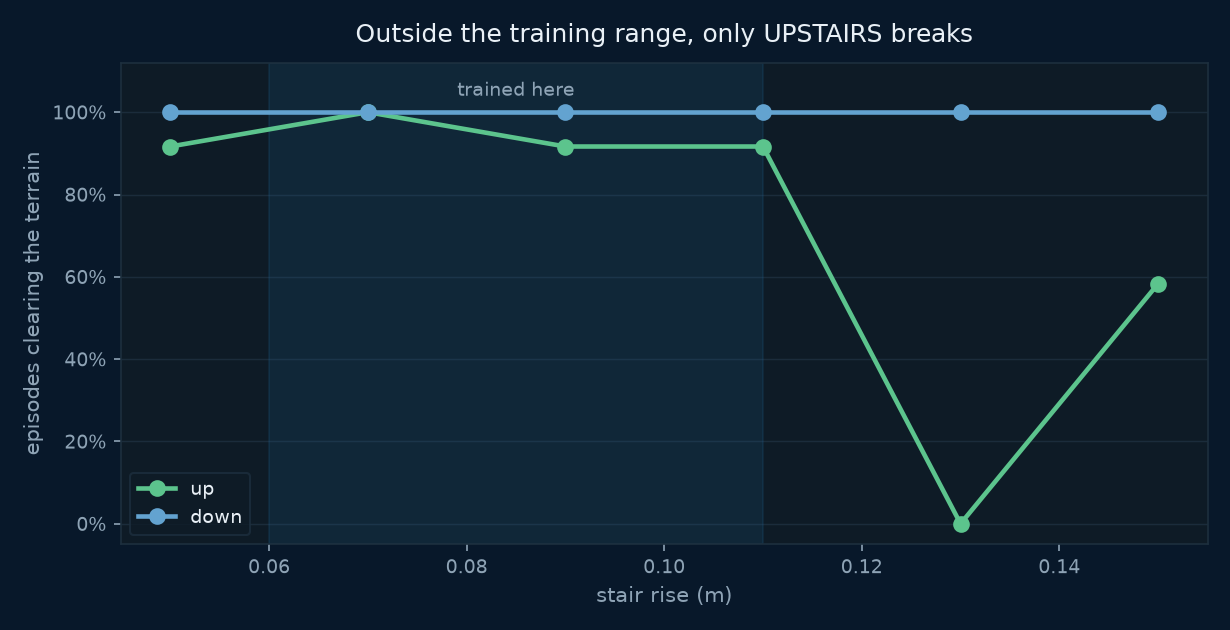
| rise (m) | 0.05 | 0.07 | 0.09 | 0.11 | 0.13 | 0.15 |
|---|---|---|---|---|---|---|
| out | in | in | in | out | out | |
| upstairs | 92% | 100% | 92% | 92% | 0% | 58% |
| downstairs | 100% | 100% | 100% | 100% | 100% | 100% |
Descending is unaffected by geometry it has never seen. Climbing holds when extrapolating shallower and breaks when extrapolating steeper — and does so non-monotonically: 0% at 0.13 m, then 58% at 0.15 m.
That reversal is not explained. At twelve episodes a cell it may be noise, or the rise may interact with gait phase. It is reported rather than smoothed, because an unexplained non-monotonicity is information about how narrow the result is.
Part 2 — Making vision necessary
Part 1 found the camera worth a lot on ascent and nothing at all on flat ground or descent. The obvious next question is not "does vision help" but what kind of task makes it indispensable — and the honest answer, after four attempts, is that this robot is harder to blind than expected.
Everything below is shipped and runnable. None of it produced a publishable positive result, which is the finding.
Stepping stones
A staircase is continuous: the ground is always somewhere under the foot, so a blind policy can sweep, touch and react. That is why blind locomotion did so well in part 1, and it reproduces a known result rather than contradicting one.
Sparse footholds should remove exactly that affordance — between the stones there is nothing to feel, and a foot placed into a void gets no second chance. It is the standard benchmark for exteroception being necessary (Agarwal et al., CoRL 2022; Miki et al., Science Robotics 2022).
uv run stones_sweep.py --difficulty     # three difficulties, 3 seeds
uv run stones_sweep.py --focus          # the middle cell, 5 seeds, 1.2M steps
A one-seed pilot at 400k steps looked decisive:
| difficulty | privileged | blind |
|---|---|---|
| easy | 100% | 100% |
| medium | 75% | 25% |
| hard | 0% | 0% |
An inverted-U: information pays only in the middle band. It did not survive contact with more seeds and longer runs.
| privileged | blind | gap | |
|---|---|---|---|
| 3 seeds, 400k steps | 75% | 42% | +33 (p = 0.094) |
| 5 seeds, 1.2M steps | 78% | 85% | −8 |
The effect shrank every time rigour went up, which is the signature of an effect that was never there. The 400k runs had not converged — five of six were still climbing when training stopped, and one was falling — so their "final" numbers were snapshots taken at arbitrary points on a rising curve. At 1.2M the curves flatten and the gap disappears.
Three seeds tie exactly, one favours each arm. There is no information advantage on stepping stones at this geometry, most likely because a 0.22 m foot can partly bridge a 0.16–0.26 m gap.
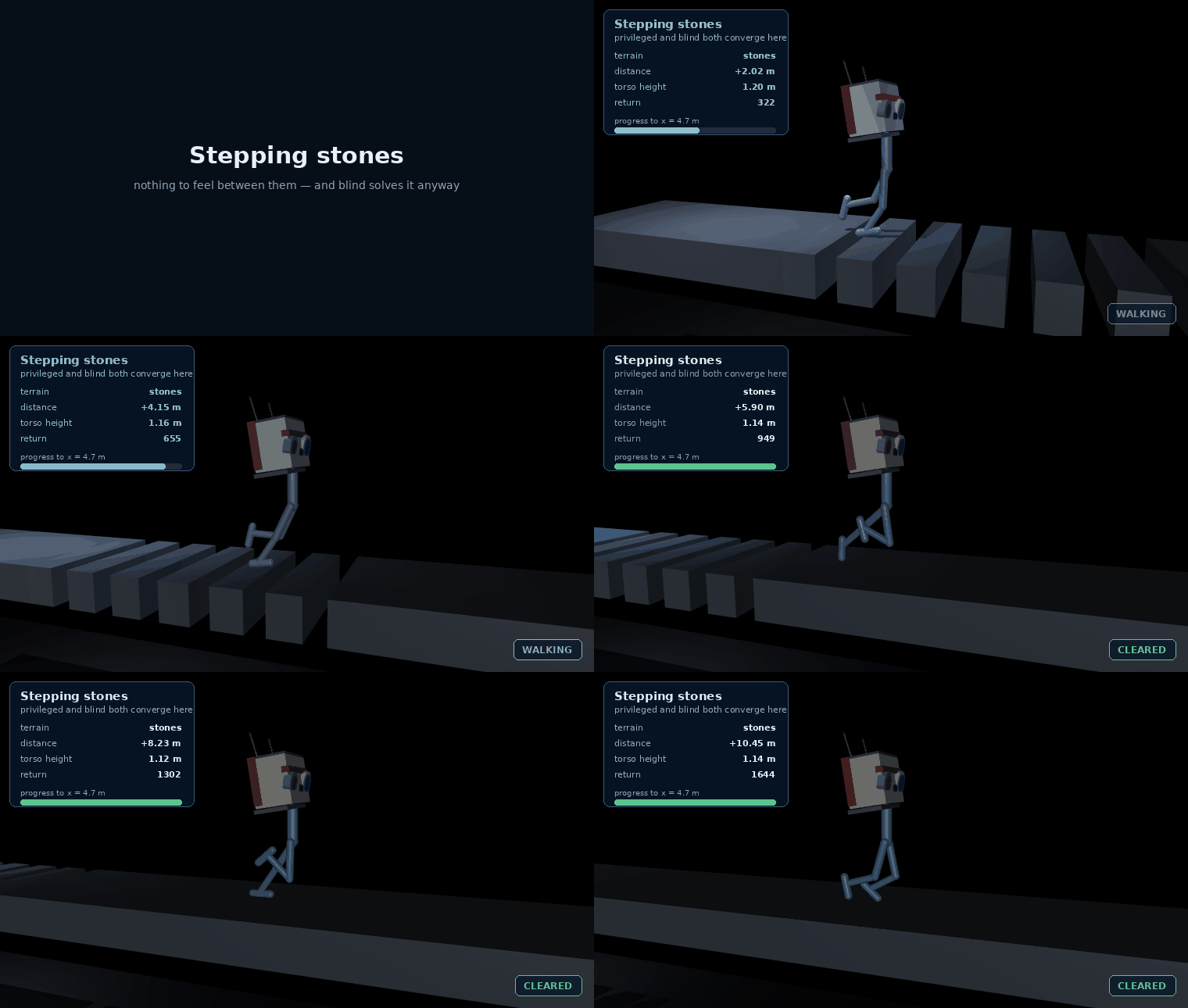
A trained policy crossing the sparse footholds. Nothing to feel between the stones, and it clears them anyway.
Friction patches
The ground stays perfectly flat. What changes is grip: patches of low-friction surface, visually distinct and geometrically identical. Dust over rock, or ice.
This is the one condition where feeling genuinely cannot substitute for looking — on a slippery patch the proprioceptive signal is the slip, which is already the failure. It also gives the experiment a negative control it never had before: a depth camera should be worth no more than no camera at all, because depth cannot see friction. If depth ≈ blind and RGB wins, that is hard to explain as "more inputs train better".
vision_env.py grows an RGB sensor for this (sensor="rgb", 3×64×64).
The patch is physically real, and proving that took three attempts:
| push on the torso | grippy | slippery | ratio |
|---|---|---|---|
| 30 N | 0.0002 m | 0.0060 m | 25× |
| 60 N | 0.0009 m | 0.0194 m | 22× |
| 100 N | 0.0048 m | 0.0872 m | 18× |
The first version of this terrain was completely inert. The patches were in the scene, correctly named in the contact list, visible in the render — and the robot slid exactly as far on them as on normal ground.
MuJoCo combines contact friction as the elementwise maximum of the
two geoms, and the foot carries μ=0.9 from the default class. So
max(0.9, 0.06) = 0.9 and the low-friction surface did nothing.
priority="1" on the patch geoms makes its parameters win outright.
This is lab 1's decorative obstacle in a new costume, and it was caught the same way: by pushing the robot and measuring, not by training a policy and believing the number.
Two further probes were wrong before one was right — the first measured the torso rotating about the ankle rather than the feet sliding, and the second used a 220 N push that exceeds both friction limits and dragged the robot across three surfaces at once. All three failures would have produced a confident null.
Settled at 2M steps, and it is the fifth null. The oracle learns the severe hazard completely — 0% until 0.5M, then 100% and flat for the last 1.2M steps — so the terrain is genuinely solvable with the information, which is what makes a blind failure interpretable. The blind arm then does it too:
| eighths of training | 1 | 2 | 3 | 4 | 5 | 6 | 7 | 8 |
|---|---|---|---|---|---|---|---|---|
| privileged | 0% | 0% | 57% | 100% | 100% | 100% | 100% | 100% |
| blind | 0% | 0% | 13% | 46% | 88% | 99% | 94% | 100% |
Same ceiling. The only difference is how long it takes: privileged reaches 100% around 0.75M steps, blind around 1.75M. Information bought learning speed, not capability — a 2.3× difference on one seed, which is a real thread and not yet an established result.
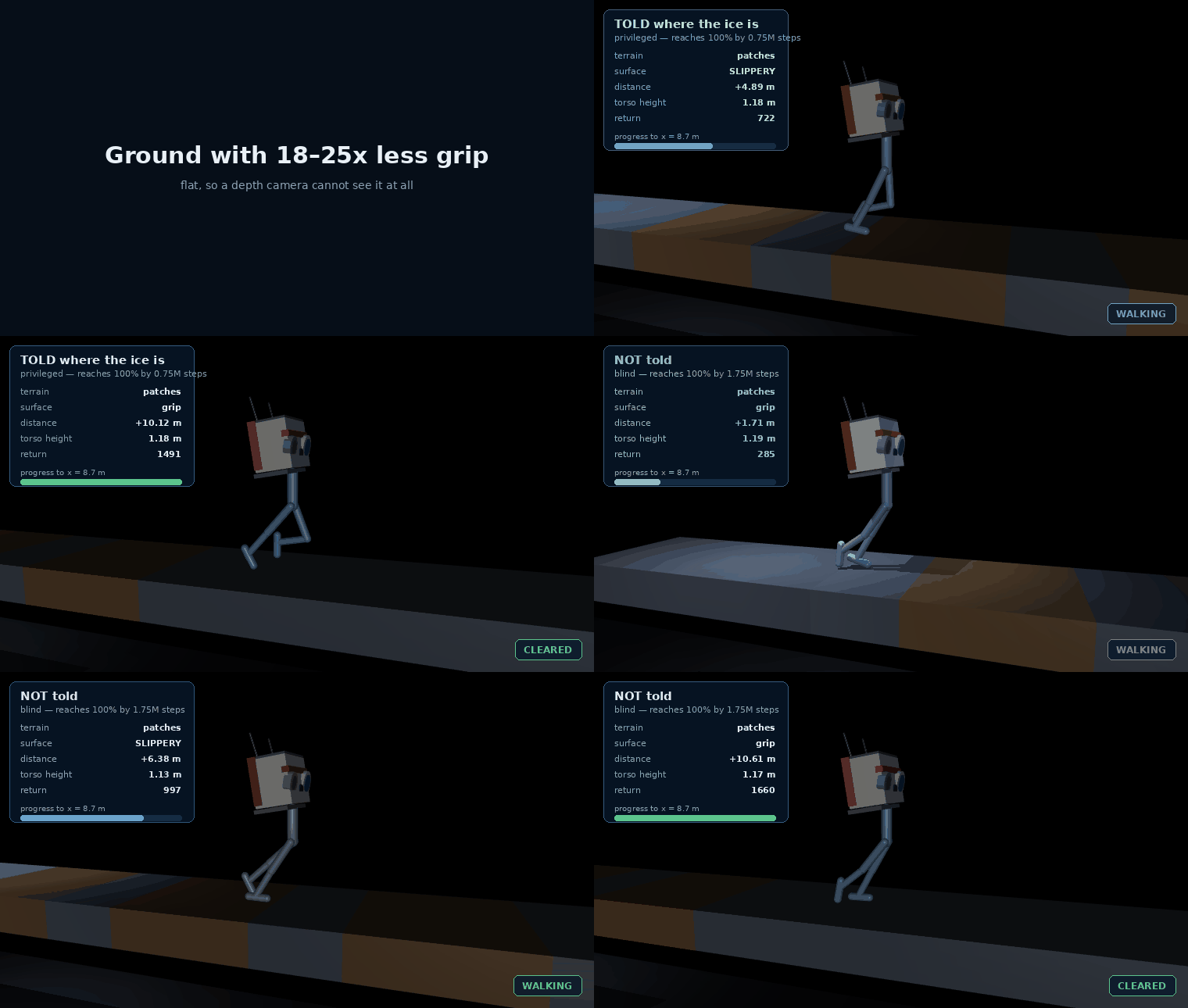
Both arms, same terrain. This is what a measured null looks like: the
policy that was told where the slippery ground is, and the one that was
not, doing the same thing. The HUD's surface field is read from the
live contact list rather than from x-position, so it cannot disagree
with the physics — which is exactly how the patch managed to be inert
and look correct for three attempts.
What five attempts add up to
| design | outcome |
|---|---|
a gap to leap (hop) | blind won, 3/3 seeds |
| stepping stones, 3 difficulties | no consistent effect once converged |
| friction patches, mild | both arms 100% |
| friction patches, severe | both arms 100%; privileged only faster |
| stairs (part 1) | camera helps on ascent only, p ≈ 0.1 |
A 6-DOF biped with a locked torso and a dense forward-velocity reward is extraordinarily hard to blind. Every hazard built here it eventually learned to handle by feel — including one with 18–25× less grip that it cannot possibly see coming.
That is the finding, and it is worth stating as a conclusion rather than as a series of failures. It is also consistent with the literature: blind proprioceptive locomotion over continuous terrain is genuinely strong, and the published cases where exteroception is necessary involve either far more degrees of freedom or hazards that are unrecoverable in one step.
The most likely culprit is the reward, not the terrain. Forward velocity plus an alive bonus pays for robustness; falling merely ends the episode, and nothing pays for anticipating. A reward that punishes the slip itself, or a task where a single misstep cannot be recovered, may well flip it — but that guess has now been wrong four times, so it is written here as a hypothesis and not as a plan.
The one live thread is sample efficiency. "Information makes learning faster rather than better" is defensible and measurable, and it would need 3–5 seeds per arm to publish.
The recurring methodological lesson is narrower and more useful: never read the final number off a run whose curve is still moving. It invalidated two results in this section before they were published, and both times the "finding" had the sign the hypothesis predicted.
What Went Wrong, and What It Taught Us
The original result was not a typo or a bad run. It was a plausible number, produced by correct code, that nobody controlled. It agreed with a good intuition, it came with a figure generated from real run artifacts, and it passed a test that looked rigorous.
Shipping the scripts guarantees the numbers match what the code produced. It does not guarantee the comparison was the right one. That gap is where this page went wrong, and it is the gap worth watching in any ML system: not the models that are obviously broken, but the ones that look right for a reason nobody tested.
An ablation means something only if it changes one thing. This one changed two, and the direction of the error was the direction of the hypothesis — exactly when it is hardest to notice.
The mistake that produced it
The first version of this lab compared two robots:
| arm | information | how it was trained |
|---|---|---|
| blind | proprioception only | PPO, from scratch, 1.5M steps |
| vision | proprioception + depth | behaviour cloning from a privileged teacher |
Those differ in two respects, not one. The vision arm does not merely have a camera — it is imitating a teacher that was handed the terrain type directly. Crediting the whole gap to the camera assumes the training method contributed nothing, and nobody checked.
Behaviour cloning (BC) means: run a teacher that was told the answer, record what a real robot could have seen paired with what the teacher did, then train a network to reproduce those actions by ordinary supervised regression. No reward, no exploration. It is the standard teacher–student recipe from quadruped locomotion (Lee et al. 2020; Kumar et al. 2021).
The missing cell is obvious once stated: a student distilled from the same teacher, by the same objective, with no camera.
What This Lab Claims, and No Longer Claims
- Teacher–student distillation closes most of the gap on terrain a blind policy struggles with — including all of descent.
- A depth camera adds a further large gain on ascent only, and makes it far more reliable across seeds.
- Neither effect is statistically established at n=3.
- Nothing generalises to stairs steeper than those trained on.
What it no longer claims: that vision is necessary, that descent requires anticipation, or that the blanking test demonstrated anything.
This is the seventh design in this category where a vision ablation came back weaker than it first appeared. The pattern is worth stating plainly: blind proprioceptive locomotion is far more capable than intuition suggests, and a controlled comparison is the only way to learn what a sensor is actually worth.
Running It
cd 07_physical_ai/03_terrain_vision
uv sync

# the RL half — ~13 min per run on CPU, three seeds per arm
for s in 0 1 2; do
  uv run train_teacher.py                 --seed $s --name v3_priv_s$s  --quiet
  uv run train_teacher.py --no-privileged --seed $s --name v3_blind_s$s --quiet
done

uv run collect.py --episodes 120              # renders the BC dataset once

# the four student arms
for s in 0 1 2; do
  uv run train_student.py            --seed $s --tag student_s$s       --device cuda
  uv run train_student.py --no-depth --seed $s --tag student_blind_s$s --device cuda
done

uv run ablations.py                           # consolidates the arms + held-out sweep
uv run make_figures.py && uv run render.py --all
--no-depth is the control arm. The three camera conditions (real
depth / training mean / zeros) are measured by train_student.py itself
and land in each run's summary.json; ablations.py collects those into
runs/results.json and adds the held-out geometry sweep. Every figure is
read from those files, so nothing here can show a result a run did not
produce.
Re-verify the arms independently, if you want to pay for it:
uv run ablations.py --only arms      # ~1 h, re-rolls every arm from its checkpoint
uv run ablations.py --only camera    # ~20 min, re-rolls the camera conditions
Hardware
All of it ran on one laptop — RTX 3080 Ti (16 GB), 20-core i9. The teachers run on the CPU, where they are faster; only the students touch the GPU, at 13.6× ± 0.9 over five repeats. That is the first GPU win in this category, and it is still not a DeepSpeed case: 193,222 parameters have nothing for ZeRO to shard.
References
- Schulman et al., PPO, 2017 · GAE, 2015
- Lee et al., Learning quadrupedal locomotion over challenging terrain, Science Robotics 2020 — the teacher–student-with-privileged-information template
- Kumar et al., RMA: Rapid Motor Adaptation, 2021
- Miki et al., Learning robust perceptive locomotion, Science Robotics 2022 — proprioception and exteroception fused
- Agarwal et al., Legged locomotion in challenging terrains using egocentric vision, CoRL 2022
- Agarwal et al., Deep RL at the Edge of the Statistical Precipice, NeurIPS 2021 — why three seeds and a mean are not enough
- Henderson et al., Deep Reinforcement Learning that Matters, 2018