Terrain Navigation
← previous: Terrain Vision · next: Mars Terrain →
The plain words boxes like this one carry the whole story; the technical detail around them is there if you want it.
The one line version: the robot has to get from A to B with hills in the way, so it can climb them or walk around. Giving it terrain information made it worse — and so did giving it the same number of extra inputs filled with nothing but zeros.
Abstract
A two-legged robot is dropped at a random point A in a 20 × 20 m arena and has to reach a random point B. Between them lie long ridges of two kinds: low ones it should walk straight over, and high ones it must walk around. We asked a question that sounds like it has an obvious answer — does telling the robot what the ground ahead looks like help it get there? — and measured it across 27 training runs. The answer was no, and the reason turned out to be more interesting than a yes would have been: the extra information made training less reliable, and a control experiment showed that feeding the robot six numbers that were always zero did much of the same damage. This page walks through the task, the result, the three bugs we had to fix before the result meant anything, and the limits of what nine random seeds can actually establish.
How this lab works
A 20 m arena, A to B, with landforms in between — the first lab in the topic where the robot has a routing choice: climb it, or go around.
The third arm is the point. Padding the observation with zeros — no information whatsoever, just more inputs — degrades the policy on its own. Without that control, "seeing is worse than blind" would have been attributed to the terrain data rather than to the width of the vector carrying it.
Problem Statement
The robot has to cross a 20 m arena with hills in the way. It can climb over them or walk around — the first task in this topic where there is genuinely a choice to make.
Labs 1–3 could not ask this question
The three labs before this one were planar. The robot had two base joints — forward and up — so terrain was a profile along a line, every obstacle arrived head-on, and there was never a choice to make. You could go over the thing in front of you or you could stop. Lab 3 ended by giving the robot a camera, and the camera helped on ascent and nowhere else, for exactly this reason: on a corridor, there is nothing to decide.
Routing only becomes a question when the robot can go around something. That needs a second dimension.
The arena, and the two kinds of obstacle
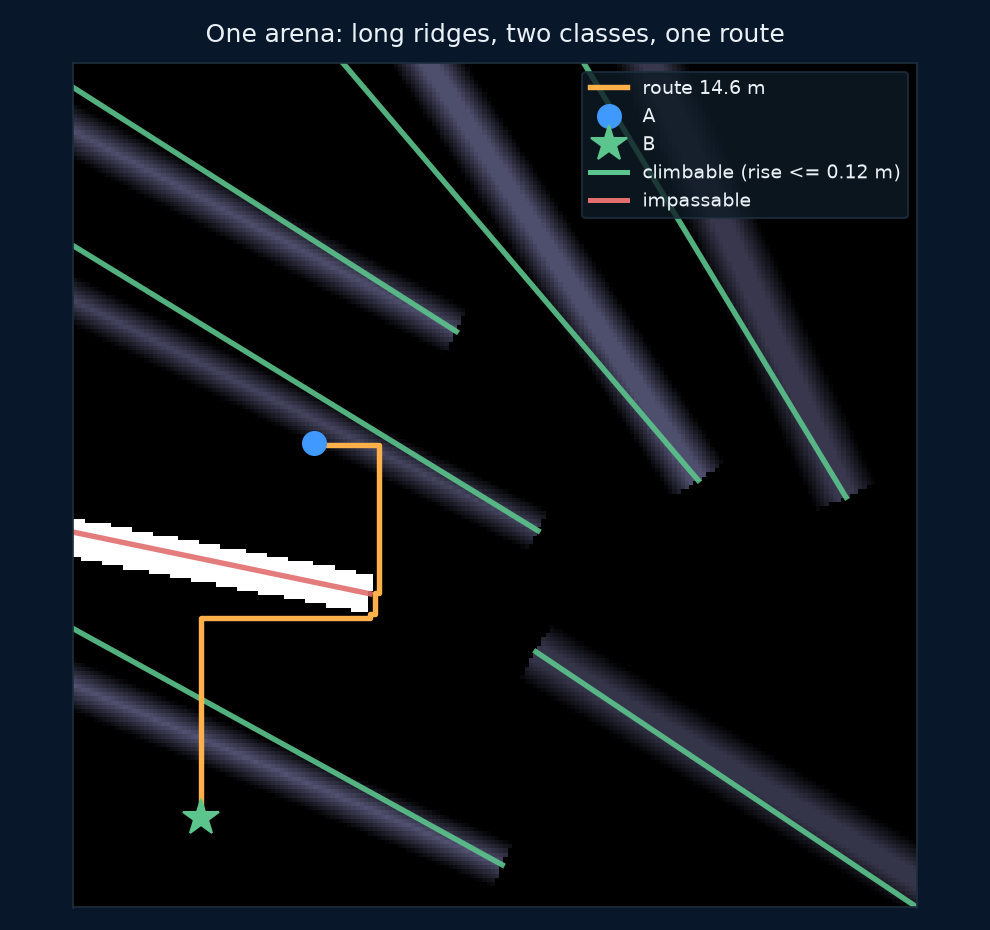
| rise | the right response | |
|---|---|---|
| climbable | ≤ 0.12 m | go straight over — detouring costs distance |
| impassable | ≥ 0.45 m | walk to its end — trying to climb wastes the episode |
The threshold is not arbitrary: lab 2 measured a two-legged robot climbing 0.04–0.10 m treads reliably and failing above that, so the boundary sits where that lab's evidence puts it.
The two classes look different to a planner and identical to a blind robot, which is what makes the experiment possible: we can give one policy a description of the ground ahead, withhold it from another, and see whether it matters.
The question, stated so it can lose
If a policy handed the ground profile ahead does not beat a blind one on arrival rate, then terrain information is not what this task needs.
Writing it this way matters. A claim phrased so that any outcome confirms it is not a finding. This one could lose, and it did.
Solution
How it is put together
The oracle certifies each map is solvable — an unsolvable arena scores every policy at zero and reads as a hard task rather than a broken one, which this repository has shipped twice. It also walks B back along its own route to set the goal range.
It is not the denominator for efficiency, and the reason is a bug
worth keeping. That search is 4-connected, so it cannot move
diagonally: it staircases, and a straight diagonal of length comes
back as . Across 59 maps it overstates the true shortest
distance by mean 1.199×, max 1.424× against a
ceiling. Efficiency is scored against a separate 8-connected Dijkstra
instead, and solve() is left alone precisely because changing it
would move the goals and redefine the task.
What the robot observes
Goal is given in the robot's own frame — range and the sine and cosine of relative bearing:
where is the world bearing to B and the robot's yaw. A world-frame goal invites memorising positions in a fixed arena; a relative one is the same problem wherever you put it.
The privileged channel is six numbers, probing three directions:
paired with a climbable flag for each. Rises are measured relative to the ground underfoot, because the decision is about the step to clear, not the altitude.
An 11 × 11 raw height patch gave a 142-dimensional observation to a 2 × 64 MLP. All three seeds sat at exactly 0% arrival for the entire run while blind reached 17%.
That is a broken arm, not a finding. Reporting "more information made it worse" from it would have been wrong, and the only reason it was caught is that three identical zeros are impossible by chance. Six summary features — which is also the shape a real perception stack emits — train fine.
The reward
Progress toward B, not forward velocity. Every earlier lab paid for velocity, which on a corridor is the same thing; here it is not — sprinting north when the goal is east is worth nothing.
With a 2000-step cap, standing still earned . Walking 7 m and arriving at step ~700 earned . Terminating on success forfeited ~1300 steps of alive bonus, so arriving was worth 2.5× less than loitering — and the policy, correctly, learned not to arrive. 75% of episodes ended in a fall after 1.4 m.
Lab 1 documents the mirror of this: "the one-off bonus must be one-off. Pay it every tick and standing on the box forever beats crossing it." Same arithmetic, opposite direction. The episode now continues after arrival.
The robot, and one simplification stated plainly
Torso pitch and roll stay locked. The robot turns and translates but cannot tip over. That is inherited from measurement, not convenience: lab 1 found that freeing the torso produces the bipedal-balance problem — 1M steps gave something that dived forward and fell at one second — and lab 2's 2×2 found that with two legs, freeing it costs a lot of return and buys no extra climbing.
What it buys is that the hard part here is navigation rather than balance. What it costs is stated rather than hidden: nothing in this lab measures recovery, and yaw is actuated directly because a planar biped with locked roll cannot generate yaw torque through contact.
Labs 1–3 used torque control. It does not survive the jump to navigation: this body needs a specific sustained torque pattern just to stand — measured at hip 0.6 / knee 1.0, with anything less collapsing in under 50 steps — and random exploration almost never finds it. A 1M-step run on flat ground reached 0% arrival because the policy spent its entire budget failing to stand.
With position control a zero action holds the standing pose and the policy learns deviations from it.
Experiments and Results
First attempt: a clean result that was entirely wrong
Our first run of this experiment produced exactly the answer we expected. The privileged policy beat the blind one on 7 of 9 seeds, Wilcoxon p = 0.022 — information helps, significant, done. We published it.
It was wrong, and nothing in the code said so. The arrival rates were plausible, every test passed, and the figures looked clean. What eventually gave it away was somebody watching an animation and asking why the robot was standing in the middle of the map while the orange trail showing its path had already reached the goal flag.
The robot was being spawned in the wrong place. rootx and rooty
are slide joints. The torso body was declared
in the XML at pos="(start_x, start_y)" while reset() also wrote
the start into qpos — and a slide joint displaces from wherever the
body is declared. So the robot spawned at twice its start
coordinates, frequently off the height field altogether.
Every distance, every terrain probe and the arrival test then ran in a
frame shifted by the start offset: to_goal() read 10.44 m where the
true distance was 14.78 m. Eighteen property checks passed
throughout, because not one of them compared the lab's own idea of
position against MuJoCo's.
Both arrival rates turned out about five times higher once this was fixed, because a robot that starts on the map can actually cross it. Every figure and animation on this page was regenerated afterwards, and the result below is what the corrected experiment says.
The lesson we took from it is not "check your coordinates". It is that a test suite proves things about the questions it asks, and nothing about the ones it does not. Eighteen checks were watching this lab and none of them compared the two numbers that disagreed.
What the corrected experiment found
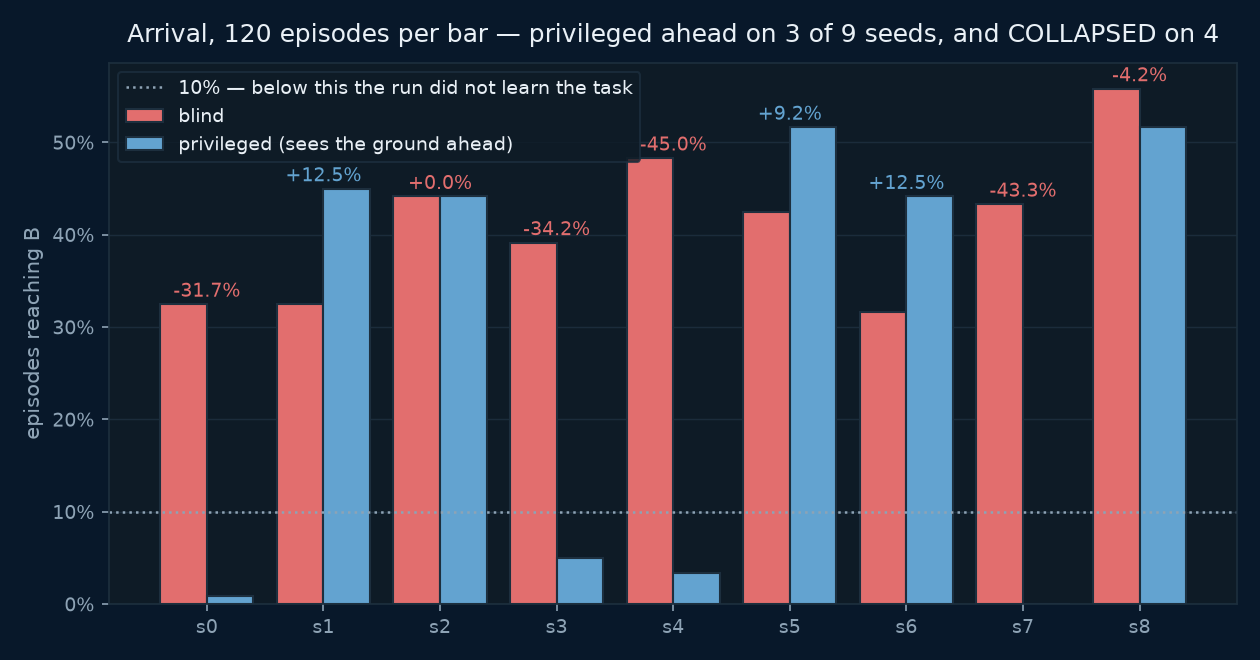
Three arms, nine seeds each, 120 evaluation episodes per checkpoint on identical maps.
| arm | obs dims | pooled arrival | range | collapsed (<10%) | mean of seeds that trained |
|---|---|---|---|---|---|
| blind — proprioception + goal bearing | 21 | 41.1% | 32–56% | 0 / 9 | 41.1% |
| privileged — plus the ground ahead | 27 | 27.3% | 0–52% | 4 / 9 | 47.3% |
| padded control — plus six zeros | 27 | 31.3% | 0–53% | 2 / 9 | 39.2% |
Paired blind against privileged: ahead on 3 of 9 seeds, mean −13.8 points, Wilcoxon exact p = 0.250, sign test 0.508. There is no arrival advantage.
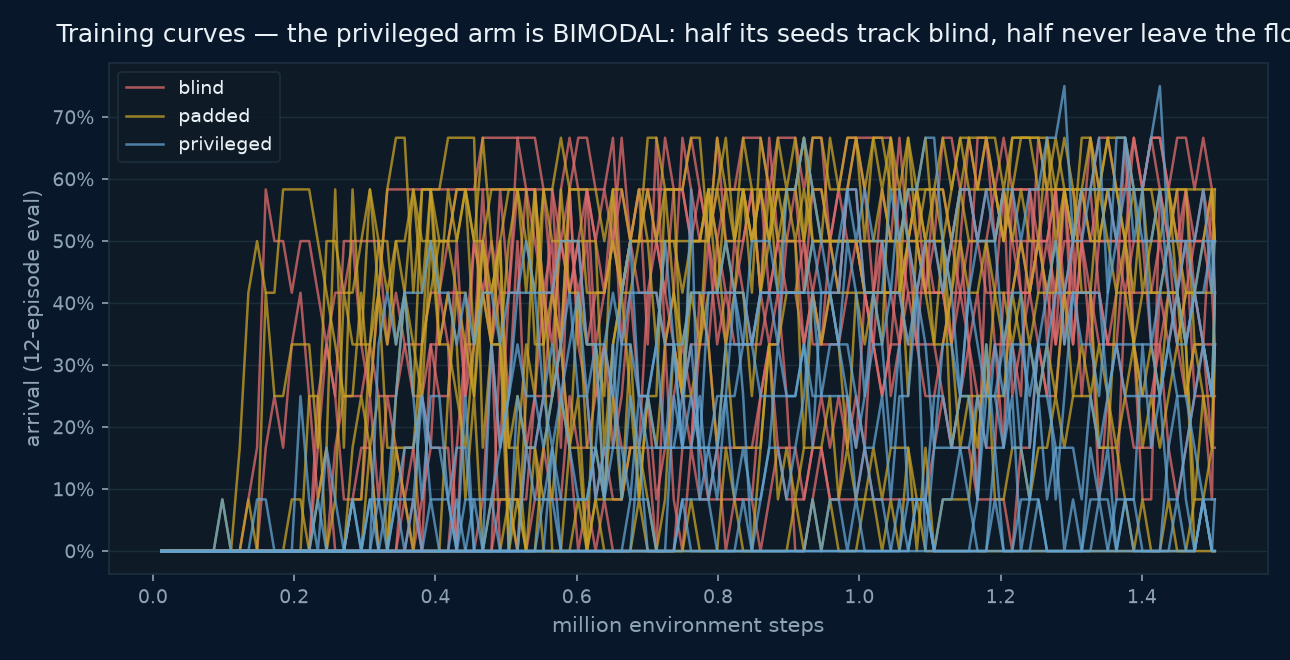
But look at the per-seed numbers rather than the means. They are not scattered around a centre — they are bimodal, and only in one arm. The privileged policy either reaches 44–52% or sits at 0–5%, with nothing in between. The blind policy never does it.
"Privileged averages 27.3%" is true and useless. No privileged seed scored anywhere near 27%. Four scored under 5% and five scored over 44%. Reporting the mean alone would have hidden the only interesting thing in the data.
Why we changed direction: the comparison was not valid
At this point we had what looked like a tidy story — extra information destabilises training — and we were ready to write it up that way. Then we noticed the comparison could not support it.
Going from blind to privileged changes two things at once: the robot gains six numbers describing the terrain, and its observation vector grows from 21 entries to 27. Those are different causes with the same symptom, and the experiment as designed could not tell them apart:
- the six extra dimensions destabilise PPO at this scale, or
- those particular features are harmful.
So we ran a third arm that we had not originally planned. Take the blind observation and pad it out to 27 entries with six constant zeros — the same width as privileged, carrying no information at all. If width is the culprit, this arm should break too. If the terrain features are the culprit, it should be as stable as blind:
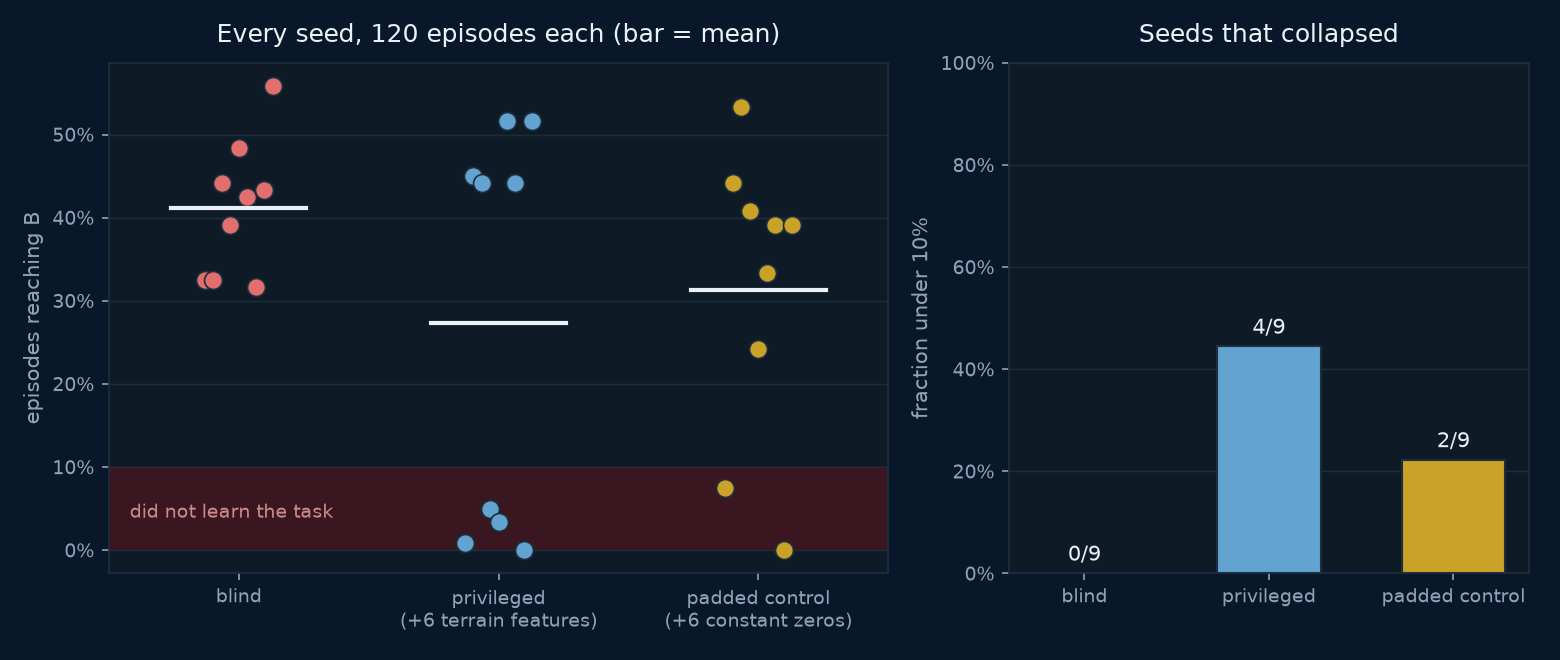
Six constant zeros collapsed 2 of 9 seeds. Blind collapsed none. Observation width destabilises this policy on its own, carrying no information whatsoever.
| comparison | Fisher exact |
|---|---|
| blind 0/9 vs privileged 4/9 | p = 0.082 |
| blind 0/9 vs padded 2/9 | p = 0.471 |
| padded 2/9 vs privileged 4/9 | p = 0.620 |
The control lands between the two arms and is not statistically separable from either. So the claim this lab can defend is narrow, and stated narrowly:
Adding six inputs to a 12k-parameter policy costs reliability even when those inputs carry nothing. The terrain features do look useful conditional on the run surviving — privileged is the best arm at 47.3% among seeds that trained, in the tightest band of the three — but this experiment cannot attribute the extra collapses to the features rather than to the width.
It would be easy to read the table above as "width explains about half of it" and move on. We nearly did. Then we worked out how much evidence that claim would actually need.
To distinguish the padded arm's 22% collapse rate from the privileged arm's 44% — with an 80% chance of detecting a difference that real — takes roughly 70 seeds per arm. Distinguishing blind's 0% from padded's 22% takes about 40. We have nine, which is already 27 training runs and about eleven hours of compute.
So two statements on this page are deliberately weaker than the numbers appear to allow. The blind-versus-privileged collapse gap is a trend (p = 0.082), not a result. And whether the damage comes from the width or from the features is left open, because we can show width does some of it and we cannot show it does all of it.
This is the uncomfortable version. The comfortable version — picking whichever reading sounded better and reporting it as the finding — is how the first result on this page came to be wrong.
Did it at least walk shorter routes?
Scored only on seeds that trained, as geodesic / distance walked to B:
| arm | efficiency | fell |
|---|---|---|
| blind | 82.6% (69–91%) | 28.1% |
| privileged | 77.6% (66–85%) | 16.1% |
| padded | 84.3% (72–91%) | 24.1% |
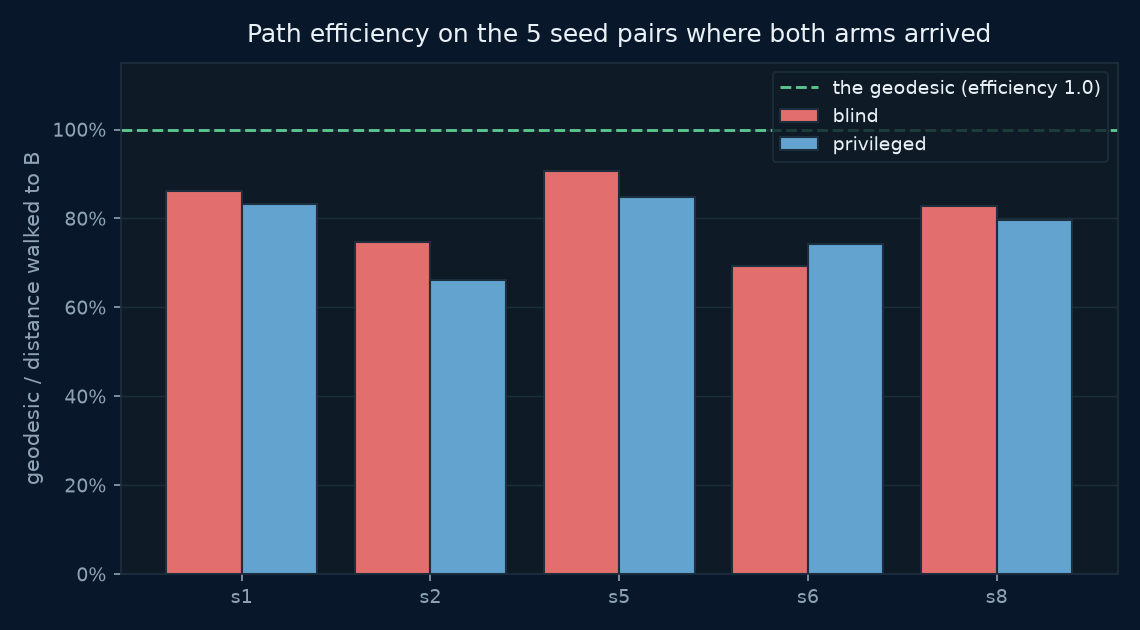
No efficiency advantage either. Privileged falls least — the one axis on which the terrain channel shows an unambiguous benefit.
"Distance walked" originally kept counting after the robot reached B. Because the episode deliberately runs on past arrival, a policy that walked a near-optimal route and then idled near the goal for another 1,300 steps was scored at roughly half its true efficiency. Frozen at arrival, every arm came out far better than first reported — and the ranking between them changed. Efficiency above is measured to the moment of arrival.
Watch it
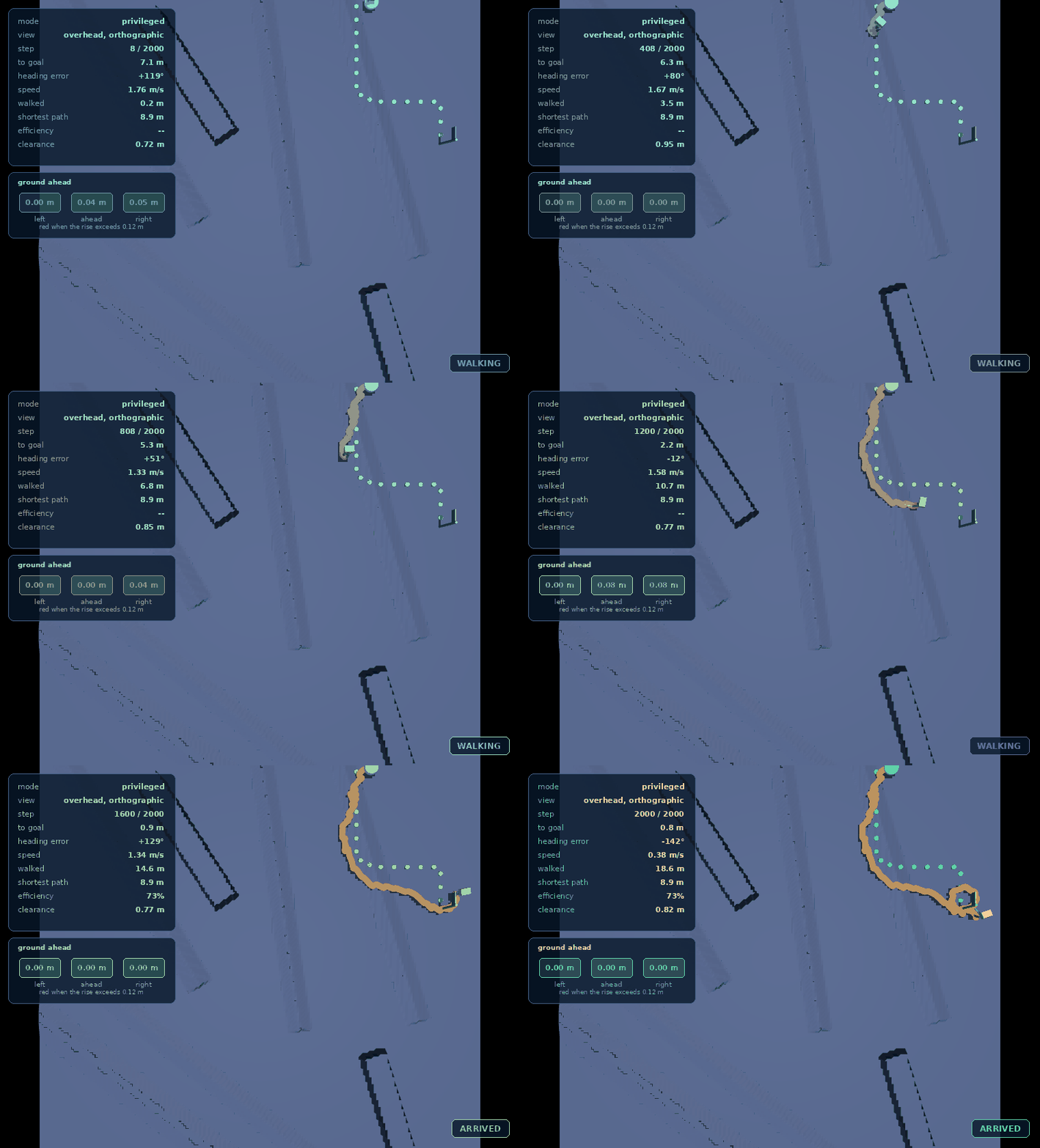
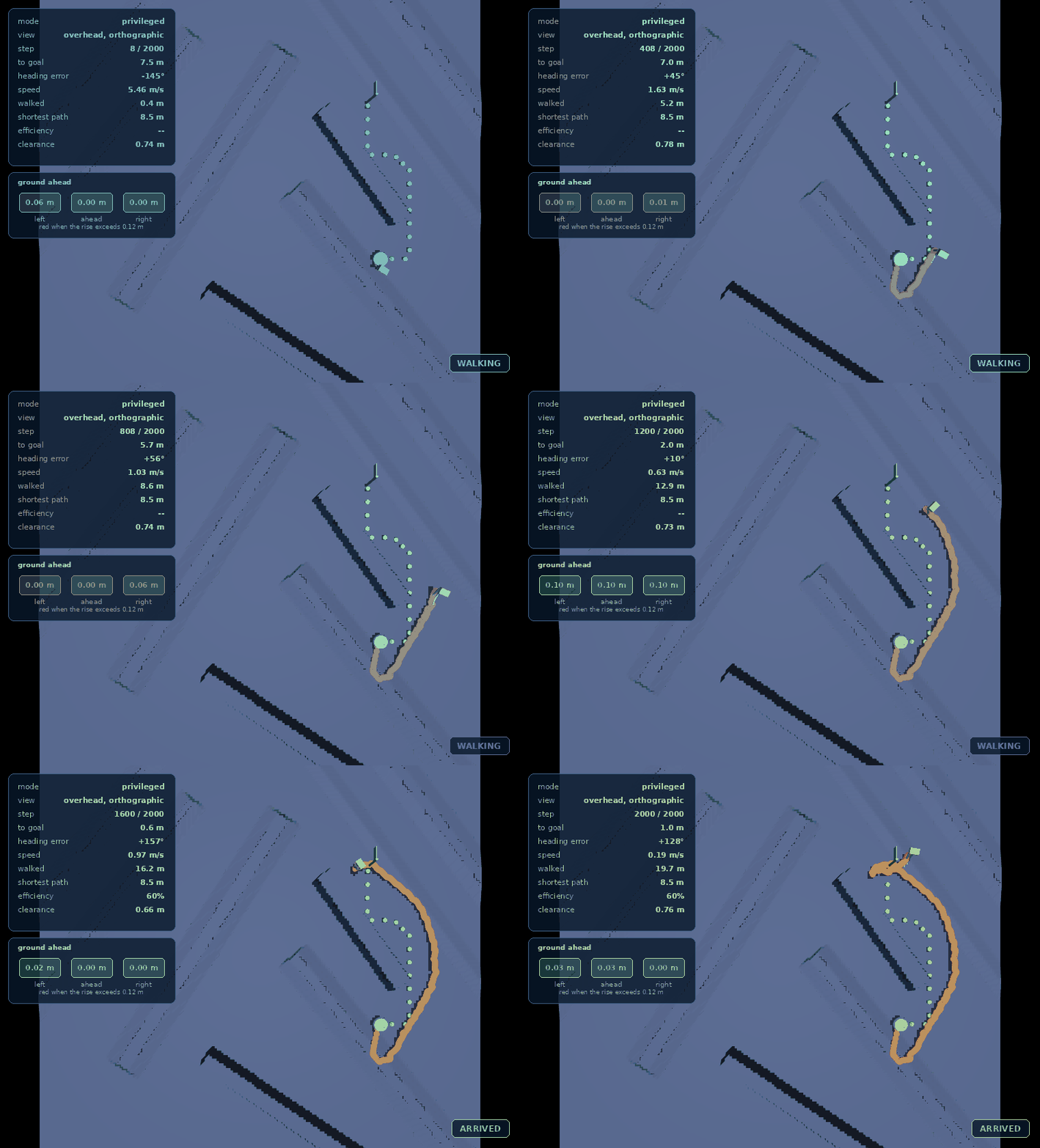
Green is the oracle's shortest route, orange is where the robot actually went. Both are drawn as scene geometry, not painted onto the frame — see the note below.
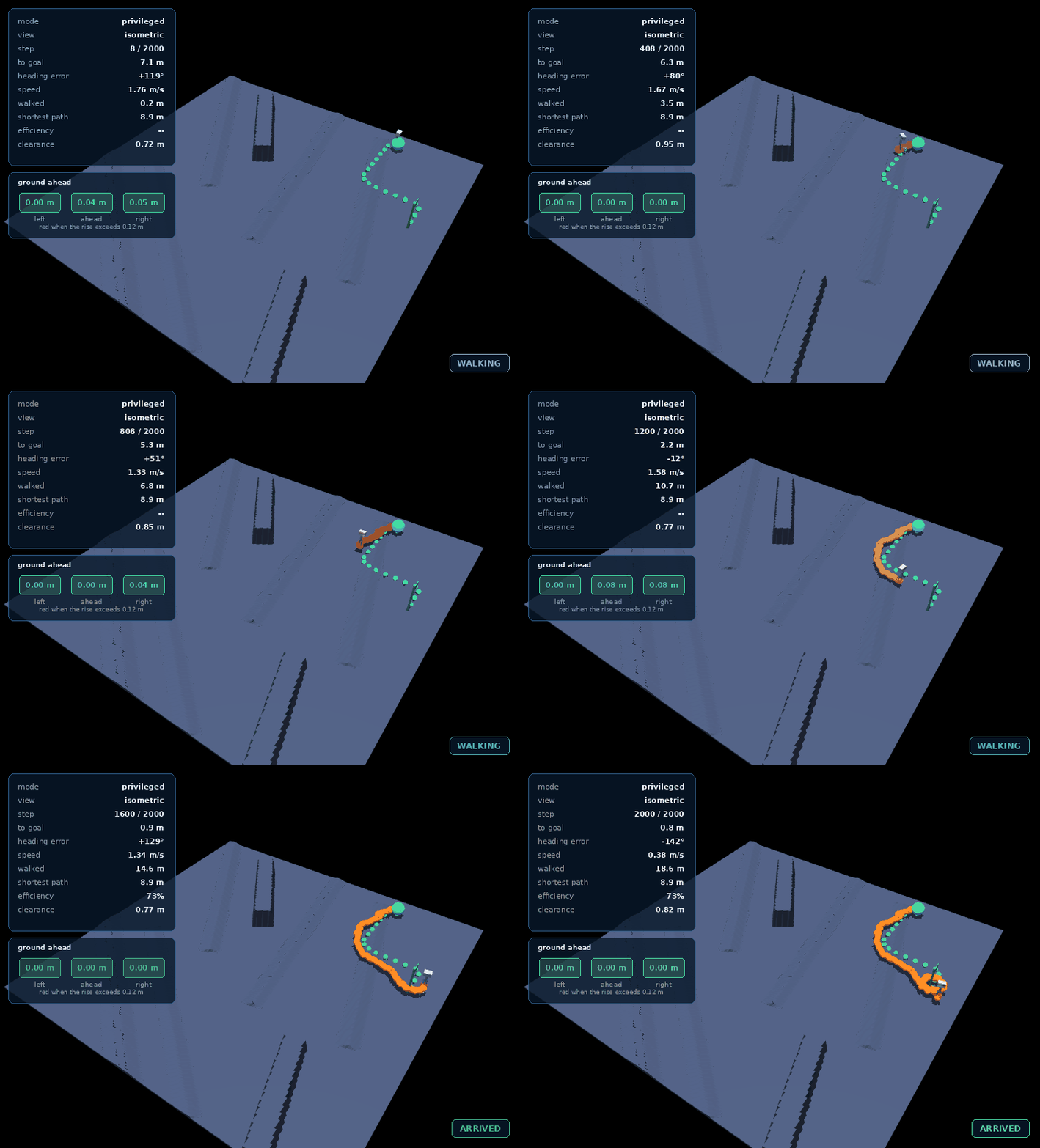
From an angle
Overhead reads the route; it flattens the terrain. These show the relief the robot is actually dealing with — and they only work because the route and track are scene geometry, so they project correctly at any camera angle.
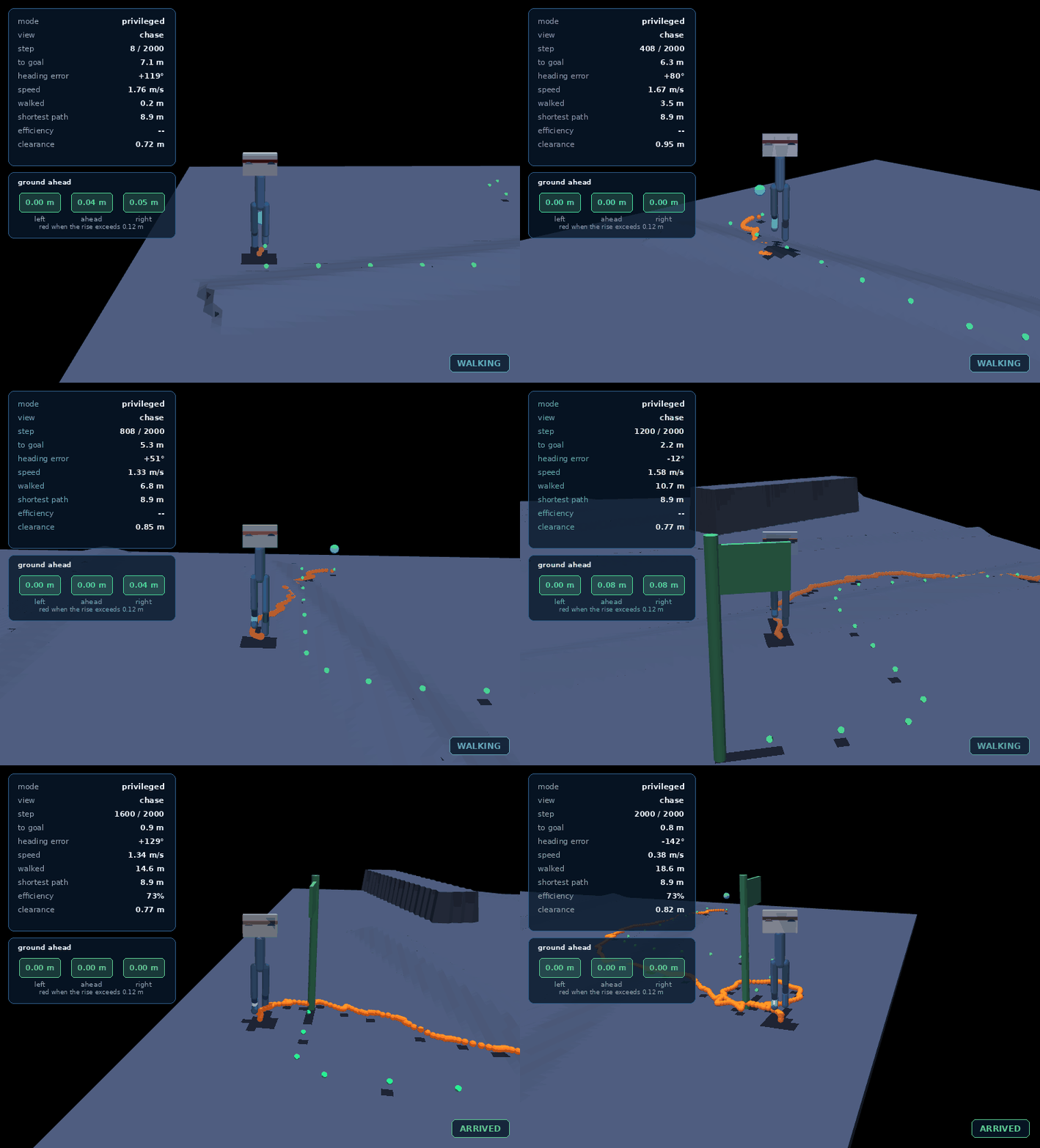
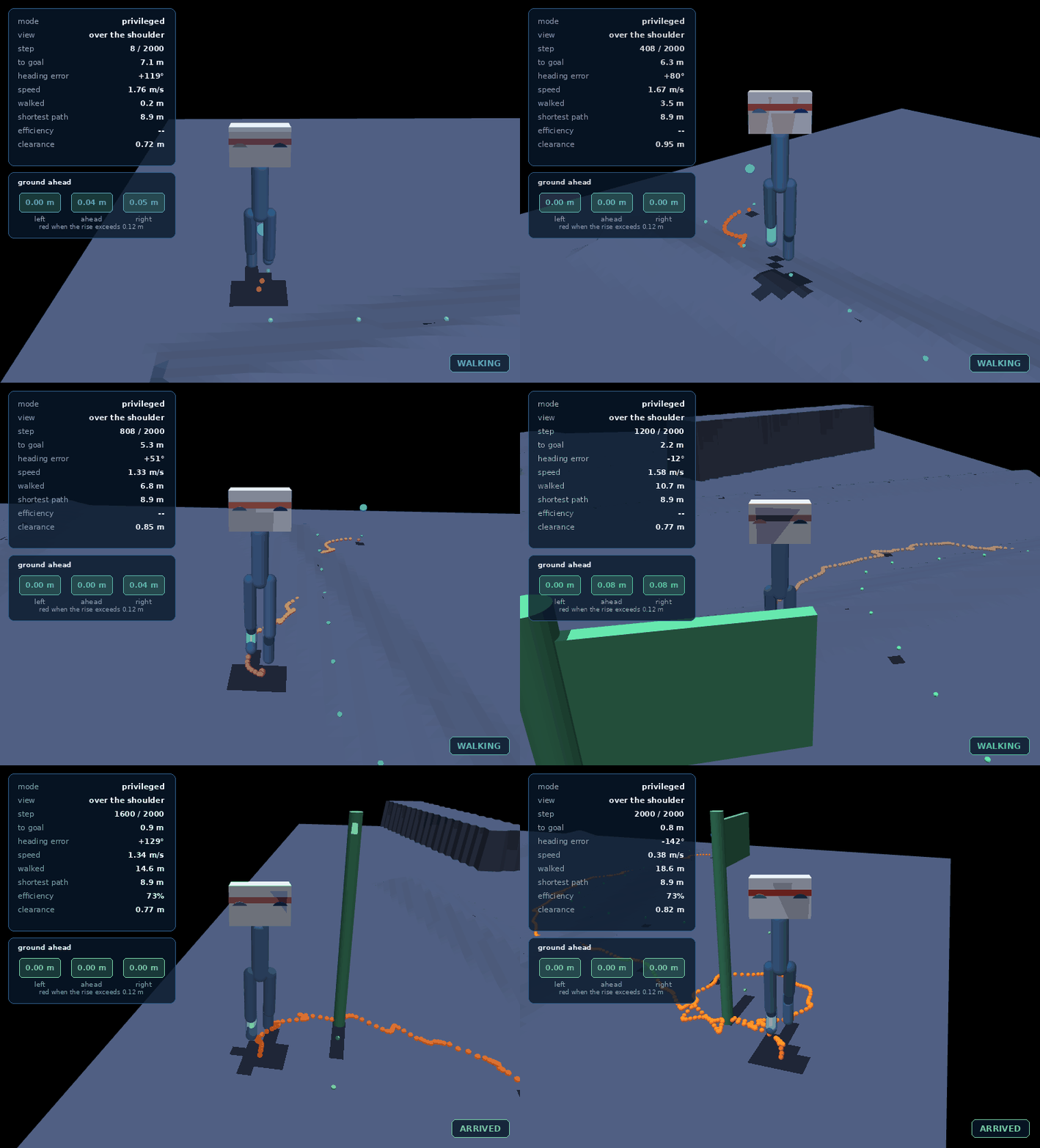
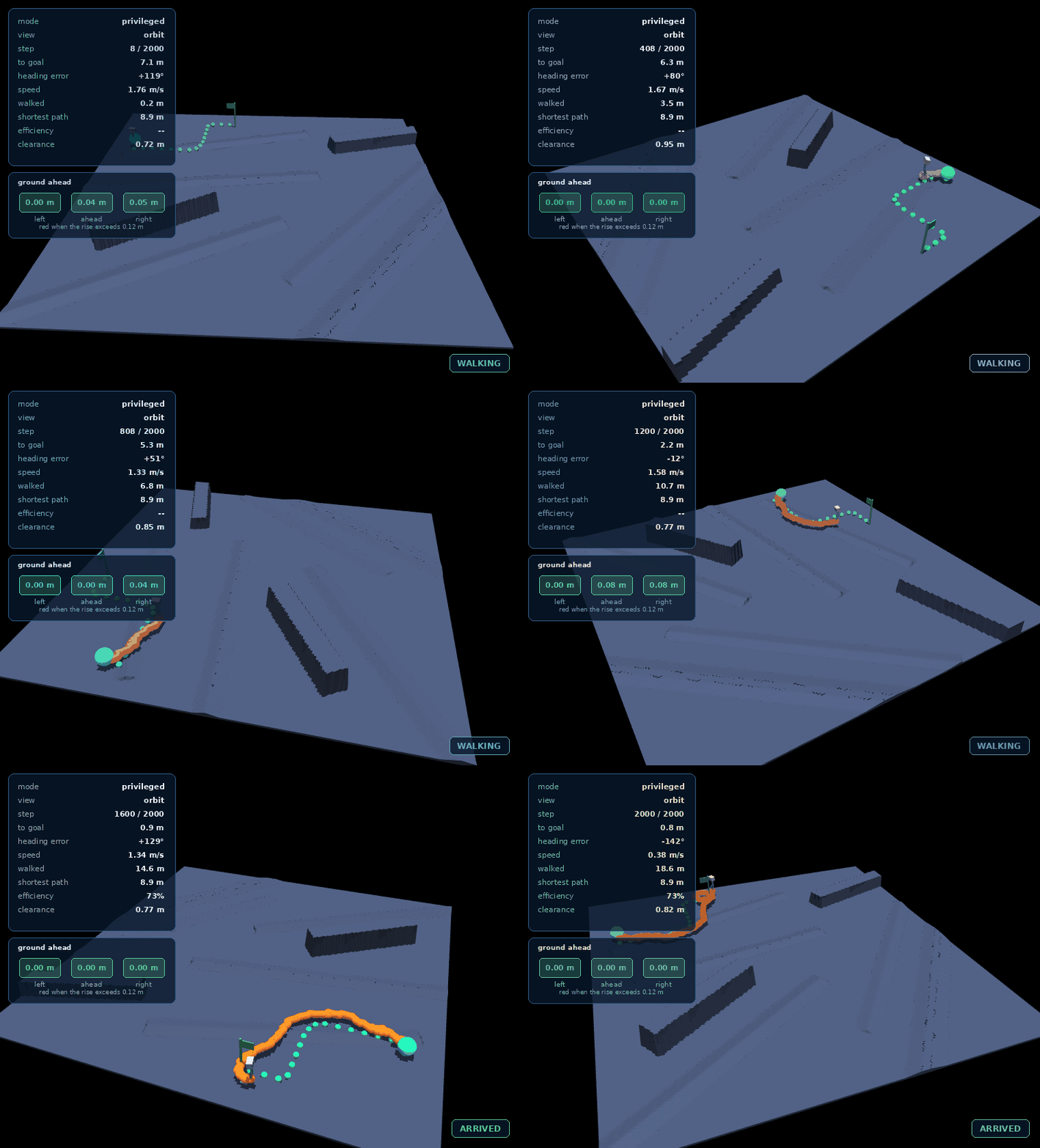
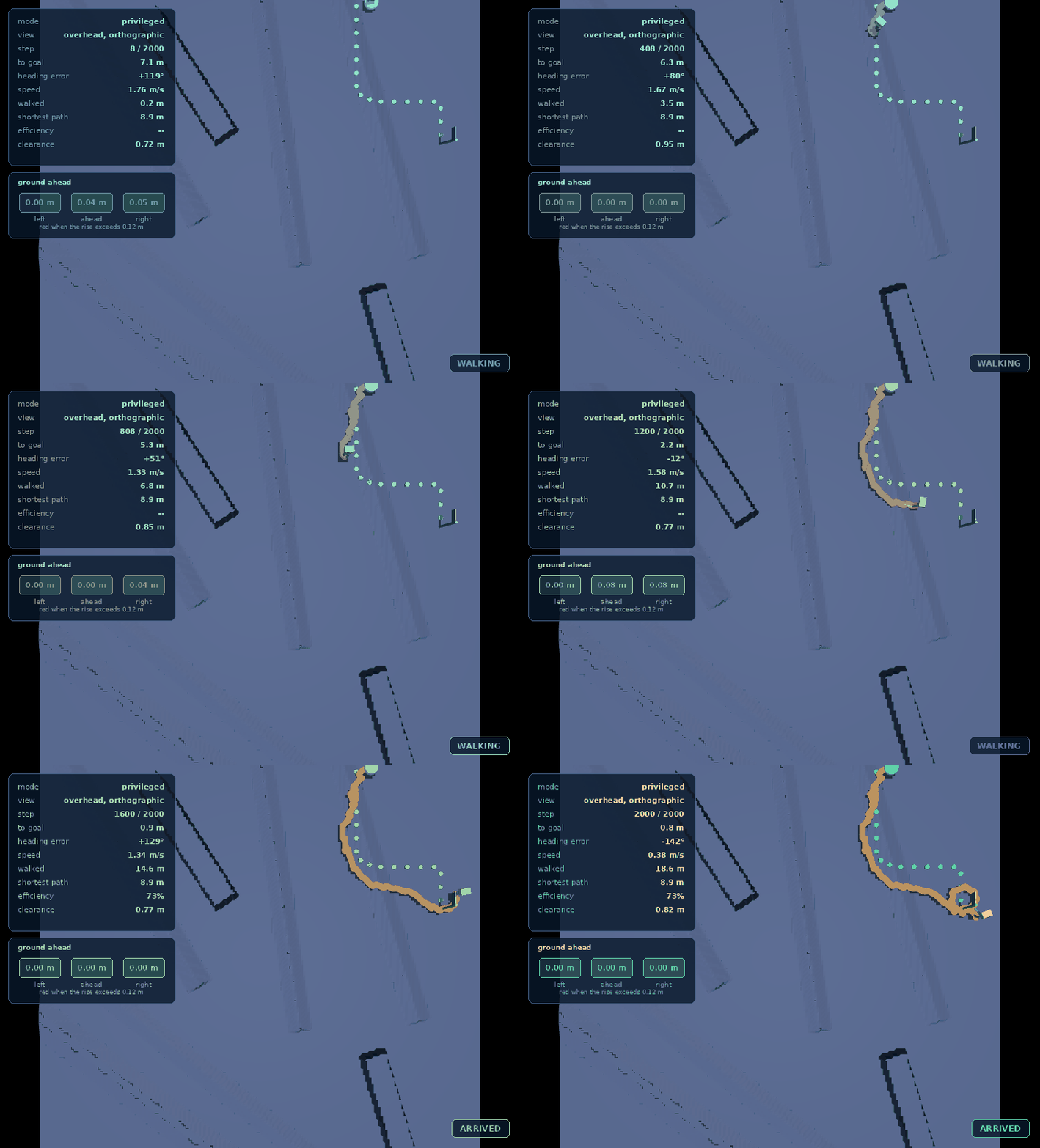
The HUD on these carries a terrain compass — the same three probes the privileged policy receives, with each reading red when the rise exceeds the 0.12 m climbable threshold. On the blind arm the panel is greyed and marked not observed, because a HUD that looked identical for both arms would quietly imply they see the same thing.
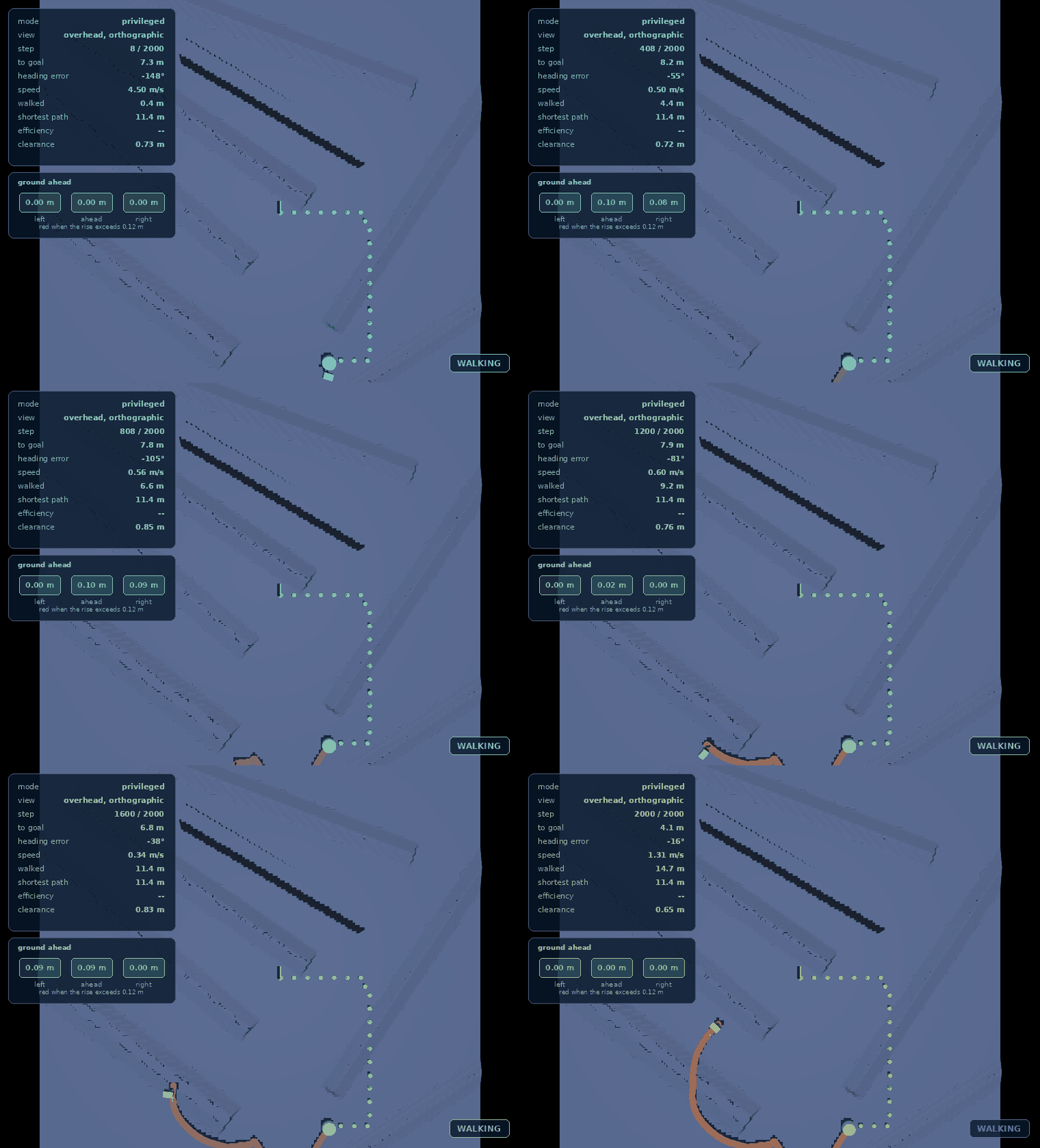
This is the common case. The best arm reaches B in about four episodes in ten, so a reel of successes would misrepresent the lab. This clip is a policy that walks competently into the wrong side of a ridge and times out 4.1 m short — not one that falls over, which would teach nothing about navigation.
The route and track were first painted onto the finished frame, which means projecting world metres to pixels by hand — reimplementing MuJoCo's camera. The hand version was wrong: rendered terrain spanned 591 px where the projection predicted 487. Every route line sat a fifth of a frame from the thing it described.
They are now MuJoCo scene geometry, rendered through the same camera as the terrain, so they cannot disagree at any angle. Two follow-on fixes were needed — the default headlight was bleaching the height field, and emission at 0.85 washed a green marker and an orange one into the same yellow, which is exactly the distinction the figure exists to make.
Scaling it up: a 40 m world
Everything above is a 20 x 20 m arena with 14 ridges and goals 7 m away. The obvious question is whether any of it survives a bigger world, so here is the same experiment at four times the area:
| standard | large | |
|---|---|---|
| arena | 20 x 20 m | 40 x 40 m |
| ridges | 14 | 42 |
| A to B | 7 m | 20 m |
| episode | 20 s | 60 s |
| cost of refusing to climb | mean +5.94 m | mean +13.80 m |
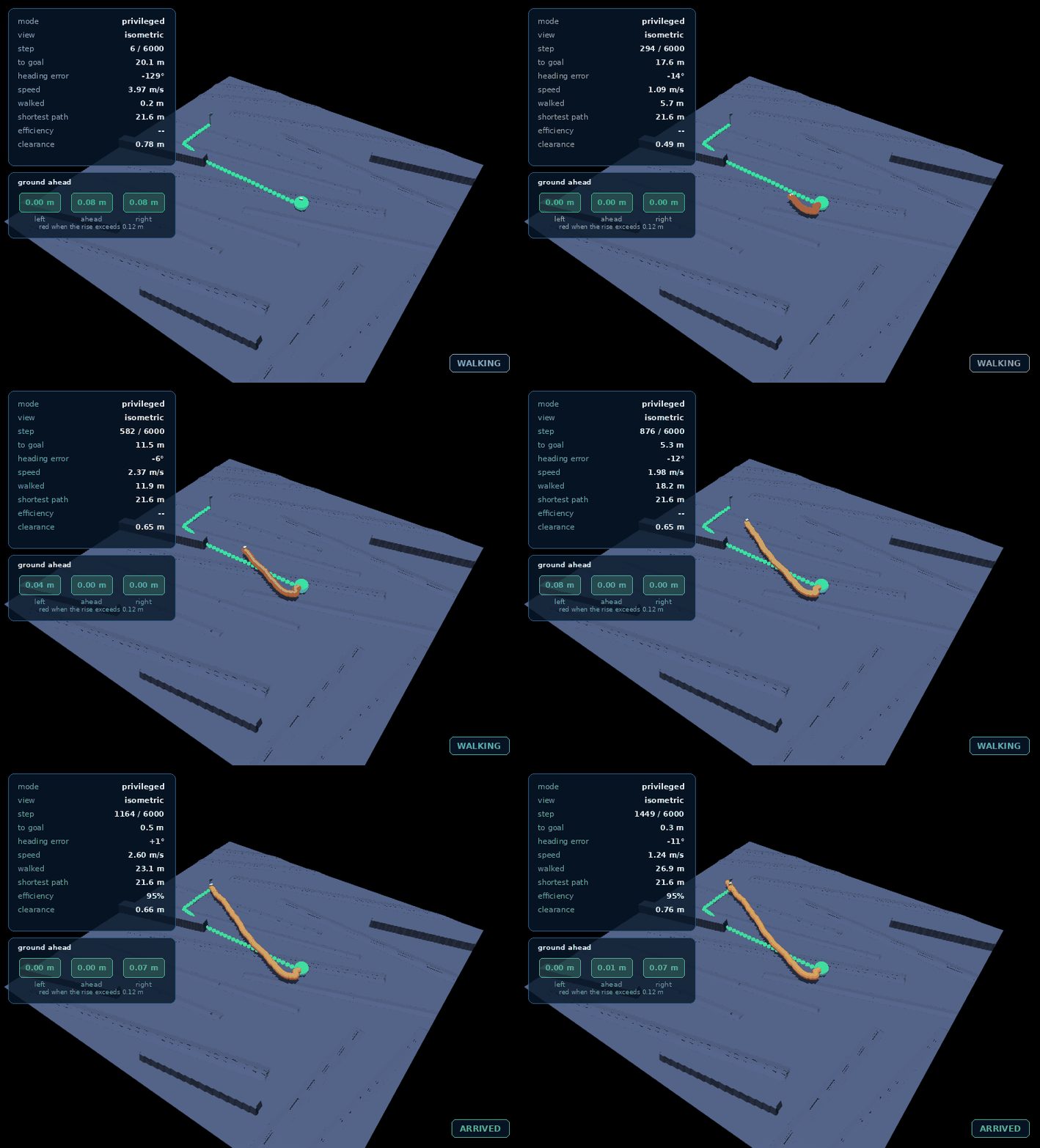
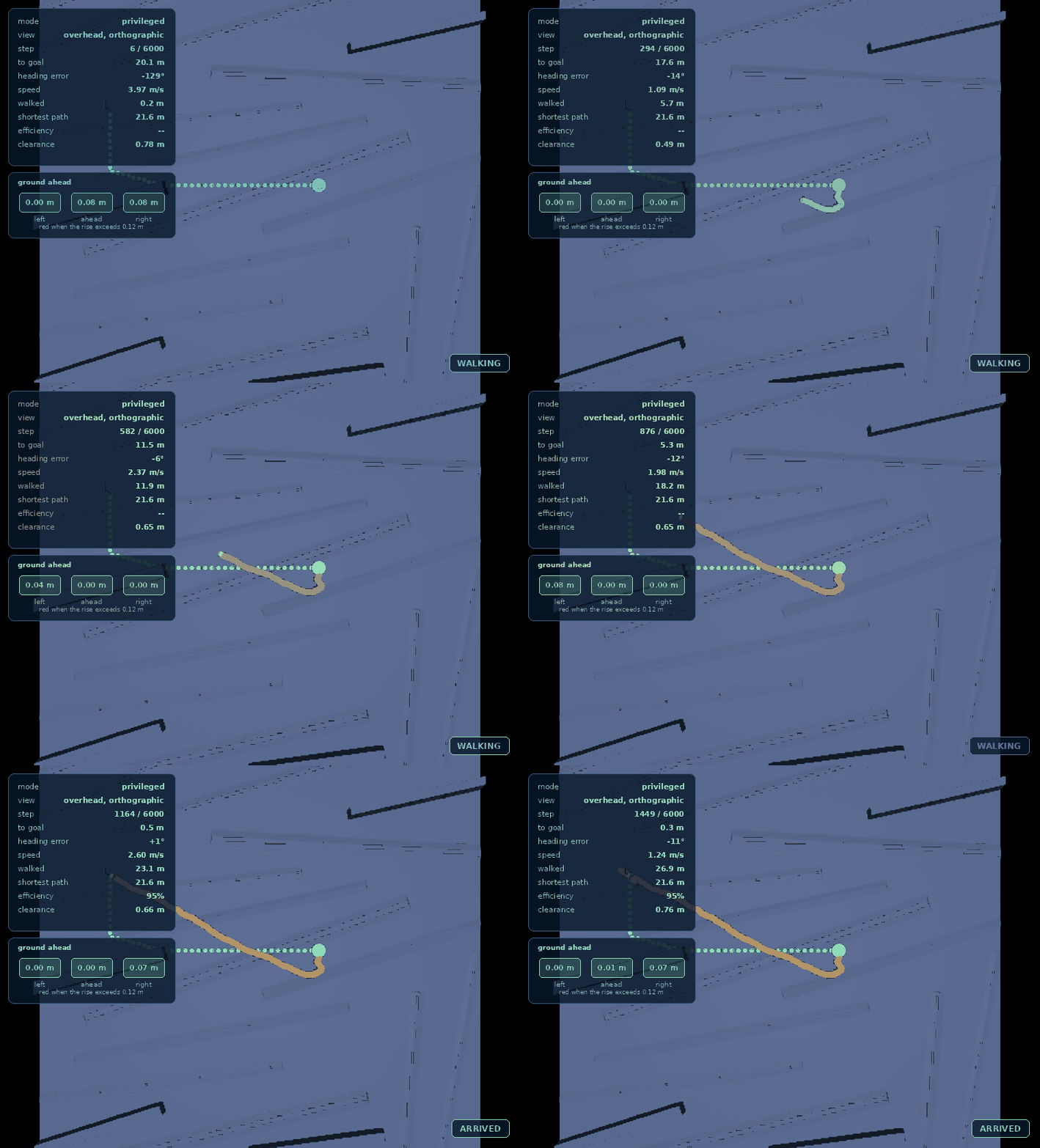
The robot walks 26.9 m against a 21.6 m shortest path — 95% efficient — across an arena three times the width of the one it was originally built for.
What the scale-up shows, and what it does not
It works: the task is learnable at 4x the area. Pooled arrival is 25.0% blind and 30.0% privileged over 60 episodes per checkpoint, and path efficiency is 89–95%, noticeably tighter than the small world's 83%. Nothing about the method broke when the box got bigger.
It proves nothing about the arms. Three seeds per arm, intervals that overlap heavily, and the ordering is the opposite of the nine-seed result above. That is what three seeds buy you. It is reported here as evidence the task scales, not as a comparison.
The routing story is weaker than it looks. Capping the goal at 20 m pulls B back along the oracle's route onto a straight segment, so the detour ratio in these clips is only 1.08 — the robot covers real distance but is not forced into the dramatic go-around the small world's clips show. The uncapped big world has a 1.36 detour ratio, but filming that would mean showing a policy a task it was never trained on, which is the exact mistake documented above. The honest clip is the one the policy was actually trained for.
Three of nineteen arriving episodes scored over 100% efficiency —
one walked 19.8 m where the "shortest path" was 21.6 m. That is not a
measurement bug this time. traversable() blocks a cell when the rise
to any neighbour exceeds 0.12 m, but a physical body can clip the
corner of a ridge the grid forbids, so the oracle is a conservative
lower bound on what the robot can do.
Which is exactly why the min(..., 1.0) clamp had to go. Last time
an impossible number meant a broken denominator; this time it means a
real capability the planner cannot express. Both are worth knowing and
the clamp would have erased both.
What Went Wrong, and What It Taught Us
Building this lab took several attempts, and the failures were more instructive than the result. What they have in common is that none of them crashed. Every one produced plausible numbers, passed the tests that existed at the time, and would have been published as a finding if nobody had looked twice. They are collected here because the same shapes recur in any measurement-heavy project.
The ruler was coarser than the effect. The in-training evaluation
uses 12 episodes, which quantises to 8.3% — so it once reported two
arms as exactly 8.3% versus 8.3%. Everything published here comes
from evaluate.py at 120 episodes, never from the training log. The
peak of a training curve is equally unusable: it is the maximum of
~60 noisy 12-episode evaluations, and selecting on it manufactures an
advantage out of noise.
An impossible number is evidence — do not clamp it. Efficiency was
computed as route / distance, and three episodes came back at 133%,
136% and 144%: a policy beating the optimum, which cannot happen. The
code wrapped the ratio in min(..., 1.0), so every one of them was
silently rewritten to exactly 100%. The clamp did not just hide the
symptom; it destroyed the only signal that the denominator was wrong.
The √2 bug above survived behind it.
A figure and a number that disagree are not a rendering quirk. The
runs never recorded goal_range, so the renderer rebuilt the world
without one and filmed goals at the map's own endpoints — a harder
task than any policy here was trained on. The clips showed the robot
stranded 14 m out beside a table reporting 42% arrival. Each run now
records the task it was trained on, and the renderer reads it.
An asset nothing generates cannot be corrected. One animation on this page had been rendered once by hand and orphaned. When the lab was re-rendered after the frame fix, that file silently survived from the broken world, sitting here beside eight corrected clips and indistinguishable from them. There is now a check that every image these pages show is produced by a shipped command.
What This Lab Does Not Claim
- The task is not solved. The best arm reaches B in about four episodes in ten.
- There is no arrival advantage for terrain information, and the collapse difference between the arms is a trend (p = 0.082), not a result.
- The width-versus-features question is open. Settling it needs roughly 70 seeds per arm; this has nine, and says so rather than picking whichever reading sounds better.
- Every run peaks mid-training and sags. 1.5M environment steps is short for this task, and there may be late instability. The final checkpoint is what is scored; the peak is not, because the peak of ~60 noisy 12-episode evaluations is max-of-noise and selecting on it would manufacture an advantage.
- This is a privileged channel, not a camera. A depth arm would need distillation, as in lab 3.
- Four privileged seeds of nine failed outright, and all four stay in the table.
Running It
cd 07_physical_ai/04_terrain_navigation
uv sync

uv run world.py --check 200         # are the maps solvable, and do they detour?
uv run robot.py                     # the body, dropped on a map
uv run nav_env.py                   # random baseline

uv run train_nav.py --flat --name gate_flat   # the LOCOMOTION GATE, first

# three arms, nine seeds. blind and privileged are the experiment;
# padded is the control that makes the comparison interpretable at all.
for s in 0 1 2 3 4 5 6 7 8; do
  for m in blind privileged padded; do
    uv run train_nav.py --mode $m --seed $s --goal-range 7 --name nav5_${m}_s$s
  done
done

uv run evaluate.py --prefix nav5_ --episodes 120   # the published numbers
uv run make_figures.py && uv run render.py --all
--flat comes first and is not part of the experiment. It removes the
terrain and asks only whether the body can walk to a point and turn to
face it. If that fails, nothing measured on rough ground means anything
— and it did fail, twice, before the position-actuator and start-pose
fixes.
uv run ../../tests/test_terrain_navigation.py # 18 checks, no GPU
References
- Schulman et al., PPO, 2017 · GAE, 2015
- Lee et al., Learning quadrupedal locomotion over challenging terrain, Science Robotics 2020
- Miki et al., Learning robust perceptive locomotion, Science Robotics 2022
- Agarwal et al., Deep RL at the Edge of the Statistical Precipice, NeurIPS 2021 — why a handful of seeds and a mean are not enough
- MuJoCo height fields