Aerial Stabilization
machine as the constraint; this one changes the machine to one that leaves the ground, where the budget is propellant rather than time. ← previous topic: Physical AI · next: Barrel Roll →
Every section opens with a plain words box like this one. Read only those and you will get the whole story; the technical detail underneath is there if you want it.
The one line version: we rebuilt the Tesla Roadster thruster stunt as real physics, taught a computer to fly it, and it lands 89 times out of 100 on a quarter of the fuel an engineered controller needs.
Baseline: a classical PD attitude controller with a thrust allocator — no learning — scored on the same held-out throws. Budget: 4M environment steps, 16-process pool, seed 0, RK4 at 2 ms, ~55 minutes on 20 CPU cores. No GPU. Falsifier: if thruster COUNT is what matters, clean-landing rate is monotone in nozzle count. It looked monotone, and then it wasn't — see Does adding more thrusters help?.
A 2-tonne car is thrown into the air tumbling. It has about three seconds of flight, ten cold-gas nozzles, and a tank holding seven seconds of hover. It has to arrive on its wheels.
How this lab works
One task, two controllers, scored on the same held-out throws. The comparison is the lab: a textbook controller written by hand against a policy that was told nothing but its score.
Nobody writes down which nozzle to open. PPO starts from random weights, crashes four million times, and hears only a number saying how that attempt went. It ends up beating the engineered controller on a quarter of the propellant — which on a vehicle carrying seven seconds of hover is the whole game.
Motivation
Tesla showed a car doing a stunt: drive upside down along a ramp, fire thrusters, spin in mid air, land on its wheels. It was one video clip. We rebuilt it as real physics so the thing can actually be tested, and then taught a computer to fly it.
Tesla revealed the Roadster on 15 October 2026 at SpaceX's McGregor site: the car drove inverted along a ramp held by fan suction, then made a thruster-powered hop with a mid-air rotation and landed on its wheels. Reported: roughly 10 nozzles, ~600 L of compressed gas in carbon-fibre overwrapped pressure vessels.
It was one clip — no repeatability, no sustained flight, no independent measurement. Everything below except those three numbers is a stated engineering assumption. This is a physics sandbox motivated by the reveal, not a reconstruction of anyone's hardware.
Checking the simulator before trusting it
Before training anything, we check the simulated world obeys the laws it is supposed to: energy and momentum have to be conserved, fuel burned has to match fuel spent. This caught five mistakes. None of them would have shown up in the training results, because a learning curve looks just as convincing when the world is wrong.
uv run verify.py measures residuals against the equations the lab
claims to solve, and prints them rather than printing the word "passed":
| check | residual | scale | relative |
|---|---|---|---|
| control effectiveness matrix vs MuJoCo's applied wrench | 0.0014 N | 15.7 kN | 8.8e-08 |
Newton, M·a_com = F + M·g, mass dropping | 0.85 N | 20.6 kN | 4.1e-05 |
| angular momentum about the system CoM, ballistic | 0.011 kg·m²/s | 3,271 | 3.3e-06 |
| energy, ballistic in vacuum | 0.0006 J | 8.1 MJ | 7.1e-11 |
propellant, Δm = ∫ G_t·A_t dt | 2.3e-13 kg | 292 kg | 7.8e-16 |
impulse, Σ m·Δv = ∫ F dt | 27 N·s | 77.6 kN·s | 3.4e-04 |
| tank pressure vs CoolProp over the blowdown | 0.022% | — | 2.2e-04 |
Five defects were found this way, two of which had already been published. A learning curve cannot find any of them — it rises just as happily against a broken simulator, and the policy exploits whatever you built rather than whatever you meant.
How much gas actually fits
Squeezed to 10,000 psi, air stops behaving like the textbook says. We had guessed at the correction and were 22% wrong about how much fuel the car carries. We now use a reference physics library instead of a guess.
The first version picked a compressibility of 1.95 by hand because it made the arithmetic come out. CoolProp's reference equation of state disagrees:
| model | Z at 689 bar, 293 K | mass in 600 L |
|---|---|---|
| ideal gas | 1.000 | 475 kg |
| van der Waals | 1.463 | 325 kg |
| a hand-picked Z | 1.950 | 244 kg ← shipped, wrong |
| CoolProp (Span–Wagner) | 1.602 | 297 kg |
The ideal figure is denser than liquid nitrogen (807 kg/m³), which should have been the tell. Tables are now generated from CoolProp and committed; interpolation error over the operating envelope is 0.001% mean.
The thrusters get weaker as they fire
Emptying a pressurised tank makes it cold, and cold gas pushes less hard. Thrust efficiency drops about 40% from full to empty, then falls off a cliff. Treating it as a constant overstated the fuel budget by 27%.
The tank cools as it drains — the blowdown is isentropic — and a cold tank holds less pressure. Effective exhaust velocity falls with it:
| gas left | tank | T | p_c | Isp | thrust |
|---|---|---|---|---|---|
| 297 kg | 689 bar | 293 K | 40 bar | 60.6 s | 100% |
| 178 kg | 193 bar | 228 K | 40 bar | 49.2 s | 101% |
| 89 kg | 67 bar | 184 K | 40 bar | 45.7 s | 103% |
| 53 kg | 38 bar | 168 K | 32.7 bar | 44.4 s | 82% |
| 15 kg | 11 bar | 153 K | 9.2 bar | 36.0 s | 18% |
Thrust rises to 103% mid-burn — colder gas is denser at the throat, so mass flux gains more than vₑ loses while the regulator holds — and then falls off a cliff when the regulator drops out. Total impulse integrated along this path is 139 kN·s; a constant-vₑ model claims 176, a 27% overstatement.
The same thruster works better on Mars
A rocket nozzle fights the air pressure around it. Mars has almost none, so identical hardware gets about 9% more push there for free.
It takes nitrogen below its 63.15 K triple point. The nozzle uses a real
area ratio with the (pₑ − pₐ)·Aₑ term, which also shows that Earth has an
optimum area ratio and Mars does not — and that the same hardware gets
Isp 65.8 s on Mars against 60.6 s on Earth, purely from ambient pressure.
The simulated car was the wrong car
As fuel burns the car gets lighter, and we updated the weight but not the balance point. The simulator was quietly modelling a vehicle that does not exist, and the policy spent its first full training run learning to fly it.
The worst defect, and invisible from outside. Gas mass was written into
body_mass as it burned, but not into body_subtreemass — and MuJoCo
divides by that to obtain subtree_com, about which the entire
composite-rigid-body dynamics are expressed. Angular momentum drifted
3.1e-02 in a ballistic tumble where it is exactly conserved. Fixed:
3.5e-07, a factor of 89,000. The policy had been training against a
vehicle that does not exist.
Choosing the maths solver
Simulators step forward in time using an approximation, and there are several to choose from. The fast one is right for a walking robot that is always touching the ground. A flying car needs the accurate one, or the simulated spin slowly drifts and the car learns to correct a problem that is not real.
Measured on a 4 s tumble in vacuum with zero contacts:
| integrator | dH/H | dE/E | steps/s |
|---|---|---|---|
| Euler | 1.07e-02 | 8.74e-05 | 144,000 |
| implicitfast | 1.07e-02 | 8.74e-05 | 137,000 |
| implicit | 1.00e-02 | 1.09e-04 | 110,000 |
| RK4 | 4.19e-07 | 1.84e-10 | 39,000 |
Topic 7 adopted implicitfast after measuring it 3.9× faster on a legged
robot — correctly, for a machine with feet on the ground every step. This
vehicle is ballistic for most of its episode, the energy-conserving case
RK4 is for. A 1% momentum drift per four seconds is not a rounding error
on a task whose entire content is arresting a tumble: the policy would
spend propellant cancelling the integrator. RK4 costs 4× end to end
(5,700 → 1,300 steps/s) and is worth it.
A perfectly insulated tank freezes itself
If no heat leaks into the tank, the gas gets so cold while emptying that it turns to liquid inside. Our equations only describe gas, so the model now refuses that case loudly instead of returning a confident wrong answer.
At β = 0 — perfect insulation — the tank crosses the saturation dome below
about 60 kg remaining and nitrogen condenses inside it. The single-phase
tables do not describe that, so gas.blowdown_T refuses it rather than
interpolating across the dome and returning a plausible pressure. The
default β = 0.30 keeps 54 K of superheat margin.
The result
We trained the controller for 4 million practice steps, about an hour on an ordinary laptop processor. It lands 89 times out of 100, against 75 for a conventional engineered controller, and it does it on a quarter of the fuel. The fuel margin is the valuable part: the car only carries about seven seconds of thrust.
96 held-out throws, rig reveal, Earth, rolling terrain:
| clean landings | sink | tilt | gas used | |
|---|---|---|---|---|
| classical PD + allocator | 75% | 0.17 m/s | 1.6° | 147 kg |
| PPO, 4M steps | 89% [81, 94] | 0.01 m/s | 1.2° | 36 kg |
PPO beats the textbook controller and uses a quarter of the propellant. On a vehicle with seven seconds of hover in the tank, that margin is the whole game. The classical controller holds a commanded descent rate the whole way down, which means firing continuously; the learned policy coasts, then catches itself late.
All four landings, one continuous film → (1000 x 560, 197 frames.) It is linked rather than embedded because it is the right artefact for studying a policy frame by frame and the wrong one to load into a page. The four short clips below are inline.
Every frame is MuJoCo rendering the same state the policy acted on. The arrows are real quantities at a stated scale — net thrust, weight, angular momentum, velocity — and the panel reads tank pressure and temperature, compressibility, superheat margin, chamber pressure, live Isp, nozzle exit temperature against the freezing point, and thrust fraction.
The same four landings, one at a time
The film above runs all four throws together. Here they are separately, in case one is easier to watch than four. Each is a different random tumble off the ramp, and the policy has never seen any of them.
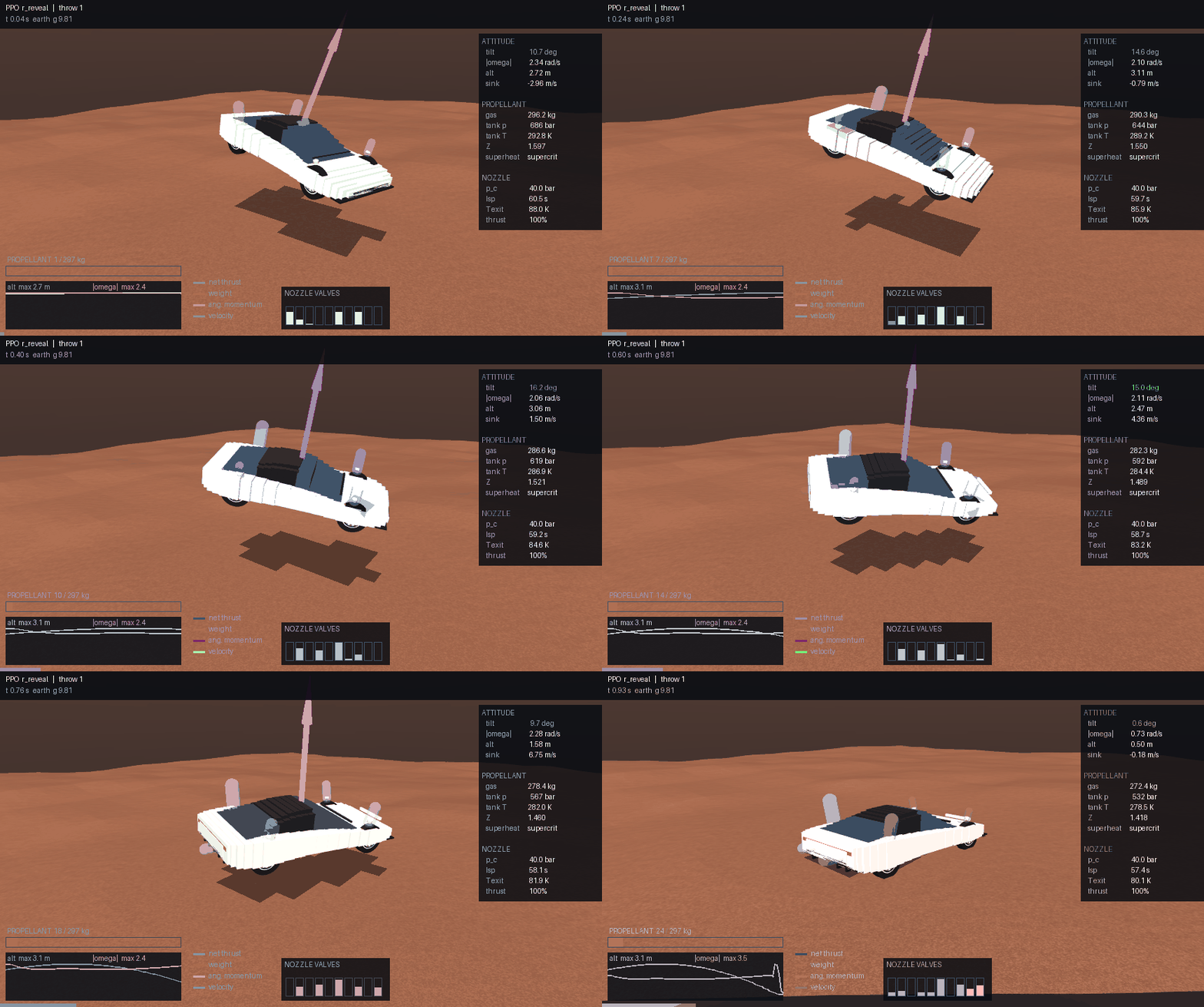
Throw 1 — 0.93 s, 24 kg of gas. Higher resolution →
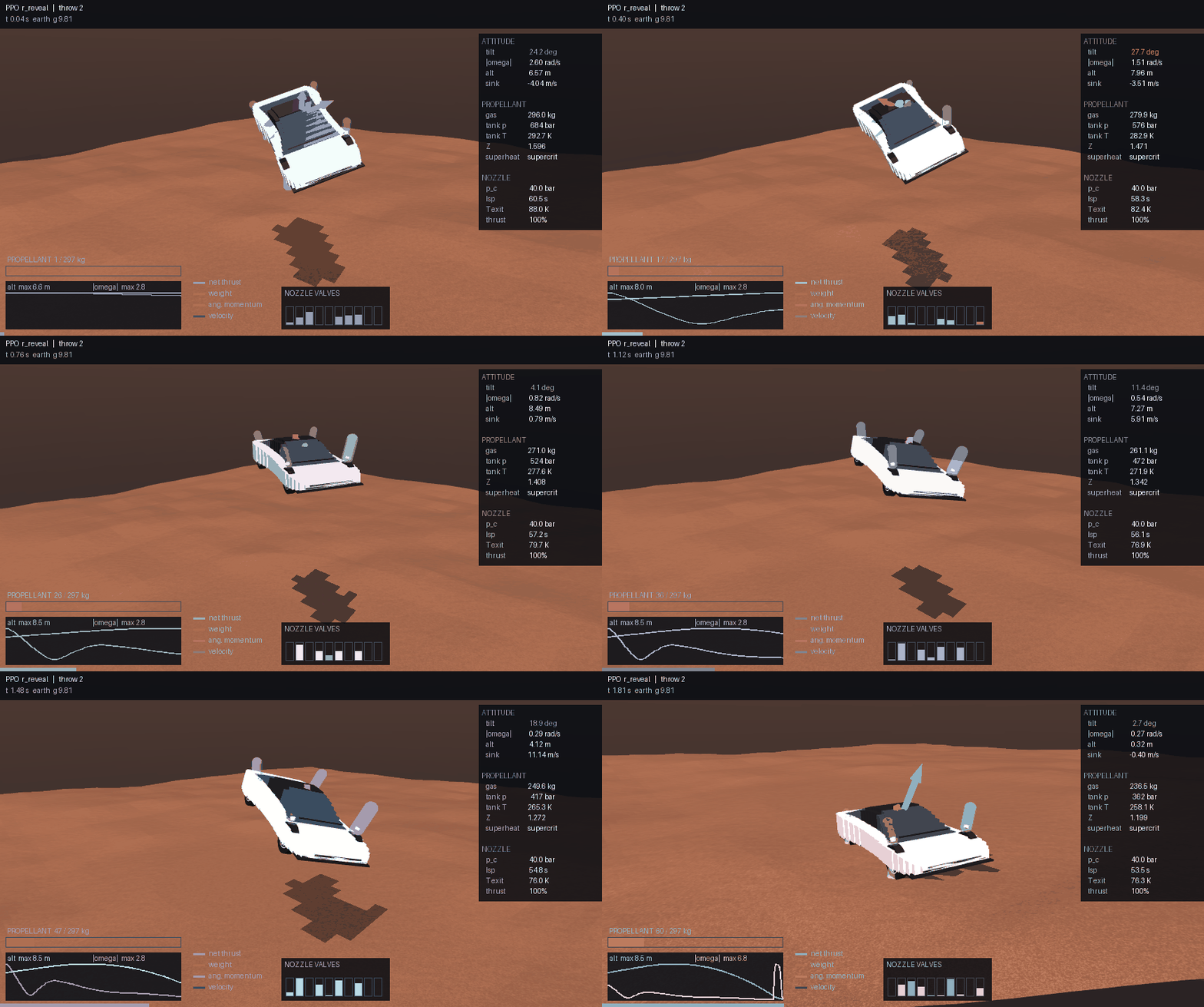
Throw 2 — 1.81 s, 60 kg. The hardest of the four: it arrives higher and has to come a long way down. Higher resolution →
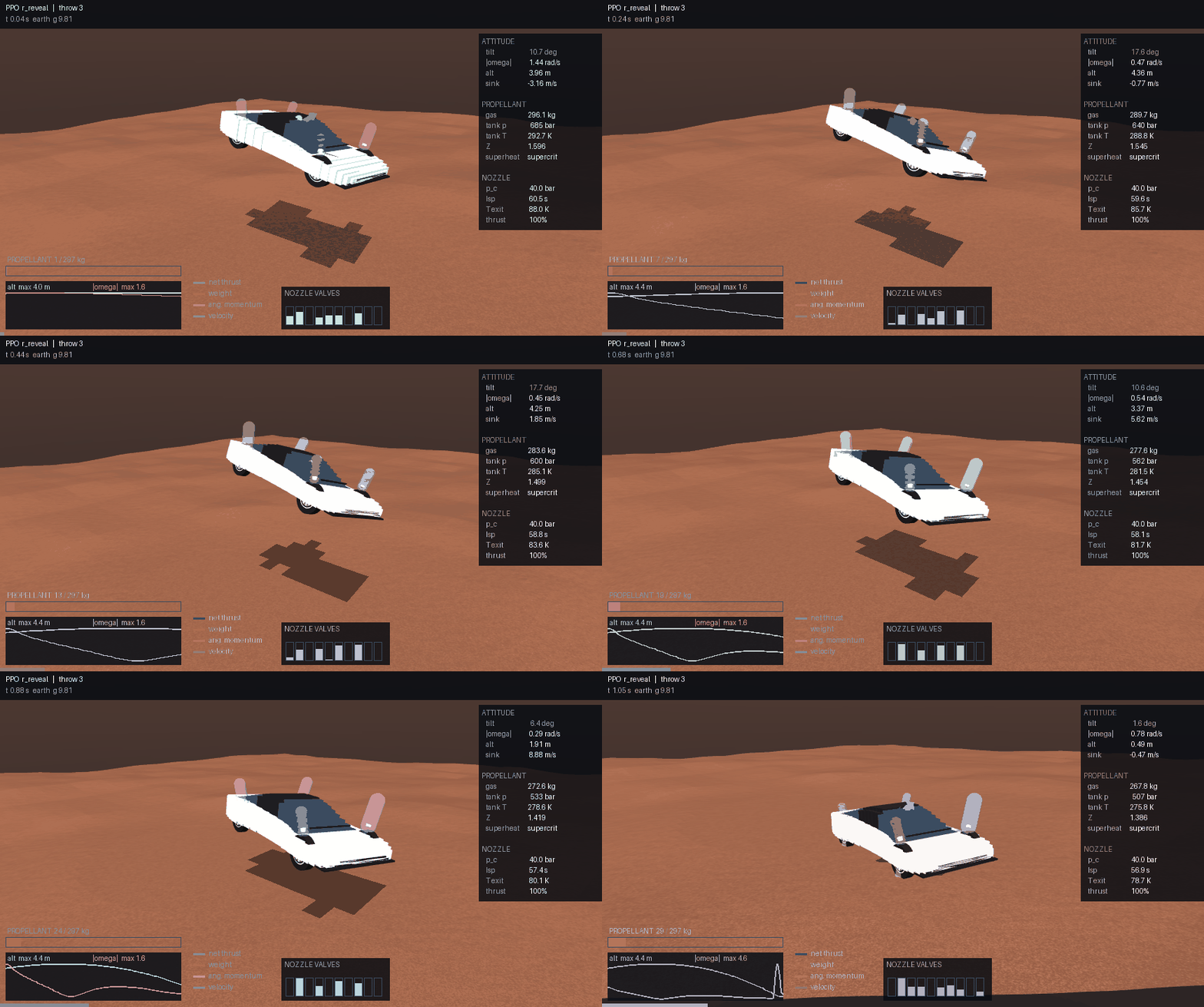
Throw 3 — 1.05 s, 29 kg. Higher resolution →
Throw 4 — 0.89 s, 25 kg. The cheapest: it starts nearly level, so there is little to undo. Higher resolution →
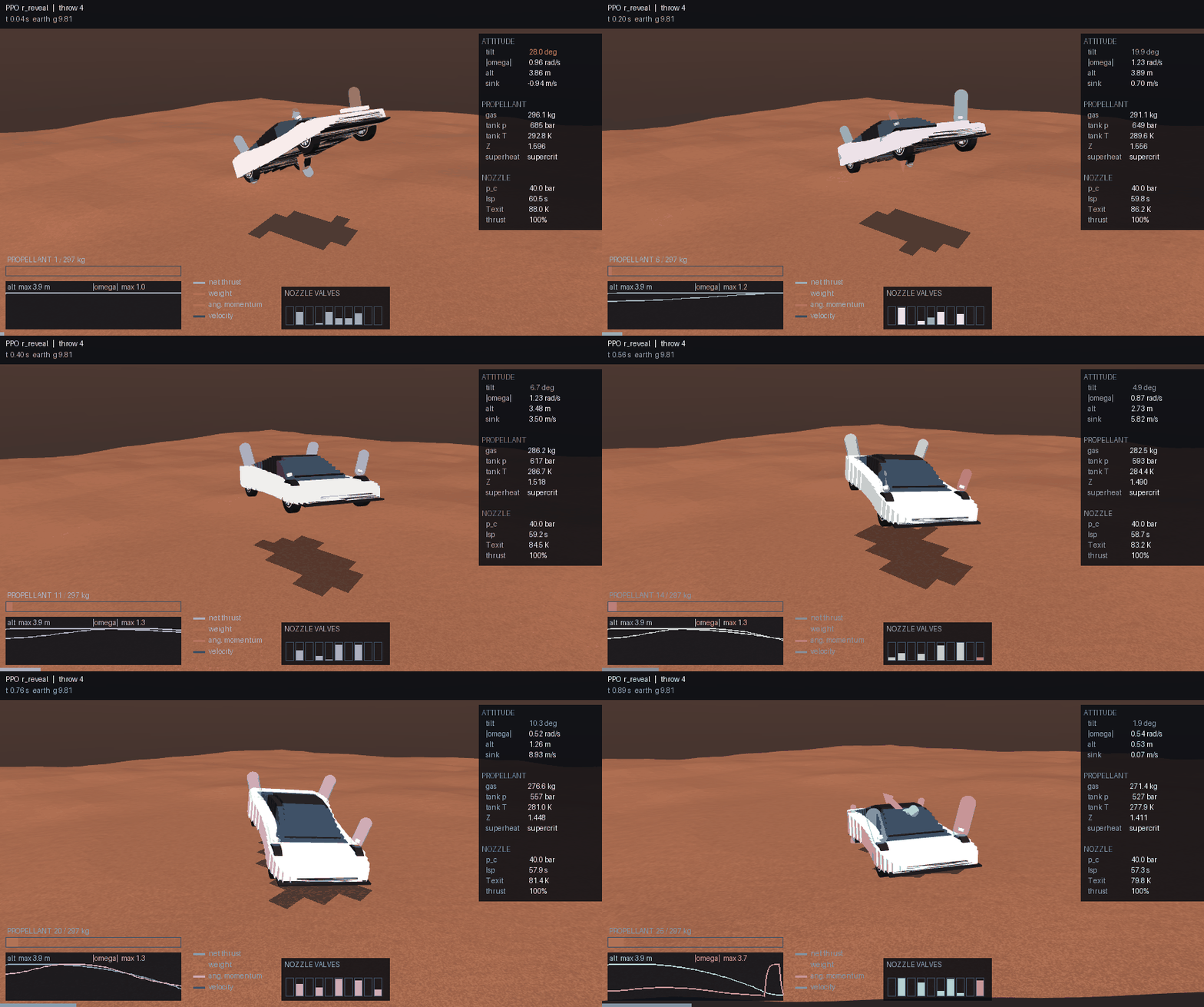
Watch the nozzle valve bars at the bottom. The policy fires hard early to kill the spin, then shuts almost everything off and falls, then catches itself at the end. That coasting middle is where the fuel saving comes from, and nobody programmed it.
How it learned, and where it got stuck
Partway through training the car found a loophole. It learned to stop crashing by simply never landing: hover until the clock runs out, collect the safety points, take no risk. It sat there for 600,000 practice steps. That was our fault, not its own, and fixing the scoring fixed the behaviour.
| steps | crashes | landings | what it had learned |
|---|---|---|---|
| 60k | 97% | 0% | nothing |
| 370k | 33% | 0% | how to stop tumbling |
| 680k–1.3M | 0% | 0% | how to never land |
| 1.6M | 2% | 14% | that the ground is survivable |
| 4M | 0% | 89% | the task |
For 600k steps the policy sat at a zero percent crash rate and a zero percent landing rate. It had discovered hovering — not a bug, but the correct answer to a reward that paid for being upright and alive and priced a timeout at −10 against a crash's −60.
Fixed by repricing the timeout to −40 and adding potential-based shaping on altitude, Φ = −2.5·h + 3·cos θ. Ng, Harada & Russell's result is that γΦ(s′) − Φ(s) leaves the optimal policy provably unchanged while still indicating which way is down — the reason to use that shape rather than a "descend!" bonus, which changes what optimal means and can be collected by diving into the ground. A first attempt at weight 0.9 failed differently: landings fell 1.0% → 0.0% over 550k steps while crashes fell 98% → 2%.
The plateau reproduced exactly after the physics was corrected, which is what makes it a property of the reward rather than an artifact.
What we were actually paying it for
You score the car to teach it what good looks like. We measured where the points actually came from, and the surprise was that the penalty for wasting fuel contributed nothing at all, yet the car is four times more frugal than the engineered controller. It became efficient without being told to.
A reward is a list of terms with weights, and reading the weights tells you
almost nothing: a large coefficient on a quantity that barely moves
contributes nothing, and a small one on something that moves a lot
dominates. The only way to know is to integrate each term over episodes the
trained policy actually produces — uv run evaluate.py runs/r_reveal --reward-audit:
| term | per episode | share |
|---|---|---|
| terminal (landed or crashed) | +56.67 | 74% |
| shaping (altitude potential) | +17.59 | 23% |
| upright | +2.35 | 3% |
| spin · alive · dive · gas | −0.15 combined | under 1% |
Three knobs moved across two redesigns, and they were not the same kind of change. Pricing a timeout at −10 against a crash's −60 said running out the clock is six times better than touching the ground, and paying 0.20 per step merely for existing said delay is fine. Those were wrong statements of the goal, not missing guidance — the policy believing them is the system working. Only the altitude term is shaping, and it is the safe kind: potential-based, so it provably cannot change which policy is optimal, only how findable it is.
The propellant penalty contributes 0.0% of the reward, and the policy still flies on a quarter of the baseline's gas. Efficiency was never paid for. It fell out of "land soon and land softly" — the terminal bonus plus the altitude potential. If you want frugal behaviour, you may not need a frugality term; you may just need to stop paying for delay.
Does adding more thrusters help?
No. We tested nine thruster layouts and expected more to be better. What actually matters is which direction they point. A car with 12 thrusters that can brake beats one with 18 that can only push forward.
Not what was predicted. The falsifier was written first: if count is what matters, the rate is monotone in nozzle count. Read the first five rows in count order — 66, 69, 75, 78, 100 — and it is monotone. The hypothesis carried over from topic 7, "placement beats count", does not survive its own test.
Then the controls arrived. dense was the only rig with forward-firing
nozzles, so its 20-nozzle count was confounded with a capability nothing
else had — two variables moved at once, which is the ablation failure
topic 7 wrote a rule about. dense8 is dense without the fore pair;
fore10 is reveal with one:
| rig | N | rank | braking / weight | landed | 95% CI |
|---|---|---|---|---|---|
| waisted | 6 | 5/6 | 0.00 | 16% | [9, 26] |
| minimal | 6 | 5/6 | 0.00 | 66% | [53, 76] |
| sixlift | 8 | 5/6 | 0.00 | 69% | [57, 79] |
| narrow | 10 | 6/6 | 0.00 | 67% | [55, 77] |
| reveal | 10 | 6/6 | 0.00 | 75% | [63, 84] |
| wide | 14 | 6/6 | 0.00 | 78% | [67, 86] |
| dense8 | 18 | 6/6 | 0.00 | 83% | [72, 90] |
| fore10 | 12 | 6/6 | 1.16 | 98% | [92, 100] |
| dense | 20 | 6/6 | 1.16 | 100% | [94, 100] |
Perfect separation, and count has nothing to do with it. Every rig that can brake lands ≥ 98%; every rig that cannot tops out at 83%. A 12-nozzle rig beats an 18-nozzle one by 15 points. The apparent monotonicity was an artifact: the two rigs that happened to carry fore nozzles sat at counts 12 and 20, and 20 was the largest in the table.
Every layout, turning, captioned with what it cannot produce →
Side by side, reveal and dense8 look like healthy rigs and neither can
produce any backward force at all.
Why the standard engineering check fails
Engineers have a standard test for whether a set of actuators can control a vehicle. It quietly assumes each one can push and pull. A thruster only pushes. So a layout can pass the test with full marks and still be unable to slow down, which is exactly what happened.
reveal is rank 6 and can produce exactly zero backward force. Every
horizontal nozzle on it pushes the same way: it can accelerate and it
cannot brake. The throw hands the car up to 6 m/s of downrange velocity,
and it arrives still carrying it.
Rank asks whether the six wrench axes are spanned when coefficients may be any real number — including the negative ones that mean firing a nozzle backwards. A nozzle cannot do that. Commands are box-constrained to [0, 1], so the achievable set is
a convex polytope, not a subspace. Full rank is necessary and nowhere
near sufficient. This lab shipped rank as its headline hardware metric
and it was wrong; thrusters.py now reports the signed reach on every
axis and names the directions a rig cannot produce at all.
The other end of the table is the same lesson: waisted has the same six
nozzles as minimal and scores 16% against 66%, because it has no
fore-aft lever arm and therefore no pitch torque in either direction.
Better hardware, slower learning
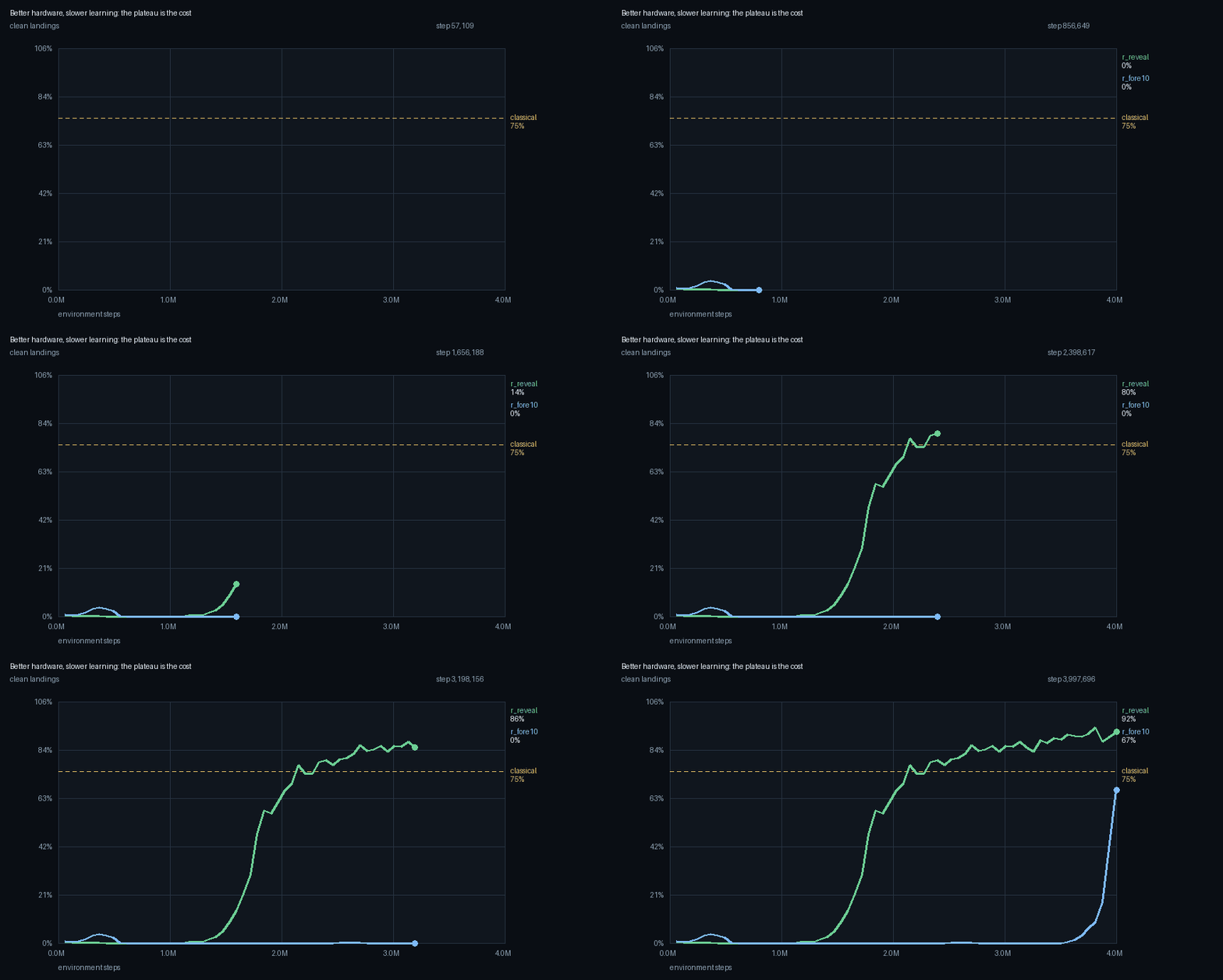
The car with braking thrusters is better hardware, and the engineered controller shows it: 98% versus 75%. But when we trained from scratch on both with the same time budget, the better car finished no better. Extra ability is also extra things to work out.
The classical controller does no exploration, so it reads the hardware
directly: fore10 beats reveal 98% to 75%. Give the same two rigs to
PPO at an identical budget, seed and configuration — one variable, the
rig — and the ordering reverses:
| escapes the plateau | held-out | 95% CI | gas | |
|---|---|---|---|---|
reveal — 10 nozzles, cannot brake | 1.47M steps | 89% | [81, 93] | 36 kg |
fore10 — 12 nozzles, can brake | 3.75M steps | 83% | [75, 89] | 235 kg |
Two extra nozzles cost 2.5× the steps to escape the hover plateau.
fore10 got out with 250k steps left and had not converged: it lands
almost as often and spends six and a half times the propellant doing
it, which on a seven-second tank is the difference between a margin and
none.
The intervals overlap, so the honest statement is not "reveal is better".
It is: the better hardware bought no measurable learned performance at
this budget, and cost 2.5× the exploration. A larger action space is a
larger space to search, and capability you cannot afford to find is not
capability yet.
Both runs are a single seed. Topic 7's first lab exists to make the point that one seed proves nothing, and plateau exit is exactly the kind of event that varies between them. The rig finding above rests on the classical sweep — a deterministic controller over 64 held-out throws per rig with Wilson intervals — not on these two runs.
An artefact worth knowing when reading the curve: the in-training trace
samples actions, so it carries exploration noise, while the held-out
evaluation uses the distribution mean. fore10's training trace reads 0%
at 3.2M while its deterministic policy was already landing — the noise
was masking a policy that had learned.
What is in the simulation, and what is not
The short version: the flying, the contact, the thermodynamics of the fuel and the nozzles are all modelled properly. The exhaust blowing dust around and the car bending under load are not, and the list below says so rather than leaving you to find out.
6-DOF rigid-body flight · real-gas tank blowdown from CoolProp tables, isentropic with a wall-return blend · an isenthalpic regulator · a real-gas converging-diverging nozzle whose throat is found as the maximum of mass flux along the isentrope · flow separation at pₑ < 0.4 pₐ · saturation refusal · 25 ms valve lag and 10 ms transport delay · mass and inertia that shrink as gas leaves (297 kg of 2047 is 15%, and roll inertia moves more than mass because the tanks sit outboard) · wheel contact and hull strikes · Earth or Mars, with gravity, air density and ambient pressure travelling together.
Not modelled, and said rather than hidden: plume impingement on the ground, boundary-layer and divergence losses beyond a flat 0.92 velocity efficiency, tank wall heat transfer as anything but the β blend, structural loads, suspension travel beyond MuJoCo's contact solver, and two-phase flow anywhere.
Why not a game engine
The animations are drawn by the physics simulator itself, not by separate animation software. If the picture came from somewhere else it could show the car doing something the physics never did, which is a mistake this course has made before.
A renderer that is not the simulator can show a car doing something the
physics never did, and this course has paid for that once already. Every
frame here is MuJoCo drawing the same MjData the policy acted on. The
cosmetics went into the model — a 24-slice lofted hull, glass, wheels with
rims and brake discs, a bell at every nozzle — and the loft carries no
mass, which the suite pins at exactly 1750 kg after it once added 394 kg
nobody chose.
What transfers
| A learning curve cannot audit your physics | it rises just as happily against a broken simulator |
| Full rank is not reachability | unidirectional actuators make a polytope, not a subspace; a rank-6 rig could not brake |
| An ablation is only an ablation if one thing moved | dense confounded 20 nozzles with a thrust direction nothing else had |
| Report residuals, not verdicts | a tolerance nobody can see is a tolerance nobody checked |
| The ideal gas law fails where the pressure is interesting | it claimed a tank denser than liquid nitrogen |
| Derived state must be maintained, not just set | body_mass without body_subtreemass simulates a different vehicle |
| A reward with no cost for stalling will be stalled | 600k steps at a 0% crash rate and a 0% landing rate |
| Capability you cannot afford to explore is not capability | the better rig took 2.5x the steps to leave the plateau and finished no better |
| The right integrator is a property of the system, not a preference | the same measurement reversed topic 7's answer |
Prior work — the method here is not ours
Reinforcement learning for attitude control of a thrust-vectored vehicle is established, and one of these papers describes almost exactly this lab's opening scene.
| Hwangbo, Sa, Siegwart & Hutter (2017), Control of a Quadrotor with Reinforcement Learning · arXiv:1707.05110 | A neural policy maps state straight to actuator commands with no predefined control structure, and stabilises a quadrotor thrown upside-down into the air at 5 m/s. That is this lab's task with rotors instead of nozzles. |
| Schulman, Wolski, Dhariwal, Radford & Klimov (2017), Proximal Policy Optimization Algorithms · arXiv:1707.06347 | The algorithm every arm in topic 8 optimises. |
| Schulman, Moritz, Levine, Jordan & Abbeel (2015), High-Dimensional Continuous Control Using GAE · arXiv:1506.02438 | GAE(λ), which supplies the advantage. |
| Gaudet, Linares & Furfaro (2018), Deep RL for Six Degree-of-Freedom Planetary Powered Descent and Landing · arXiv:1810.08719 | RL for powered descent — the task family topic 8 sits in. |
Control allocation — turning a desired wrench into individual actuator
commands — is classical aerospace engineering and long predates any of this.
The thrusters.py rig audit solves it as a linear program, which is textbook.
What this lab adds
A propellant comparison against a tuned classical controller on the same
hardware: PPO lands 89% against the PD controller's 75% and uses 36 kg of
gas against 147. The policy was never rewarded for efficiency — it falls out
of "land soon and land softly", which the reward audit in evaluate.py
confirms by integrating each reward term over real episodes. The
one-quarter-the-fuel result is the part worth carrying; the method is
Hwangbo's.
Where this goes next
Three things carry forward. The audit: every number above sits downstream
of an integrator, and verify.py found five defects no learning curve
could have, including a simulation whose centre of mass was wrong for an
entire round of training.
The reachability result, which generalises past thrusters. Any actuator that only pushes one way, a tendon or a jet or a muscle, makes the achievable set a polytope rather than a subspace, and the usual linear algebra health check cannot see the difference.
And the gap between the two rankings. The hardware the classical controller prefers is not the hardware the learner does best with, at a fixed budget. Capability enlarges the search space that has to find it.