Thruster Failure
this one breaks it mid-air and asks whether the policy can tell. ← previous: Fly on Mars · next: Learned Dynamics →
Every section opens with a plain words box like this one. Read only those and you get the whole story; the technical detail underneath is there if you want it.
The one line version: a two-tonne car is thrown into the air and a thruster breaks on the way down. A controller that practised with broken thrusters lands 89 times in 100; one that never saw a breakage manages 72.
Baseline: a PPO policy trained on the identical task with no failures in
it, scored on the same broken-thruster landings. 72% across two seeds.
Budget: 2.5M steps to learn the clean landing, then 2.5M warm-started with
a failure in every episode. reveal rig, Earth, two seeds, best checkpoint.
~35 min per run on 20 CPU cores. No GPU.
Falsifier: if a cheap static authority check told you which failures are
survivable, the policy's landing rate should split on it. It does not split
at all — see The geometry does not predict the flight.
A two-tonne cold-gas car is thrown into the air tumbling. It has six seconds and 297 kg of nitrogen to arrive on its wheels. Somewhere between 0.5 s and 3.0 s, one of its ten nozzles breaks.
A car with gas thrusters is thrown into the air and has to land itself. Part way down, one of the thrusters breaks — either it stops working, or it jams fully on and cannot be switched off. We trained a computer to fly it, and asked whether practising with broken thrusters actually helps.
How this lab works
Two policies on the identical broken-thruster task. One practised with failures; one never saw a failure until the day it was scored.
A nozzle either goes dead or jams fully on and cannot be shut off, which is the harder case. Both arms are scored on the same failures. Practice is worth 17 points — and a cheap static check of whether the remaining nozzles could hold the car up does not predict which flights survive, which is the lab's second and less comfortable finding.
Result
It works, and practice matters a lot. A controller that trained with broken thrusters lands 89 times out of 100. An identical controller that never saw a breakage — but is just as good at normal landings — manages 72. It also lands faster and on a quarter of the fuel.
PPO trained with in-flight failures lands 89% of broken-thruster descents, against 72% for a policy that never saw one. Both arms are scored on the same 128 held-out launches, and the failure is drawn from the seed, so the two policies meet exactly the same breakages on exactly the same throws.
| arm | landed | 95% CI | propellant |
|---|---|---|---|
| robust (pooled, 2 seeds) | 89% (227/256) | [0.84, 0.92] | 21 kg |
| healthy (pooled, 2 seeds) | 72% (185/256) | [0.66, 0.77] | 37–73 kg |
Paired, seed by seed, on identical failures:
| pairing | only robust lands | only healthy lands | McNemar |
|---|---|---|---|
| seed 0 | 42 | 10 | p = 9.1 × 10⁻⁶ |
| seed 1 | 15 | 5 | p = 0.041 |
Both seeds significant, same direction. The per-seed spread is wide on the healthy arm — 59% and 85% — which is why the pooled figure and the paired test are both reported rather than one flattering seed.
Film: the same failure, twice
▶ Robust policy — three failures, three landings (15 MB)
▶ Healthy policy — the same three failures, three crashes (21 MB)
Identical seeds, identical breakages. In the HUD: the fault panel names the nozzle, the mode and the second it broke; the nozzle strip draws the broken one in red at what it is actually doing rather than what was commanded; and the attitude ball shows tilt against the 25° landing gate. Watch nozzle 9 latch open at 0.72 s and the healthy policy go past 50° of tilt while still commanding a normal descent.
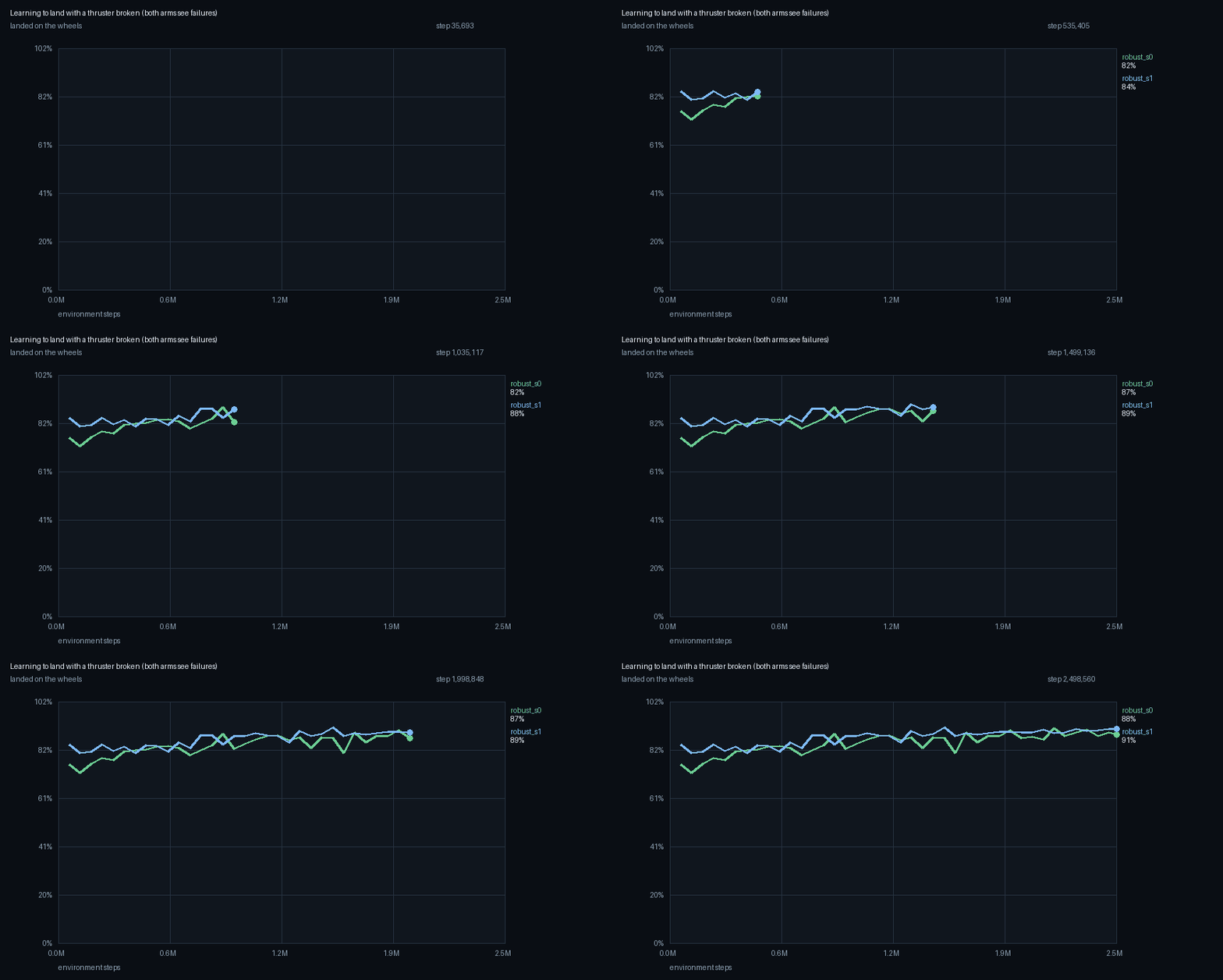
Both robust seeds, landing rate during training. The healthy arm is deliberately not plotted here: it trains without failures, so its training curve describes an easier task and putting the two side by side would imply a closeness that the held-out numbers contradict.
It is faster and cheaper, not just luckier
The robust policy uses a quarter of the propellant and arrives more gently. That is not an artifact of failing earlier — failing early would spend less fuel while landing less often, and this lands more often.
| healthy | robust | |
|---|---|---|
| landed (48 episodes) | 27 | 40 |
| time to touchdown | 1.93 s | 1.23 s |
| mean valve-sum per step | 2.58 | 1.60 |
| propellant | 80.3 kg | 17.9 kg |
Two measured factors: it finishes sooner, and it commands less valve opening while doing it. The healthy policy spends its tank fighting a fault it does not know it has.
The geometry does not predict the flight
Before training anything, you can ask a cheap question with no simulation at all: with this thruster broken, can the vehicle still hold itself in the air? It takes milliseconds. We expected it to tell us which failures were survivable. It tells us nothing useful — the "impossible" ones land about as often as the possible ones.
fault.py answers a question about shape. Lab 1 established that nozzles push
and never pull, so the achievable wrench set is a convex polytope rather
than a subspace. A failure shrinks it. Asking whether a hover is still inside
that polytope is a linear program that runs in milliseconds, before any
training. On reveal it says 4 of 10 stuck-shut failures and 6 of 10
stuck-open failures are infeasible.
Split the held-out landings on that prediction:
| arm | shut, feasible | shut, infeasible | open, feasible | open, infeasible |
|---|---|---|---|---|
| healthy | 65% | 73% | 50% | 51% |
| robust, seed 0 | 86% | 82% | 86% | 83% |
| robust, seed 1 | 95% | 91% | 96% | 89% |
The split carries no information. The infeasible group lands about as often as the feasible one in every arm and both modes, and on the healthy arm's stuck-shut cases it lands more often.
The reason is that the cheap test asks the wrong question. Landing is not hovering. Hover feasibility asks whether the vehicle can hold station indefinitely; a lander never needs to. It can spend its remaining authority on the way down and arrive inside the gate having never been able to stop.
A second, graded test fails the same way for the same reason. max_lift()
computes the largest torque-free upward force still available:
| nozzle | broken how | torque-free lift | hover feasible |
|---|---|---|---|
| 0, 2, 4, 6 | stuck shut | 0.00× weight | no |
| 1, 3, 5, 7 | stuck shut | 2.40× | yes |
| 8, 9 | stuck open | 0.00× | no |
Losing any one of the four corner lift nozzles destroys torque-free lift entirely — three corner thrusters all pushing up cannot balance roll and pitch except by all going to zero. And the vehicle still lands 82–91% of those cases, because it does not need torque-free lift: it trims with the other nozzles and accepts transient spin.
So the lab's finding is a negative one about desk-checking, and it is the argument for the RL: you cannot tell whether a vehicle survives a failure by computing its static authority. You have to fly it.
Stuck open is worse than stuck shut, and not by a little
Both the geometry and the flight agree on this, which is worth noting because they disagree on everything else.
| rig | n | world | stuck shut infeasible | stuck open infeasible |
|---|---|---|---|---|
| minimal | 6 | both | 4/6 | 6/6 |
| sixlift | 8 | earth | 4/8 | 6/8 |
| sixlift | 8 | mars | 0/8 | 8/8 |
| reveal | 10 | both | 4/10 | 6/10 |
| fore10 | 12 | both | 0/12 | 0/12 |
| dense | 20 | both | 0/20 | 0/20 |
A dead nozzle costs authority. A latched one costs authority, adds a force and torque nobody asked for, and drains the tank until it is dry. The drain is unconditional: commanding every valve shut, a latched nozzle still spends 11.7 kg in 0.6 s while a dead one spends nothing.
The rotational signature is real but milder than a single example suggests. Averaged over all ten nozzles on one launch, a latched nozzle leaves the vehicle at 2.90 rad/s against 2.19 for a dead one — 1.32x, not the 4.6x the first draw happened to show. For four of the ten it is the dead nozzle that spins the car more. The first version of this section quoted that single draw.
sixlift on Mars is the case worth remembering. It survives losing any
one of its eight nozzles — 0 of 8 infeasible — and is killed by any one of
them sticking on, 8 of 8. Redundancy is not symmetric. A design review that
asked only "what if one fails?" would have passed that vehicle.
Telling the policy what broke is worth nothing
We also tried giving the computer a perfect fault alarm — a readout naming exactly which thruster broke and how, the instant it happened. It did not help. The controller had already worked it out from how the vehicle was moving.
A third arm gets the fault in its observation: a one-hot over the nozzles plus
a sign for the mode, exact and instant. Scored on the same 128 failures as
robust_s0:
| arm | landed | paired McNemar |
|---|---|---|
| robust (told nothing) | 84% (108/128) | — |
| told (perfect fault detector) | 79% (101/128) | p = 0.31 |
Not significant, and pointing the wrong way. The policy infers the fault from the dynamics well enough that a perfect detector adds nothing — which is worth knowing before anyone funds one.
Problem setup
Below is exactly what the car may do, what it cannot do, and what counts as winning. Reinforcement learning needs all three stated precisely or it will find a way to win that you did not mean — which happened twice here.
Goal. Arrive on the wheels under 2.5 m/s sink, 25° of tilt and 1.2 rad/s of spin, within six seconds of a tumbling launch, with one nozzle broken.
| degrees of freedom | |
|---|---|
| vehicle | 6 — three position, three attitude |
| wheels | 4 spins |
| commanded | 10 valve openings in [0, 1] at 100 Hz |
| constraints | |
|---|---|
| propellant | 297 kg; thrust fades as the tank cools |
| nozzles | push only, never pull |
| actuation lag | 25 ms valve time constant, 10 ms transport delay |
| clock | 6 s |
| failure | one nozzle, shut or open, at a uniform time in [0.5, 3.0] s |
| termination | anything but a wheel touching the ground ends the episode |
Observation. 41 numbers: attitude as two rotation-matrix columns,
uprightness, body rates, velocity, altitude and lowest-corner clearance, ground
slope, propellant fraction and thrust availability, time remaining, the
previous action, and a fault channel that is zero unless --tell.
The fault is applied to the realised control, not the command. It never
touches u_act, which is what the policy asked for and what the observation
reports. The gap between the two is the fault, and the vehicle has to notice
it from the dynamics — as a real one would.
Propellant follows the realised opening too. A latched nozzle keeps spending whether or not the policy asks it to. Billing the command would have hidden half of why stuck-open is worse.
The reward function, in full
The scoring rule in maths. In one paragraph: every moment airborne costs a small fixed amount, so hovering is never free; there is a running "how well is this going" score that pays only its improvement; and at the end one large number depending on whether it landed and how neatly. Running out of time is the worst possible outcome — worse than crashing — and the next box explains why that is not a typo.
Per step. At each of the 600 control steps,
Shaping. with :
where is height above ground and the cosine between the car's up-axis and the world vertical. , so the toll is about 3 per episode against a landing worth about 80.
Lab 1 used and a uprightness bonus. That bonus is worth over six seconds for hovering neatly, and lab 1 spent most of training collecting it. Both are gone.
Terminal.
Crashing is scored by how fast it hit, not as one flat number. That matters most on the failures nothing could save: when landing is impossible, arriving slowly is the only improvement left, and a flat penalty would make the computer indifferent between a gentle bump and a write-off.
Why running out of time is the worst outcome
Lab 4 put the crash at the bottom of its ladder, on the honest argument that destroying the vehicle is worse than running out of clock. Ported here unchanged, that taught the policy never to try: across a full 4M-step run, crashes fell 97% → 3% while timeouts rose 3% → 97%, and landings never exceeded 1%.
The two tasks differ in what inaction reaches. On lab 4's gate course, doing nothing earns no gates, and the gate bonus pulls the policy out of a hover. In a pure landing task, doing nothing is a hover, and the only route to a landing runs through the risk of a crash.
So the rule is neither "crash worst" nor "timeout worst":
The outcome reachable by doing nothing must be the worst one available, or a policy that cannot yet do the task will do nothing instead.
That one line reconciles labs 3, 4 and 5, which had each picked a different answer for reasons that looked sound locally.
The curriculum is not optional
Trained from scratch with a failure in every episode, the policy never learned
to land at all — 0.8% landings at 1.35M steps. On reveal, about half of
all (nozzle, mode) draws leave no hover reachable, so half the training signal
came from episodes nothing could save and the base skill never formed.
Learn to land, then break the vehicle. The robust arm warm-starts from the healthy one, which is also the control.
Prior work — the method here is not ours
Fault-tolerant flight control is an old field, and the specific move of training with the fault present is standard sim-to-real practice.
| Tobin, Fong, Ray, Schneider, Zaremba & Abbeel (2017), Domain Randomization for Transferring Deep Neural Networks from Simulation to the Real World, IROS · arXiv:1703.06907 | Randomise the thing you cannot model and the policy learns to be robust to it. Training with a random nozzle broken is domain randomisation over faults. |
| Sun, Wang, Chu & de Visser (2021), Autonomous Quadrotor Flight Despite Rotor Failure With Onboard Vision Sensors, IEEE RA-L 6(2) | Flight with a dead rotor, on real hardware. |
| A model-free deep RL approach to manoeuvre a quadrotor despite single rotor failure · arXiv:2109.10488 | The direct RL formulation of the same problem. |
| Mid-flight propeller failure detection and control of a propeller-deficient quadcopter using RL · arXiv:2002.11564 | Detection plus recovery, learned. |
Classical fault-tolerant control — control reallocation after an actuator
loss — predates all of it and is what fault.py's reachability check is a toy
version of.
What this lab adds
Two things, and the second is the one worth keeping.
A budget-matched comparison: a policy that practised with failures lands 89% of broken-thruster descents against 72% for an identical policy that never saw one, both scored on the same faults.
And a negative result about the obvious shortcut. A cheap static check — can the remaining nozzles still hold the vehicle up? — does not predict which flights survive. Geometry and flight come apart, which means you cannot screen fault cases offline and must fly them. The lab also withdrew an overclaim along the way: a "4.6× spin signature" from a single nozzle draw measured at 1.32× across ten, with 4 of 10 reversed.
Limitations
- The healthy arm's seeds spread widely — 59% and 85%. Two seeds is enough to see that and not enough to characterise it. Both the pooled figure and the per-seed paired tests are reported for that reason.
- One rig, one world, one failure at a time.
fault.pycan price simultaneous failures and other rigs; nothing was trained on them. - The fault is instantaneous and permanent. Real valves degrade, chatter and sometimes recover.
- The
--tellarm is one seed, so "a perfect fault detector is worth nothing" is a single measurement, not a replicated one. ds_config.jsonis absent deliberately, as in labs 1 to 4: a ~14k-parameter MLP has nothing for ZeRO to shard.
Running it
cd 08_aerial_physics/05_thruster_failure
uv sync

# free checks, cheapest first
uv run fault.py                    # which failures are survivable, by geometry
uv run fault.py --simultaneous     # how many at once can `dense` take?
uv run thrusters.py --all          # what the rig can and cannot do
uv run verify.py                   # conservation residuals
uv run train_fail.py --dry-run     # 40 s, assembles

# the control: learn to land, no failures (~35 min on 20 cores)
uv run train_fail.py --fail-p 0.0 --name healthy_s0 --total-steps 2500000

# the robust arm, warm-started from it
uv run train_fail.py --fail-p 1.0 --name robust_s0 \
    --init-from runs/healthy_s0 --total-steps 2500000 --eval-episodes 128

# did the geometry predict the flight?
uv run analyze.py runs/healthy_s0 runs/robust_s0

# everything
bash run_arms.sh
No deepspeed launcher and no GPU, both deliberate and both measured. The
policy is ~14k parameters; topic 7 measured a policy this size running 1.7×
slower on a GPU because the rollout batch never fills a card. This lab wants
cores.
Environment & local testing
Python ≥ 3.10, with numpy, mujoco, scipy, pillow and torch==2.11.0.
No model downloads, no dataset, ~39 packages, CPU only. CoolProp appears only
under the optional tables extra and is build-time only — the nitrogen
property tables are committed as n2_tables.npz.
uv run tests/test_thruster_failure.py # property checks, from the repo root
Renting a box (RunPod)
uv run runpod/runpod_ctl.py run 08_aerial_physics/05_thruster_failure \
    --dry-run --collect --wait --terminate --yes
uv run runpod/runpod_ctl.py pods          # confirm nothing is left running
--terminate is driven from your machine in a finally, so the pod shuts
itself down even if the run dies. Always confirm with pods afterwards.
What transfers
- The worst terminal must be the one inaction reaches. Not "crash worst", not "timeout worst" — it depends on what a policy that cannot yet do the task can get by doing nothing.
- A cheap static feasibility check can carry no information at all. Two different ones here — hover feasibility and torque-free lift — both failed to predict landing, because both answer a question the task does not ask.
- Train on the perturbation you will face. Not a new idea; the size is the news. 72% → 89% on identical failures, from the same base policy.
- Robustness can be cheaper, not just safer. The robust arm landed more often, sooner, and on a quarter of the propellant.
- Price the sensor before you build it. A perfect, instant fault detector was worth nothing here, because the dynamics already carried the signal.