Learned Dynamics
the car; this one asks whether a computer can learn to predict it — and whether that model is ever big enough to need sharding. ← previous: Thruster Failure · next: Teacher and Student →
Every section opens with a plain words box like this one. Read only those and you get the whole story; the technical detail underneath is there if you want it.
The one line version: we trained models from four thousand to a hundred and eighteen million parameters to predict the car's physics. The best one has eighteen thousand. Bigger did not help, so the big-model machinery this course is named after has nothing to do here — now measured rather than assumed.
Baseline: the null model — predict that nothing changes. 0.2185 at one step, 1.633 over fifty. Budget: 228k transitions over 1,200 episodes, 8 epochs, batch 256, six model sizes from 4k to 118M parameters, both an MLP and a GRU, on one RTX 3080 Ti. Learning rate re-swept at 3e-4 and 1e-4 for the top rungs. Falsifier, written down before the measurement: a model 1000× larger must cut 50-step error by at least half, or the sharding machinery is not earning its place in this topic.
Labs 1 to 5 all train a ~14k-parameter policy, and all five say the same thing: there is nothing for ZeRO to shard. That is true of the policy. This lab builds the one model in topic 8 big enough to make the question real — a dynamics model that has to reproduce real-gas blowdown, valve lag, contact and terrain — and measures the answer instead of asserting it.
The last five labs taught a computer to fly the car. This one asks whether a computer can learn to predict it — to run the physics in its head. And since that kind of model can be made very large, it is the first place in this topic where the big-model machinery this course is named after might actually be needed. We checked. It isn't.
How this lab works
Not a policy this time — a world model. Can a network learn to predict the car's physics, and does making it bigger help?
The bar was written down first: a model 1000× larger must halve the 50-step error. It did not — the best rung on the whole ladder has 18,281 parameters, and scaling past it makes prediction worse. So the sharding machinery this course is named after has nothing to do here, now measured rather than assumed.
Result
Making the model bigger does not make it better. The best predictor we trained has eighteen thousand numbers in it; a model six thousand times larger is slightly worse. And none of them is much better than simply assuming the car keeps doing what it was already doing.
Across 29,000× the parameters, 50-step prediction error is flat. The best model on the entire ladder has 18,281 parameters.
| kind | size | params | 1-step | 50-step | vs null |
|---|---|---|---|---|---|
| null: predict no change | — | 0.2185 | 1.633 | 1.00× | |
| mlp | tiny | 4,073 | 0.0270 | 1.292 | 1.26× |
| mlp | small | 18,281 | 0.0288 | 1.148 | 1.42× |
| mlp | medium | 155,433 | 0.0266 | 1.166 | 1.40× |
| mlp | large | 1,843,241 | 0.0262 | 1.425 | 1.15× |
| mlp | xl | 21,172,265 | 0.0257 | 1.476 | 1.11× |
| mlp | xxl | 117,850,153 | 0.0257 | 1.468 | 1.11× |
| gru | tiny | 9,353 | 0.0256 | 1.584 | 1.03× |
| gru | xl | 126,081,065 | 0.0252 | 13.360 | 0.12× |
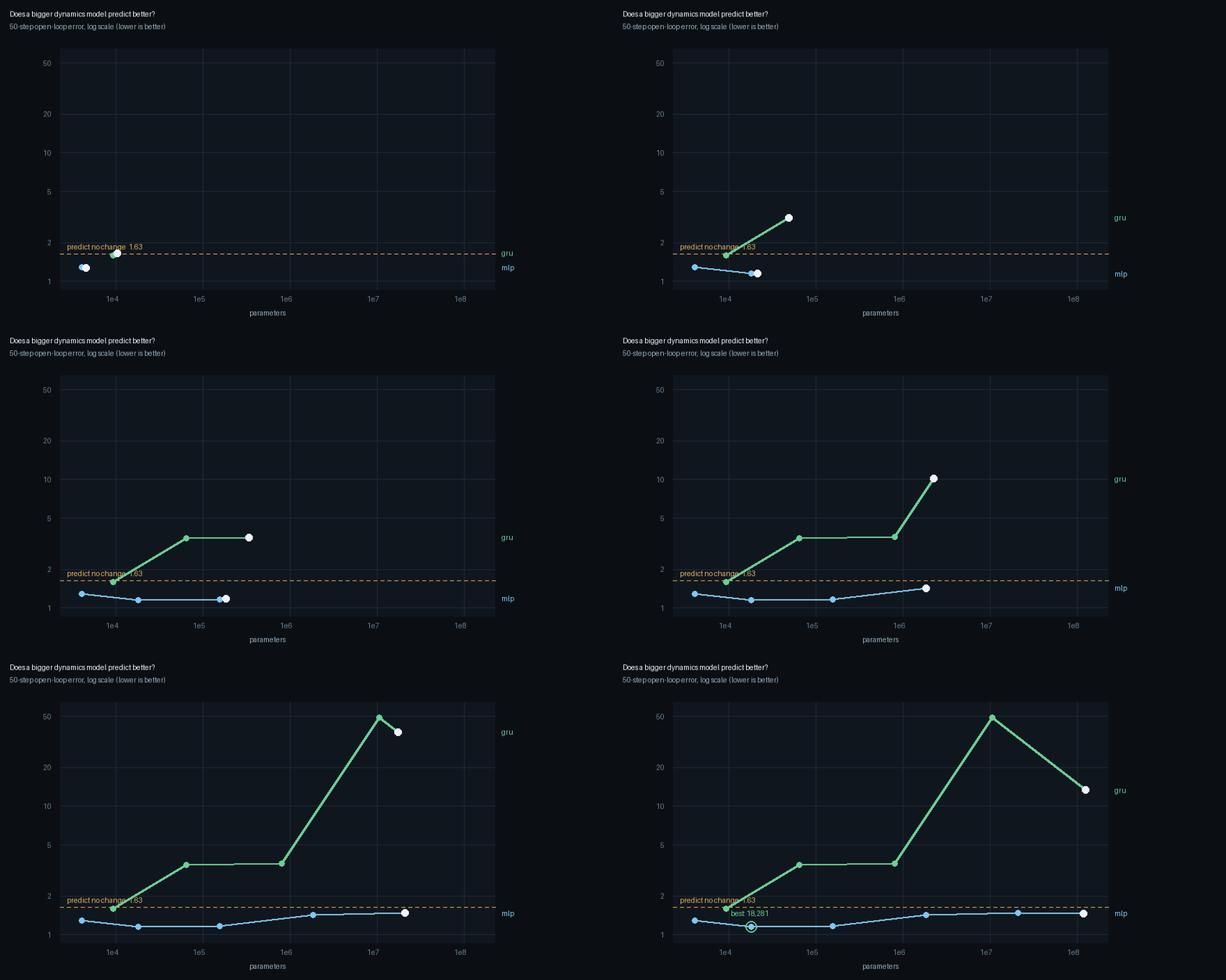
50-step error against parameter count, log on both axes. The MLP line is flat and just below the null; the GRU climbs above it. The best rung is circled.
The bar is not met, and it is not close. 1000× would need to halve the error; 29,000× moves it from 1.292 to 1.468.
One-step accuracy is not prediction
Every model learns the next hundredth of a second almost perfectly. That sounds like success and is nearly worthless: at that timescale the car barely moves, so "nothing changed" is already a good guess. What matters is whether the model can still be trusted half a second later, and it cannot — small errors feed back into themselves and compound.
Every rung beats the null at one step by about 8×, and the spread between a 4k model and a 118M one is 0.0270 against 0.0257 — nothing.
The 50-step number is a different story because the model is fed its own prediction, so error compounds. That is the metric any downstream use would actually depend on, and it is where every model collapses toward the null.
Film: the car and its own prediction
▶ Watch the best model's ghost drift away (13 MB)
▶ The same flight under the 118M model (13 MB)
One MuJoCo scene, two vehicles. The solid car is the real physics; the translucent one is where the dynamics model thinks the car is, having been given the true starting state and then nothing but the valve commands. They start on top of each other and come apart. The HUD carries the live drift and both altitudes.
The ghost's position is not predicted directly — it is integrated from the model's predicted velocity, which is exactly what a planner asking "where will I be" would have to do, and it compounds accordingly.
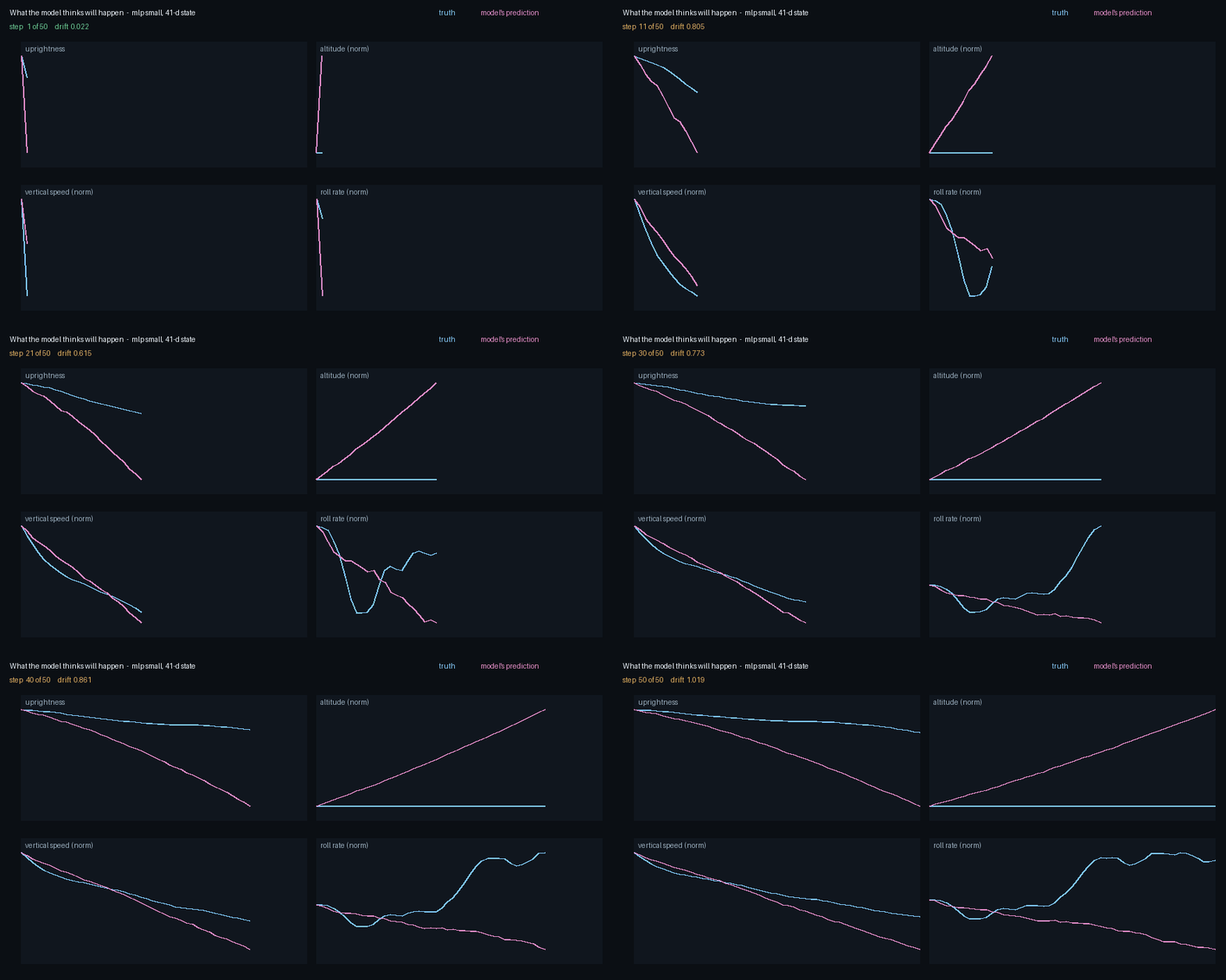
The best model, run open-loop from a real state. The traces sit on top of each other for the first few steps; by step 50 the model has the vehicle steadily climbing while the truth is level. The one-step error of 0.029 became a car in the wrong place.
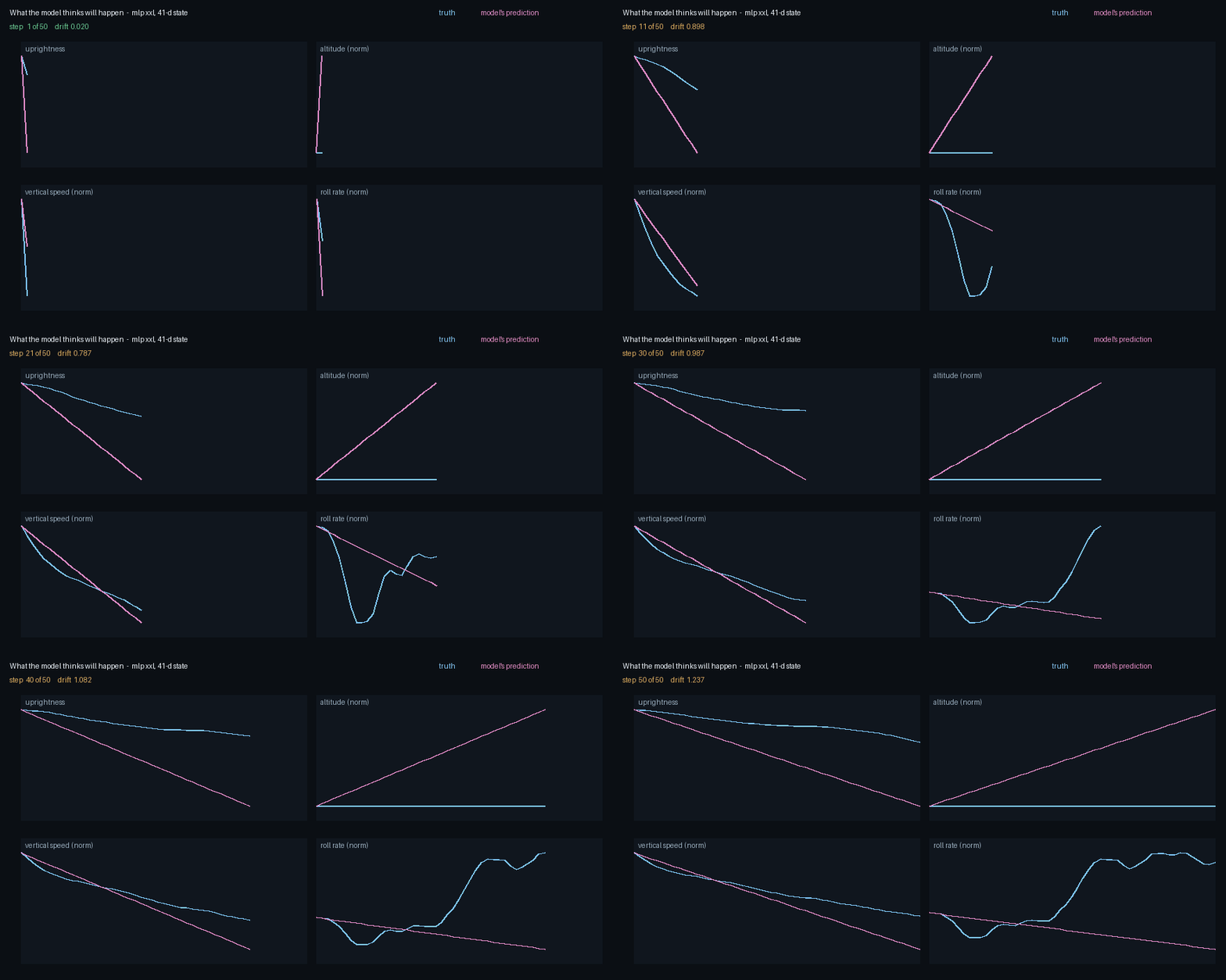
A model 6,400× larger, same picture.
Bigger is worse, and it is not the optimiser
A fair objection: maybe the big models failed because we trained them badly — large models usually need a gentler learning rate. We re-ran them at two gentler rates to check. It did not rescue them.
The ladder used lr = 1e-3 everywhere, and gru_xl's first epoch hit a loss of
231,748 before recovering. That is a diverging optimiser, not a statement
about capacity, and publishing it as a scaling result would have been
publishing a hyperparameter.
| model | params | lr 1e-3 | lr 3e-4 | lr 1e-4 |
|---|---|---|---|---|
| mlp xxl | 117,850,153 | 1.468 | 1.447 | 1.338 |
| gru large | 10,702,121 | 49.087 | 8.551 | 13.819 |
| gru xl | 126,081,065 | 13.360 | 46.925 | 12.247 |
Lowering the rate helps the big MLP a little and does not rescue the GRU at all — 12.2 at best against tiny's 1.58. The ordering survives, so it is a property of the problem rather than of the optimiser.
The GRU's failure has a shape worth naming: its one-step error is the best on the board (0.0234) while its rollout is the worst. It is the compounding that kills it — a recurrent state fed its own output amplifies its own mistakes, and more capacity amplifies harder.
DeepSpeed, actually run
We did not just estimate whether the big-model machinery would help — we ran it. On a single graphics card it used nearly twice the memory and took longer, for the same accuracy. That is not a bug; it is what the tool does when there is only one card to share work across.
Same model, same data, same learning rate, same epochs:
| 50-step error | peak GPU | wall | |
|---|---|---|---|
| plain torch | 1.338 | 2.46 GB | 12.4 min |
| DeepSpeed ZeRO-2 | 1.302 | 4.46 GB | 14.0 min |
ZeRO at world size 1 costs 1.81× the memory and 1.12× the time and buys nothing. Accuracy is unchanged, as it should be — ZeRO is a memory optimisation, not a numerical one. With one card there is no one to partition with, so you pay the bookkeeping and receive no sharding. This is the cargo cult this course keeps warning about, with a number attached.
Where sharding would be real
The largest rung is a 705M-parameter GRU. Weights plus Adam state alone:
| model | params | 1 card | ZeRO-2 ×8 | ZeRO-3 ×8 |
|---|---|---|---|---|
| mlp xxl | 117,850,153 | 1.89 GB | 0.65 GB | 0.24 GB |
| gru xl | 126,081,065 | 2.02 GB | 0.69 GB | 0.25 GB |
| gru xxl | 705,196,073 | 11.28 GB | 3.88 GB | 1.41 GB |
Measured rather than predicted: gru_xxl trains at 15.97 GB of the card's
16.38 GB at batch 256. It fits, barely. A slightly larger model, or a larger
batch, would not — and that is exactly where ZeRO starts earning its place.
But that model is not worth training, which is the whole finding. The sharding question becomes real at a size the accuracy curve says is pointless.
The nvcc trap
deepspeed.initialize with "optimizer": {"type": "Adam"} builds DeepSpeed's
fused Adam and JIT-compiles it with nvcc. There is no CUDA toolkit on this
box — the PyPI CUDA wheels ship ptxas, not nvcc — so it dies with:
OSError: CUDA_HOME environment variable is not set.
which reads like a misconfiguration and is really a missing toolchain. The
repo already carries this lesson for DS4Sci_EvoformerAttention; this is a
second instance. Handing DeepSpeed a pre-built torch optimiser keeps ZeRO's
partitioning and skips the kernel build entirely.
A second trap on the way in: without RANK, WORLD_SIZE and MASTER_ADDR
set, DeepSpeed falls through to MPI discovery and dies on a missing mpi4py.
There is no rendezvous to discover in a single-process run; the variables are
set in train_dyn.py before the import.
The data
A model that only ever watched a good pilot has never seen a crash, and will be confidently wrong the moment anything goes unusual. So the training data deliberately mixes good flying, mediocre flying, and completely random flailing.
| episodes | transitions | |
|---|---|---|
| trained policies (from lab 5) | 526 | |
| scripted hover-plus-wander | 281 | |
| random valve commands | 393 | |
| train total | 1,200 | 227,709 |
| validation, disjoint seeds | 300 | 54,840 |
15% of training transitions had a broken nozzle, inherited from lab 5's fault
model. The mix is written into the .npz, because a prediction error
quoted without the distribution it was measured on is not a number.
Problem setup
Goal. Given the 41-number observation and the 10 valve commands, predict the next observation — and keep predicting when fed your own output.
The model predicts the delta, not the state:
At 100 Hz consecutive observations differ by very little, so a model asked for the absolute state spends its capacity learning the identity. The output head is zero-initialised, so an untrained model predicts no change — the right prior here, and it keeps the first epochs from diverging.
The loss is a per-channel normalised squared error, weighted by the inverse spread of the true delta:
Without that weighting a channel that barely moves is invisible to the loss and one that moves a lot dominates it.
The metric is open-loop rollout error at horizon :
Note the on both sides: the model is fed its own prediction, which is what makes the error compound and what separates this from the one-step number.
Prior work — the method here is not ours
Learning a dynamics model and rolling it out open-loop is model-based RL's oldest idea, and the failure mode this lab measures has its own paper.
| Lambert, Pister & Calandra (2022), Investigating Compounding Prediction Errors in Learned Dynamics Models · arXiv:2203.09637 | The compounding-error problem stated and studied directly: one-step predictions that are accurate become useless over a composed horizon, and the system's own dynamics, not the model, are the strongest factor in the error's shape. This lab's headline metric is their subject. |
| Ha & Schmidhuber (2018), World Models · arXiv:1803.10122 | Learn a compressed model of the environment and train a policy inside it. |
| Chua, Calandra, McAllister & Levine (2018), Deep Reinforcement Learning in a Handful of Trials using Probabilistic Dynamics Models (PETS) · arXiv:1805.12114 | Ensembles and uncertainty propagation, the standard answer to model error. |
| Kaplan et al. (2020), Scaling Laws for Neural Language Models · arXiv:2001.08361 | The scaling intuition this lab tests and fails to reproduce in its domain. |
What this lab adds
A scaling ladder with the bar written down first: a model 1000× larger must halve the 50-step error, or the sharding machinery this course is named after has nothing to do here. Across 4k to 118M parameters and both an MLP and a GRU, the bar is not met — the best rung on the whole ladder has 18,281 parameters and bigger is worse.
Lambert et al. predict the shape of this; what the lab contributes is the systems conclusion drawn from it, which is that there was never a model here worth sharding. That is a measurement about this vehicle at this budget, not a general claim about dynamics models, and the page scopes it that way.
Limitations
- One system, one horizon. A flat scaling curve here is a fact about a 2-tonne cold-gas car at 100 Hz, not about dynamics models generally.
- 8 epochs for every rung. Equal budget makes the comparison fair and may under-train the large models; the lr sweep is the partial check on that.
- The GRU is one recurrent architecture. A transformer over trajectory windows might behave differently and was not tried.
- No downstream task. The lab measures prediction, not planning. A model that is mediocre at 50 steps could still be useful inside a short-horizon controller, and that was not tested.
- ZeRO was measured at world size 1 because there is one card. The 8-card columns in the memory table are computed, not measured, and are labelled so.
Running it
cd 08_aerial_physics/06_learned_dynamics
uv sync

# the size ladder and what each rung costs in memory
uv run dynamics.py

# what "learned nothing" scores — read every result against this
uv run baseline.py

# collect trajectories (~25 min on CPU; needs lab 5's runs for the
# trained share, and says so if they are missing)
uv run collect.py --episodes 1200 --out data/train.npz
uv run collect.py --episodes 300 --seed0 500000 --out data/val.npz

# one rung (the small ones run on CPU with ALLOW_CPU=1)
uv run train_dyn.py --kind mlp --size small --epochs 8

# the whole ladder; an OOM is recorded, not fatal
bash run_ladder.sh

# is "bigger is worse" the optimiser?
bash lr_check.sh

# DeepSpeed, actually run
uv pip install "deepspeed>=0.14"
uv run train_dyn.py --kind mlp --size xxl --lr 1e-4 --deepspeed --zero-stage 2

# collate and judge against the bar
uv run ladder.py
This is the first lab in topic 8 with a real require_gpu(). Labs 1 to 5
deliberately carry none — a 14k-parameter MLP against MuJoCo is faster on CPU
and a guard that can never fire is decoration. Here xl and xxl genuinely
need a card, so the guard means something, and ALLOW_CPU=1 still lets the
small rungs run anywhere.
Environment & local testing
Python ≥ 3.10, with numpy, mujoco, scipy, pillow and torch==2.11.0.
DeepSpeed is an optional extra — the lab runs end to end without it. No
model downloads; the dataset is generated locally.
uv run tests/test_learned_dynamics.py # property checks, from the repo root
Renting a box (RunPod)
uv run runpod/runpod_ctl.py run 08_aerial_physics/06_learned_dynamics \
    --dry-run --collect --wait --terminate --yes
uv run runpod/runpod_ctl.py pods          # confirm nothing is left running
What transfers
- Set the bar before the measurement. "1000× must halve the error" was written down first, and the answer was no. Topic 7 lab 6 did the same with GPU physics and also got a no. A bar chosen afterwards is a description.
- One-step error is not prediction. Any model fed its own output compounds its mistakes. Report the horizon you actually care about, and report the null beside it.
- Measure the null first. "Predict no change" scores 0.2185 here. Without it, 0.0257 looks like mastery instead of a 1.4× edge that vanishes by step fifty.
- Check the optimiser before claiming a scaling law. A diverging learning rate looks exactly like a capacity ceiling.
- ZeRO at world size 1 is overhead. It is a way to split work between cards. With one card you pay the bookkeeping and get nothing, measured here at 1.81× memory.
- Sharding becomes necessary at a size this problem does not want. The
honest conclusion for five previous labs'
launcher="python"is not that DeepSpeed is bad — it is that the model has to deserve it first.