Fly on Mars
rolled it, lab 3 put it on a mark; this one flies it a route through the air — on another planet. ← previous: Land on Target · next: Thruster Failure →
Every section opens with a plain words box like this one. Read only those and you get the whole story; the technical detail underneath is there if you want it.
The one line version: a two-tonne car was trained to fly through three hoops floating above a Martian landscape and land, matching a hand-built controller while using 5 to 8% less fuel.
Baseline: a hand-written guidance law — steer at the next gate on a velocity
setpoint, tilt to translate, then flare — flying the same held-out courses from
the same seeds. 73% on Mars.
Budget: 4M steps per arm, best checkpoint, dense rig, 3 gates on 4–8 m
legs, 9 s clock. Two seeds on Mars, one on Earth. ~55 min per run on 20 CPU
cores. No GPU.
Falsifier: if the learner can only match the controller, the propellant it
spends should be unchanged too. On Mars it is not — 5 to 8% less, replicated —
and on Earth it is.
A two-tonne cold-gas car is launched from the surface and has to fly three gates floating 3–8 m above the ground, in order, within 4 m of each, and then put itself down on its wheels. Nine seconds of clock, 297 kg of nitrogen.
Three invisible hoops hang in the air above a Martian landscape. A car with gas thrusters has to fly through all three in order and then land in one piece. We taught a computer to fly it, and then asked whether the computer could beat a controller a human engineer wrote by hand.
How this lab works
A three-gate course on Mars, flown twice: once by a guidance law a human wrote, once by a policy that corrects that guidance law rather than replacing it.
The policy does not fly better — arrival rates are a coin toss between them, p = 0.65. What replicates across seeds is the propellant: the learner finds 5–8% of slack the hand-written law leaves on the table. Starting from a working controller rather than from nothing is what makes a 9-second course learnable at all.
Result
It works, and it is thrifty rather than faster. The trained car flies all three hoops and lands about as reliably as the hand-built controller — the two are too close to call — but it does the same job on noticeably less fuel. Flying the course is the achievement; saving the fuel is the measured win.
PPO flies the three-gate course and lands, on 5 to 8% less propellant than the hand-written guidance law at the same completion rate. Both arms fly the same 96 held-out courses from the same seeds, so the comparison is paired.
| Mars, 96 paired courses | completion | McNemar | propellant¹ | Wilcoxon |
|---|---|---|---|---|
| residual PPO, seed 0 | 77% (74/96) | p = 0.60 | 131.0 kg | p = 0.0024 |
| residual PPO, seed 1 | 76% (73/96) | p = 0.65 | 134.7 kg | p = 0.0078 |
| scheduled guidance | 73% (70/96) | — | 143.0 / 141.8 kg | — |
¹ measured only on the courses both arms completed (56 and 62 of 96).
Read that honestly: the completion difference is not significant. Seed 0 flew 18 courses the controller missed and missed 14 the controller flew; that is a coin toss. What replicates is the propellant — 8% and 5% on two independent seeds, at p = 0.002 and p = 0.008.
Gates flown: 2.99 of 3, both seeds. The course itself is not in doubt; only the landing afterwards ever fails.
Why the propellant comparison excludes failures
Averaging gas over every episode is a trap. A controller that crashes two seconds in spends almost nothing, so failing more often would look like efficiency. The figures above use only courses both arms completed, and compare them pair by pair with a signed-rank test.
Film: the course, flown
▶ Watch two complete courses (19 MB GIF)
Two consecutive flights by the trained policy on held-out courses. The gates are the rings of markers: blue ahead, yellow for the one being flown, green once flown. Bottom-left is a plan view of the whole course with the car's ground track; the top strip reads the phase and the distance left to the next gate. These two take 6.71 s and 6.55 s, on 131 kg and 154 kg of a 297 kg tank.
Earth, the control
We ran the same experiment with Earth gravity. There the learned controller was no better and no worse than the hand-built one, and saved no fuel at all. The car has so little spare thrust on Earth that there is nothing left to economise.
| Earth, 96 paired courses | completion | propellant¹ |
|---|---|---|
| residual PPO | 76% (73/96) | 246.5 kg |
| scheduled guidance | 79% (76/96) | 248.6 kg |
| p = 0.65 | p = 0.59, −1% |
Neither difference is significant. The learner found 8% of slack on Mars and none on Earth, and the reason is visible in the tank: the Earth controller already spends 249 kg of 297 flying this course, while the Mars controller spends 143 kg. There is simply less to give back.
Note also that Earth is better at this short course, not worse — 79% against 73%. Mars floats, and 25% of Mars episodes time out before touching down. Mars does not buy competence. It buys range, which is the next section.
Hardware check
Two numbers move between the worlds, and only one of them is gravity:
| Earth | Mars | ratio | |
|---|---|---|---|
| gravity | 9.81 m/s² | 3.72 m/s² | 0.38× |
| thrust, same hardware | 1.000 | 1.086 | 1.09× |
| lift-to-weight | 2.40 | 6.87 | 2.87× |
| hover endurance, one tank | 6.9 s | 20.4 s | 2.94× |
The vehicle weighs 62% less and pushes 8.6% harder, because a nozzle expanding against 610 Pa of Martian atmosphere does more work than the same nozzle against 101 kPa. The ratio that decides the task is lift-to-weight, and it moves by more than gravity alone.
Where that matters is range. Holding the clock fixed and growing the course:
| legs | Mars gates | Mars gas | Earth gates | Earth gas |
|---|---|---|---|---|
| 7–11 m | 3.00 | 202 kg | 3.00 | 288 kg |
| 11–15 m | 3.00 | 243 kg | 2.96 | 294 kg |
| 15–19 m | 3.00 | 250 kg | 2.38 | 295 kg |
| 19–23 m | 3.00 | 248 kg | 2.00 | 296 kg |
Earth is tank-limited and Mars is clock-limited. Earth's gas pins at the tank at every length and its gates fall away; Mars flies the whole course every time with reserve.
From scratch, the course never gets flown
Before giving the computer a head start, we tried teaching it from nothing. It never learned to fly more than about one hoop out of three, no matter how long we trained. This is the honest limit of the method, and it is why the final version starts from the hand-built controller instead.
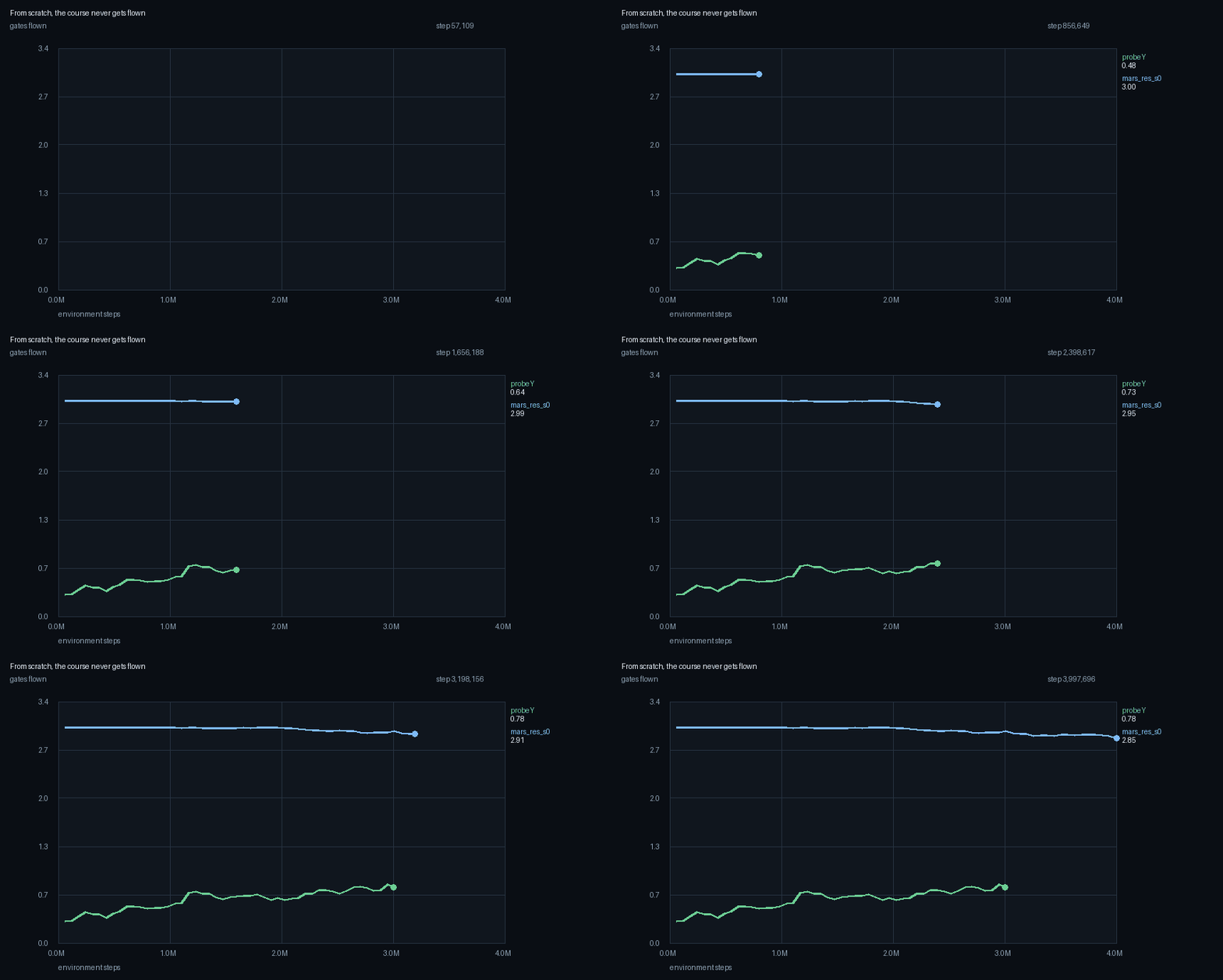
Gates flown per episode. The residual arm sits at 3.00 from the first iteration because it starts as the guidance law. The from-scratch arm climbs to about 1.1 and stops.
End-to-end RL — the policy commanding the hardware directly, as in labs 1 to 3 — plateaus at 1.14 of 3 gates. That figure survived:
- 7.4M steps. The last ten evaluation windows averaged 1.14 gates; thirty windows earlier, 1.12. Flat, not slowly rising.
- two action spaces. Twenty raw valve commands, and a 6-vector body wrench with a convex solver doing the allocation.
- four reward designs, each of which fixed something genuinely broken.
▶ Watch the from-scratch policy (13 MB GIF)
The same vehicle under the best from-scratch policy. It reaches the first gate and loses the course. Both filmed flights crash.
Chaining three waypoints is a materially larger exploration problem than
arresting a tumble or coming down on a mark, and this budget does not solve it.
That is reported rather than hidden, and --action valves and --action wrench reproduce it.
The residual
Instead of learning to fly from nothing, the computer starts as the hand-built controller and learns a correction to it. At its default output the correction is exactly zero, so on its first attempt it flies exactly as well as the engineer's version — and everything it learns after that is an improvement on something that already worked.
The policy commands a 6-vector that is added to the guidance law's wrench:
- at action 0.5 on every axis the residual is exactly zero, so episode one is the scheduled controller. Any gain is a gain over a real baseline.
- the residual is capped at 0.4× the full command range. A residual free to cancel the base wrench would be the from-scratch problem in disguise.
- the guidance law has one definition,
base_wrench()in the environment, used by the controller, the residual and the tests. A second copy would mean the baseline and the residual's starting point were different controllers.
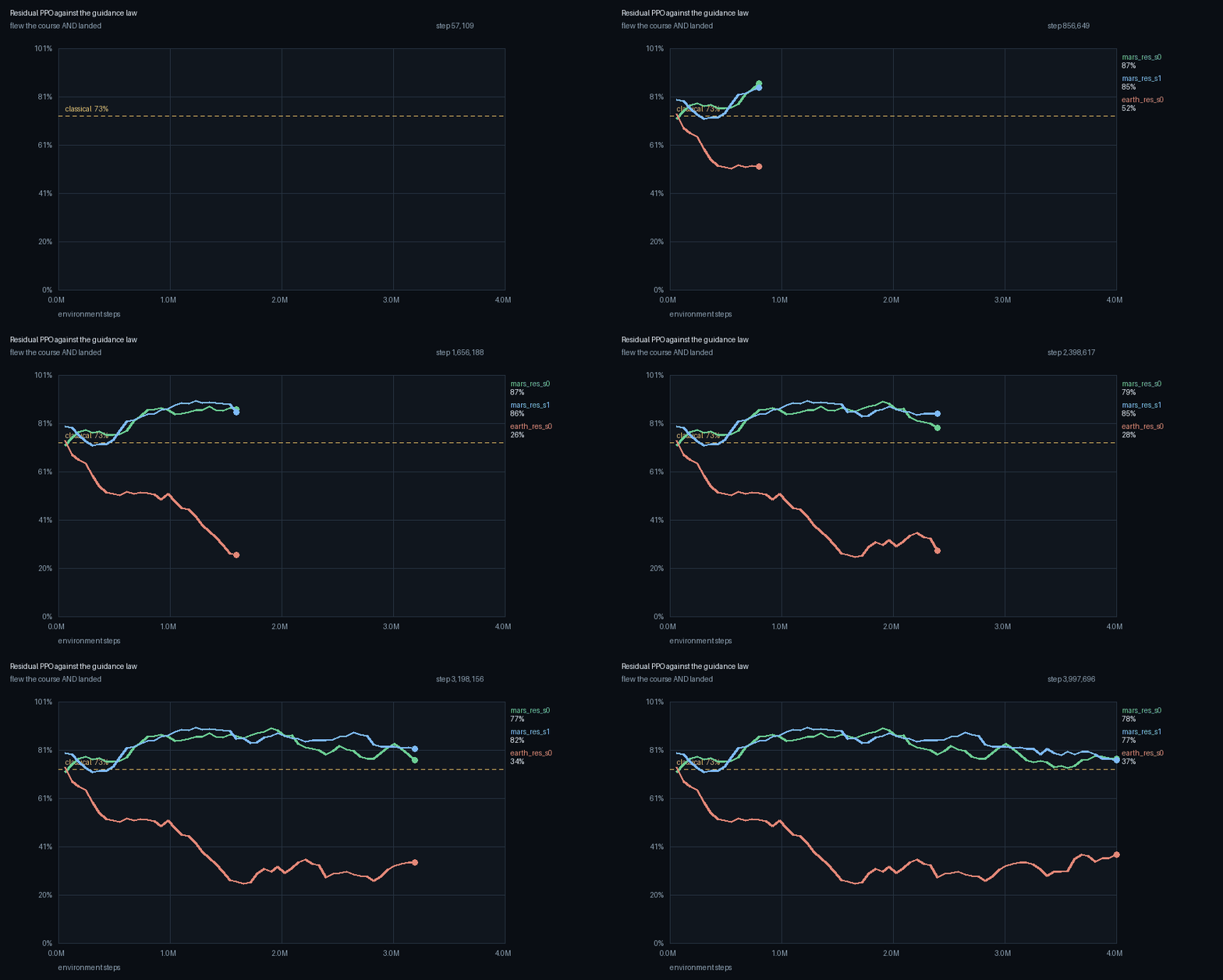
Course completion during training. Both Mars arms rise above the dashed baseline; the Earth arm declines.
Best checkpoint, not last
Both Mars runs peaked near 90% around 1.2–1.9M steps and drifted back to 77% by 4M. Scoring the final weights measured a policy that had already degraded, and the first version of this lab reported no improvement at all because of it. The trainer now keeps the best checkpoint by in-training completion rate; selection uses the training window only, and the published number is still a fresh run on held-out seeds.
The Earth arm drifts much harder — 74% down to 31% — which is why the Earth figure above is also a best checkpoint rather than a final one.
Problem setup
Below is exactly what the car may do, what it cannot do, and what counts as winning. Reinforcement learning needs all three stated precisely, or it will find a way to win that you did not mean — which happened repeatedly here.
Goal. Pass within 4 m of three gates in order, then arrive on the wheels under 2.5 m/s sink, 25° of tilt and 1.2 rad/s of spin. Gates without a landing do not count as flying the course, and a landing without the gates does not either.
| degrees of freedom | |
|---|---|
| vehicle | 6 — three position, three attitude |
| wheels | 4 spins |
| commanded | a 6-vector residual wrench at 100 Hz (or 20 valves directly) |
| constraints | |
|---|---|
| propellant | 297 kg; thrust fades as the tank cools |
| nozzles | push only, never pull |
| actuation lag | 25 ms valve time constant, 10 ms transport delay |
| clock | 9 s |
| termination | anything but a wheel touching the ground ends the episode |
Observation. 46 numbers: attitude as two rotation-matrix columns, uprightness, body rates, velocity, altitude and lowest-corner clearance, the next gate and the one after it in body frame, gates remaining, propellant fraction and thrust availability, time remaining, and the realised valve state.
The gate index is in there deliberately. Without it the task is not Markov — the same position means different things depending on how much course is left.
The reward function, in full
The scoring rule in maths. In one paragraph: every moment costs a small fixed amount, so dithering is never free; crossing a hoop pays a large bonus immediately; and at the end there is one big number that depends on whether the car finished the course and how neatly it landed. Crashing is the worst possible outcome — worse than running out of time.
Per step. At each of the 900 control steps,
The gate bonus is paid at capture, not at the end:
This was the single biggest reason the policy would not fly. Gate credit started in the terminal, where a gate flown at step 150 was paid at step 900 — discounted to 47% of its value, with 750 steps of unrelated reward in between for the advantage estimator to spread it across. Since only increases and each gate increments it once, the bonus is strictly one-off.
Shaping. with , and switches when the course is finished because the job does:
where is the distance to the next gate, the horizontal miss from the landing point and the height above ground. The first version kept pointing at the last gate — which sits metres above the ground — so after flying the course nothing pulled the car down. It hovered beside the gate at 75% timeouts.
, so the toll is about 24 per episode against a course worth about 190.
Terminal.
Notice that crashing scores worse than running out of time. That is the opposite of the previous lab, and the reversal was forced by measurement: with a per-step cost and a cheap crash one dive away, a car that could not yet fly the course learned to end the episode early instead. Crashes hit 98%. Making destruction the bottom of the ladder turns the cheapest available improvement into "stop crashing" rather than "crash sooner".
Prior work — the method here is not ours
Learning a correction to a working controller rather than a policy from scratch is a named technique with two near-simultaneous papers, and this lab is an instance of it.
| Johannink, Bahl, Nair, Luo, Kumar, Loskyll, Ojea, Solowjow & Levine (2019), Residual Reinforcement Learning for Robot Control, ICRA · arXiv:1812.03201 | Decompose control into a conventional feedback part and a residual learned by RL; the command is the superposition. That is exactly --method residual. |
| Silver, Allen, Tenenbaum & Kaelbling (2018), Residual Policy Learning · arXiv:1812.06298 | The concurrent formulation: start from a good-but-imperfect controller and learn a residual on top. Shown to beat both RL from scratch and the initial controller alone. |
| Kaufmann et al. (2023), Champion-level drone racing using deep reinforcement learning, Nature 620 · doi:10.1038/s41586-023-06419-4 | Gate-sequence flight at speed, learned. |
| Gaudet, Linares & Furfaro (2018) · arXiv:1810.08719 | Powered descent on Mars by RL. |
What this lab adds
A case where the residual policy does not fly better and is measurably thriftier. Arrival rates against the hand-written guidance law are a coin toss (p = 0.65); what replicates across seeds is 5–8% less propellant.
The useful part is the pairing: both arms fly the identical held-out
courses, asserted in compare.py, so the propellant difference is a matched
comparison rather than two independent averages. Residual RL finding slack a
human law left on the table is Johannink's result; measuring that the slack is
in fuel rather than time is this lab's contribution, and it is a small one.
Limitations
- The completion difference is not significant (p = 0.60 and 0.65). The claim is a propellant claim, not a reliability claim.
- Nothing here is at convergence, and the arms are scored at a best checkpoint rather than a final one. Both facts are stated because both change what the numbers mean.
- One Earth seed against two on Mars.
- The from-scratch plateau is an upper bound on this budget, not a proof that the task is unlearnable end to end.
- The course was sized to the vehicle, measured rather than guessed: at the original 12–18 m legs the scheduled controller finished the tank and timed out at 1.94 gates. Published numbers describe 4–8 m legs on a 9 s clock.
ds_config.jsonis absent deliberately, as in labs 1 to 3: there is nodeepspeed.initializecall because a ~15k-parameter MLP has nothing for ZeRO to shard.
Running it
cd 08_aerial_physics/04_fly_on_mars
uv sync

# free checks, cheapest first
uv run flight_env.py --budget      # can the tank afford the course?
uv run thrusters.py --all          # what the rig can and cannot do
uv run verify.py                   # conservation residuals
uv run train_flight.py --dry-run   # 40 s, assembles

# the guidance law, on each world
uv run classical.py --world mars --episodes 96
uv run classical.py --world earth --episodes 96

# the residual arm (~55 min on 20 cores)
uv run train_flight.py --world mars --name mars_res_s0 --total-steps 4000000

# the paired head-to-head, which is where the published numbers come from
uv run compare.py runs/mars_res_s0 --world mars --episodes 96

# reproduce the from-scratch negative
uv run train_flight.py --world mars --action wrench --total-steps 4000000

# everything
bash run_arms.sh
No deepspeed launcher and no GPU, both deliberate and both measured. The
policy is ~15k parameters; topic 7 measured a policy this size running 1.7×
slower on a GPU because the rollout batch never fills a card. This lab wants
cores.
Environment & local testing
Python ≥ 3.10, with numpy, mujoco, scipy, pillow and torch==2.11.0.
No model downloads, no dataset, ~39 packages, CPU only. CoolProp appears only
under the optional tables extra and is build-time only — the nitrogen
property tables are committed as n2_tables.npz.
uv run tests/test_fly_on_mars.py # 33 property checks, from the repo root
Renting a box (RunPod)
uv run runpod/runpod_ctl.py run 08_aerial_physics/04_fly_on_mars \
    --dry-run --collect --wait --terminate --yes
uv run runpod/runpod_ctl.py pods          # confirm nothing is left running
--terminate is driven from your machine in a finally, so the pod shuts
itself down even if the run dies. Always confirm with pods afterwards: a pod
that outlives its job bills until someone notices.
What transfers
- Pay credit where the behaviour happens. Moving the gate bonus from the terminal to the moment of capture mattered more than any other single change. A discount factor and a 900-step episode will bury a delayed reward.
- Compare paired when the arms share an environment. Two independent binomial intervals could not separate these controllers; the paired test on the same courses found a significant propellant difference the unpaired view missed entirely.
- Exclude failures from efficiency metrics. Crashing early is cheap. Any "uses less fuel" claim has to be restricted to the runs that succeeded.
- Keep the best checkpoint. A policy that peaks at 90% and is scored at 77% reports no improvement when it learned a large one.
- When exploration is the wall, give the learner a floor. Residual RL on a working controller turned an unlearnable task into a measurable improvement, and the from-scratch curve is still worth publishing beside it.
- The world reaches more than you think. Three separate defects here were a world that failed to reach one derived constant: the hover bias, the rig audit, and the training log's header.