Land on Target
made it roll all the way over first; this one makes it land somewhere specific. ← previous: Barrel Roll · next: Fly on Mars →
Every section opens with a plain words box like this one. Read only those and you get the whole story; the technical detail underneath is there if you want it.
The one line version: a two-tonne car was trained to throw itself at a four-metre mark painted on boulder-strewn ground and land on it, as reliably as a controller a human engineer designed by hand. Letting it see the ground made it worse.
Baseline: a hand-written guidance controller — pick a spot, fly a PD
trajectory to it, flare — scored on the same held-out launches. 61% on target.
Budget: 4M steps per arm, dense rig, badlands terrain, two seeds per
arm, 16-process pool, RK4 at 2 ms. ~47 min per run on 20 CPU cores. No GPU.
Falsifier: if knowing the ground is useful, the arm that sees more of it
should score higher. The ordering is the exact reverse, monotonically, and a
second controller reproduces it independently.
A two-tonne car is thrown into the air, tumbling, over broken ground. A spot is marked on the surface. It has six seconds of clock, seven seconds of propellant, and twenty nozzles that can only push. It has to come down on its wheels, intact, within four metres of the mark.
How this lab works
One task, three policies, and the only thing that changes between them is how much of the ground the policy is allowed to see.
Everything else is held fixed — reward, terrain, rig, budget, seeds. The ordering is the exact reverse of what you would expect and it is monotone: more terrain information, worse landing. A hand-written controller reproduces it independently, and its best use of perfect terrain knowledge turns out to be ignoring it.
Result
It works. The trained controller puts the car on the mark more than half the time, arriving so gently it is barely moving when it touches down — about as well as the hand-built engineering controller, except nobody told it how to fly. The surprise is the second half: letting it see the ground made it worse, and the more ground it could see, the worse it got.
PPO lands the car on the mark 56% of the time on held-out launches, with a mean miss of 2.63 m and a touchdown sink rate of 0.09 m/s — it arrives effectively settled rather than dropping the last metre. The hand-written guidance controller, given the same vehicle and the same launches, scores 61%. The two are statistically indistinguishable, and the learned one was given no guidance law, no trajectory, and no notion of a flare.
| arm | observation | on target | 95% CI | mean miss |
|---|---|---|---|---|
| blind | 33 dims | 56% | [0.46, 0.66] | 2.63 m |
| slope | 35 dims | 25% | [0.17, 0.35] | 4.43 m |
| patch | 58 dims | 0% | [0.00, 0.04] | 4.26 m |
96 held-out episodes per arm, pooled over two seeds. The arms differ in
exactly one thing: how much of the ground the policy may see. blind gets
the mark and its own state plus a radar altimeter. slope adds the ground
gradient under the car. patch adds a 5 by 5 height patch spanning 8 m.
Film: three landings on the mark
▶ Watch the landing reel (9.5 MB GIF)
Three consecutive on-target landings by the trained blind policy, from held-out launches it never trained on. The HUD carries the whole state: the circular widget bottom-left is a plan view 24 m across with the 4 m scoring circle drawn at true scale, so "inside the circle" is something you judge by eye and the miss readout only confirms. Top right reads the phase and the live miss distance; the right-hand panel carries attitude, tank pressure and temperature, live specific impulse and nozzle exit temperature. The yellow posts in the 3D scene mark the scoring circle on the ground itself.
Watch the gas counter: these landings take 86, 176 and 91 kg of a 297 kg tank, and between 1.5 and 2.8 seconds of a six-second clock.
Film: a failure, for calibration
The same policy on a launch it does not recover. It arrives over the mark and runs out of vertical authority before it runs out of descent rate. A page that only showed the successes would be describing a different controller, so here is the whole distribution over the 96 held-out launches:
| outcome | blind arm |
|---|---|
| on target | 56% (54/96) |
| crash | 29% (28/96) |
| landed, too hard | 7% (7/96) |
| landed, missed the mark | 5% (5/96) |
| never landed (timeout) | 2% (2/96) |
Crashes are the dominant failure, not misses: when this controller fails it is almost always because it arrived too fast, not because it arrived in the wrong place. The mean miss across all launches is 2.63 m, comfortably inside the 4 m circle.
Terrain information makes it worse
We ran the same training three times, changing one thing: how much of the ground the computer was allowed to see. The version that could see nothing did best. The version that could see most barely learned to land at all.
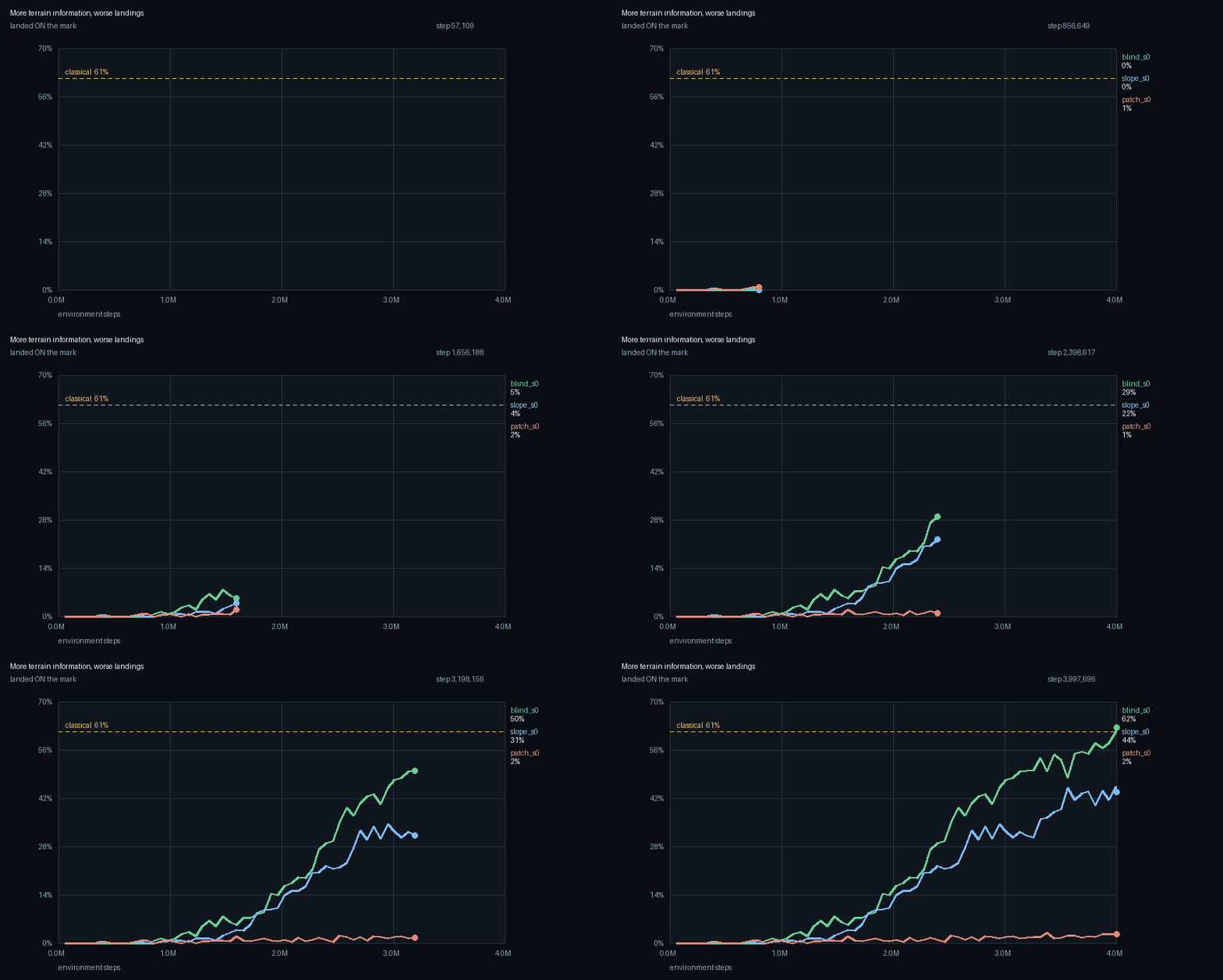
On-target rate against environment steps, for the three arms. The dashed line is the hand-written controller. The blind arm (green) reaches it; the gradient arm (blue) trails; the full height-patch arm (red) never leaves the floor inside this budget.
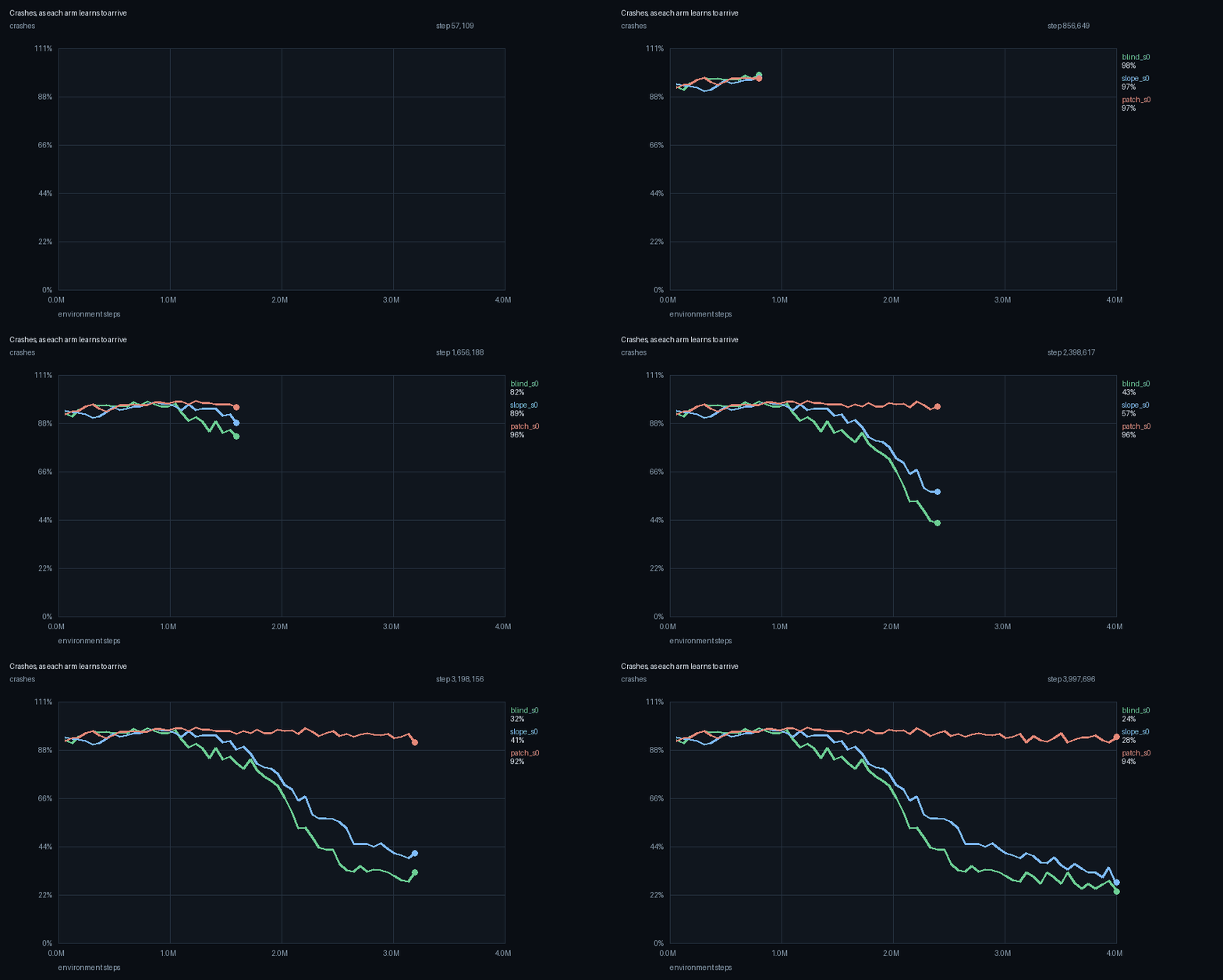
The same three runs, scored on crashes. Blind and gradient both fall to roughly a quarter; the height-patch arm is still crashing on 94% of episodes at 4M steps.
The second controller agrees
The hand-written controller chooses a landing spot by searching outward for survivable ground. How far it will divert is a single knob, and sweeping it separates two different questions: is terrain knowledge useless, or was it merely used badly?
| divert budget | on target | survived | mean miss | gas |
|---|---|---|---|---|
| 0 m (ignores terrain) | 61% | 83% | 2.81 m | 146 kg |
| 2 m | 61% | 83% | 2.82 m | 147 kg |
| 4 m | 55% | 80% | 3.05 m | 148 kg |
| 6 m | 52% | 78% | 3.28 m | 151 kg |
Diverting up to 2 m is free and worthless. Past that it costs accuracy, survival and fuel together. The best use of perfect terrain knowledge is to ignore it, and that holds for a hand-written controller and a learned one independently — two different mechanisms arriving at the same answer.
▶ Watch the engineered controller diverting (14.9 MB GIF)
The scheduled controller with a 6 m divert budget. The magenta cross on the plan view is the spot it chose; the gap between that cross and the centre of the circle is the divert, and it is the thing the sweep above prices. These runs reach the mark, and they spend 127 to 174 kg of gas doing it against the blind controller's 146 kg average.
Why ignoring the ground wins
The mechanism is a comparison of two lengths, and it is measured rather than argued:
| quantity | measured |
|---|---|
| touchdown scatter of either controller | 2.6–2.8 m |
| median distance from bad ground to good | 4.0 m |
| targets with survivable ground within 2 m | 66% |
| targets with survivable ground within 4 m | 82% |
A controller that aims at bad ground still lands on good ground much of the time, because its own scatter is the same size as the gap it would have deliberately crossed. Crossing that gap on purpose costs lateral travel, propellant, clock, and — since the scoring circle is 4 m and the escape is 4 m — frequently the target itself.
The car cannot land exactly where it aims; it is off by about three metres either way. The patches of bad ground are also about three metres across. So aiming at a bad patch lands you on good ground roughly as often as aiming at a good patch does, and going out of your way to reach the good patch burns fuel and pushes you off the target. The knowledge is genuine, and using it still does not pay.
The catch-up test
A fair objection: maybe seeing the ground is not harmful, just slower to learn from, and the wide-view version simply needed more practice. We gave both versions two and a half times the practice to find out. It did not catch up.
At 4M steps every arm was still improving, so "patch scores 0%" was a claim about sample efficiency rather than a ceiling. Both arms were therefore continued to 10M steps on matched budgets — carrying only the losing arm further would have answered a different question.
| arm | 4M | 10M | 95% CI at 10M |
|---|---|---|---|
| blind | 56% | 71% | [0.61, 0.79] |
| patch | 0% | 8% | [0.04, 0.16] |
patch improved, from 0% to 8%, with its crash rate falling from 94% to
82%, and it is still improving. It is not stuck. But at 2.5 times the budget
it reaches roughly a ninth of what the blind arm reaches, and the gap is
wider in absolute terms at 10M than at 4M. So the claim is not "the wide
view can never learn this" but something nearly as strong: 25 extra inputs
of perfect, noiseless terrain information cost more than 2.5 times the
sample budget and were still losing.
The mechanism is unglamorous and matters more than the framing. Those 25 inputs nearly double the observation width for a 13k-parameter policy, and each one is a dimension the network must learn to ignore. The information is not merely unhelpful; it is expensive to discount.
Problem setup
Below is exactly what the car may do, what it cannot do, and what counts as winning. Reinforcement learning needs all three stated precisely, or it will find a way to win that you did not mean — which is exactly what happened here, four times.
Goal. Arrive on the wheels within 4 m of the mark, under 2.5 m/s sink, under 25 degrees of tilt, under 1.2 rad/s of spin. Close but broken does not count. Intact but elsewhere does not count.
| degrees of freedom | |
|---|---|
| vehicle | 6 — three translation, three attitude |
| wheels | 4 spins |
| commanded | 20 valve openings in [0, 1] at 100 Hz |
| constraints | |
|---|---|
| propellant | 297 kg, about 7 s of hover; thrust fades as the tank cools |
| nozzles | push only, never pull |
| actuation lag | 25 ms valve time constant, 10 ms transport delay |
| clock | 6 s |
| termination | anything but a wheel touching the ground ends the episode |
| ground | badlands — packed boulder fields, not a parking lot |
The reward function, in full
Below is the exact scoring rule, written in maths. If that is not your language, here it is in one paragraph: every moment that passes costs the car a small fixed amount, so dithering is never free. Spinning and burning gas cost a little more. On top of that there is a running "how well is this going" score — closer to the mark, lower down, right way up — and the car is paid the improvement in that score each moment rather than the score itself. Then at the very end it gets one big number: a large bonus for landing on the mark, a small one for landing safely elsewhere, and penalties of increasing size for landing hard, crashing, and never landing at all.
Per step. At each of the 600 control steps the car receives
where is the body angular rate and is the commanded opening of nozzle . The spin and gas terms are deliberately tiny — about per step against a time cost of — because they are preferences, not objectives.
Shaping. is a potential-based shaping term in the sense of Ng, Harada and Russell (1999):
with, writing for the horizontal miss distance in metres, for height above ground, and for the cosine between the car's own up-axis and the world vertical,
The shaping term is a trick for giving hints without changing what counts as winning. You define a "warmth" score — warmer when the car is near the mark, low down and the right way up — and pay the car the change in warmth at each step. Because the payments are differences, they cancel out over a whole flight, so the hints steer the search without quietly inventing a different goal. The ranges on the right are the deliberate part: the whole warmth score can never exceed 6, and the next paragraph explains why that ceiling matters more than it looks.
Why is capped at 6. Telescoping the shaping over an episode that ends at step leaves
The last term is the one that bites. With below 1 it is a toll on occupying high-potential states, worth roughly over an episode. At , and that is about 3.6 — negligible against a terminal prize near 100. The first version of this lab had at , a toll of about 93, and the policy duly learned to run away from good states. See Reward design.
Terminal. One of five mutually exclusive outcomes is added on the final step. Writing for sink rate in m/s and for tilt in degrees, and calling a touchdown gentle when , and :
Every line of that table is graded rather than pass/fail, and that is the point. Landing dead centre pays more than landing at the edge of the circle; arriving at walking pace pays more than arriving at speed; and even a crash is scored by how fast the car hit, so "slow down" is something the computer can discover one small improvement at a time. A rule that just said "crash = bad" would be a cliff with nothing to climb.
Two properties of this ladder are load-bearing and the test suite pins both. It is monotone — every outcome scores strictly above the one below it, so no failure is ever worth choosing — and the worst outcome is never landing, not crashing. The reason that ordering has to be enforced rather than assumed is the discounting argument in Reward design: a penalty arriving later is cheaper, and the policy will exploit that unless something charges for delay.
Hardware check
Two rigs in the set have no dead wrench axis, meaning they can translate in any direction without rotating first:
| rig | nozzles | rank | dead axes |
|---|---|---|---|
minimal | 6 | 5 | −Fx, −Fz |
reveal | 10 | 6 | −Fx |
fore10 | 12 | 6 | none |
dense | 20 | 6 | none |
Full rank is not reachability: unidirectional nozzles make the achievable
wrench set a convex polytope rather than a subspace, so a rank-6 rig can
still be unable to push backwards. reveal is rank 6 and cannot produce
−Fx.
That left two candidates, and they are not interchangeable:
| rig | on target at 2.8M steps |
|---|---|
fore10 | 6% |
dense | 37% |
Lab 1's own run history says the same thing: on the easier task fore10 did
not break out until 3.9M steps where reveal broke out at 1.7M. Three
probes of this lab were written off as reward failures before that curve was
read. Check whether the rig is slow before concluding the reward is
wrong.
Terrain decidability
A perception experiment on ground with no decision in it produces a clean null by construction, so the ground is measured before the policy is.
| preset | target survivable | good ground within 2 m | within 4 m |
|---|---|---|---|
rough | 55% | 97% | 100% |
hazard | 43% | 81% | 90% |
badlands | 40% | 66% | 82% |
rough was rejected: per-spot success varied by sd 0.13 against a 0.14
binomial noise floor, so every spot was as good as every other. hazard
made spots differ, but its features sat 1.5 m from safety — smaller than a
touchdown error, so the decision existed and was unexploitable. badlands
builds landable pans and impassable fields in 10–20 m patches from a
low-frequency mask, putting the median escape at 4.0 m.
The honest reading of the result above is therefore not "there was nothing to see". There was something to see, it was measured, and seeing it lost.
Reward design
This was the longest part of the work and none of it was about the car. Four separate times the scoring rules accidentally described a different game from the one we meant, and the computer correctly won that game instead. Every time, the training charts looked healthy.
The policy initially learned to fly away: crash rate falling to 0%, miss distance climbing from 12 m to 86 m, 100% of episodes timing out. Four distinct defects contributed, and the order they were found in matters because three plausible fixes changed nothing.
1. The shaping leak has a scale, not just a sign. Potential-based
shaping adds γΦ(s') − Φ(s). At γ below 1 an agent occupying a state
collects (γ−1)Φ every step it stays there. Lab 2 learned that a negative Φ
pays an agent to stall. This lab learned the other half: Φ max was 31, so
the toll for being in a good state was 93 per episode against a prize of
about 100. Φ is now capped near 6, a toll of about 3.
2. Shaping must not go flat inside the arena. The distance term saturated at 12 m, so beyond 12 m the gradient was exactly zero and nothing pulled the car home once it had fled. The term now falls out to 40 m.
3. Discounting ranks terminals by timing, not only by size. This is the one that mattered:
| outcome | raw | discounted to step 0 |
|---|---|---|
| crash at step 100 | −60 | −54.3 |
| timeout at step 600 | −90 | −49.4 |
The larger penalty was the cheaper one, purely because it arrived later. The policy was not avoiding a bad outcome, it was postponing one. Raising the timeout penalty to −90 — worse than a crash — did nothing, and neither did raising γ from 0.995 to 0.999. What fixed it was a constant per-step cost, which makes postponement itself expensive. If every episode times out, reach for a time cost, not a bigger terminal.
4. A flat terminal has no gradient in it. A crash scored −60 whether the car arrived at 10 m/s or 2.6 m/s, so "slow down" was not discoverable. The penalty is now graded by impact speed, the same reasoning that already graded the on-target reward by miss distance.
One diagnostic error belongs with them. After fix 3, the car reached the mark and dived into it on 98% of episodes. That was read as the time cost being too aggressive, so it was halved — which brought the fleeing straight back. Two symptoms, two causes: the dive was defect 4. Swapping one fix for the other would have lost both.
The resulting outcome ladder is monotone, and the test suite pins it along with a permanent counterexample for each of the four defects:
timeout −90 < crash −64 < hard landing −5 < landed off +5…+25 < on target +70…+100
Prior work — the method here is not ours
| Ng, Harada & Russell (1999), Policy Invariance Under Reward Transformations: Theory and Application to Reward Shaping, ICML, pp. 278–287 · paper | Potential-based shaping, and the proof that leaves the optimal policy unchanged. Everything this lab says about Φ — including the leak that made the first version flee — is their result applied carefully. The page named them; it now cites them. |
| Gaudet, Linares & Furfaro (2018), Deep RL for Six Degree-of-Freedom Planetary Powered Descent and Landing · arXiv:1810.08719 | Pinpoint powered descent by RL, targeting a sub-5 m landing ellipse. The task. |
| Schulman et al. (2017), PPO · arXiv:1707.06347 | The algorithm. |
Hazard detection and avoidance for planetary landing is a large aerospace literature in its own right, and this lab's "the mark is often on a boulder" premise is a toy version of it.
What this lab adds
A negative result with a second, independent confirmation: giving PPO a 5×5 height patch takes it from 56% to 0% on target, monotonically worse with more terrain information. A hand-written controller then reproduces the ordering from the other direction — sweeping its divert budget shows the best use of perfect terrain knowledge is to ignore it.
That two-method agreement is what makes it a finding about the task rather than about PPO. Topic 8 lab 7 is the follow-up that explains it, and also inherits the warning: the patch was never the problem, the training signal was.
Limitations
- Nothing here is at convergence. Every arm was still improving at 4M, and the two carried to 10M were still improving there. Every comparison is at a fixed, matched budget.
slopehas a four-fold spread across two seeds (40% / 10%). Two seeds is enough to notice that and not enough to characterise it.slopewas not carried to 10M, so the middle of the ordering is pinned at 4M only.- The terrain is noiseless and perfectly known. A real lander's height estimate would be worse, which can only weaken the case for using it.
- One terrain generator, one vehicle, one gravity. The claim is scoped to
badlandson Earth with thedenserig.
Running it
cd 08_aerial_physics/03_land_on_target
uv sync

# free checks, cheapest first
uv run thrusters.py --all          # what the rig can and cannot do
uv run target_env.py --decidable   # is there a DECISION in this ground?
uv run verify.py                   # conservation residuals
uv run train_target.py --dry-run   # 40 s, assembles

# the engineered baseline, and the divert sweep that prices it
uv run classical.py --episodes 64 --max-divert 0
uv run classical.py --episodes 64 --max-divert 6

# one arm (~47 min on 20 cores)
uv run train_target.py --sense blind --name blind_s0 --total-steps 4000000

# everything, including both seeds and the baselines
bash run_arms.sh
No deepspeed launcher and no GPU, both deliberate and both measured. The
policy is about 13k parameters; topic 7 measured a policy this size running
1.7 times slower on a GPU because the rollout batch never fills a card.
This lab wants cores.
Environment & local testing
Python 3.10 or newer, with numpy, mujoco, scipy, pillow and
torch==2.11.0. No model downloads, no dataset, about 39 packages, and the
whole lab runs on CPU. CoolProp appears only under the optional tables
extra and is build-time only — the nitrogen property tables are committed as
n2_tables.npz.
uv run tests/test_land_on_target.py # 22 property checks, from the repo root
What transfers
- If every episode times out, the problem is probably timing, not size. A discount factor silently reorders terminal rewards by when they arrive. Check the discounted value against the alternatives before making a penalty bigger.
- Potential-based shaping has two failure modes, not one. A negative potential pays you to stall; a large one charges rent for being in good states.
- Grade every terminal. A flat penalty is a cliff with no gradient, and the behaviour just short of it is invisible to the learner.
- Check the rig before blaming the reward. A six-fold difference in sample efficiency between two equally capable layouts looked exactly like a broken objective for three probes running.
- Information is only worth acting on if acting moves you further than your own error. Compare those two lengths before designing a perception system: here they were 2.6 m and 4.0 m, and that single comparison predicted the entire result.