Barrel Roll
one makes it turn all the way over first. ← previous: Aerial Stabilization · next: Land on Target →
Every section opens with a plain words box like this one. Read only those and you get the whole story; the technical detail underneath is there if you want it.
The one line version: a two-tonne car was trained to complete a full 360° barrel roll in mid-air, and it performs the roll more reliably than a hand-built engineering controller while using 40% less gas.
Baseline: a scheduled roll plus a PD landing controller — no learning — scored on the same held-out throws. Budget: 2.5M steps to learn the roll, then 3M warm-started to add the landing. 16-process pool, RK4 at 2 ms, three seeds. ~50 min per run on 20 CPU cores. No GPU. Falsifier: if the two halves of the manoeuvre are independent, the order they are taught in should not matter. It decides everything.
A two-tonne car is launched spinning at 2.6 rad/s with eight seconds of clock and seven seconds of propellant. It has to complete one full 360° turn about its own axis and then arrive on its wheels.
A car is thrown into the air already rotating. It must finish exactly one complete roll — like an aircraft barrel roll — and then land on its wheels instead of its roof. We taught a computer to fly it.
Result
It works. The trained controller completes the barrel roll 95 times out of 100, which is much better than the hand-built engineering controller manages, and it does it on about 40% less gas. Landing cleanly afterwards is harder, and there the hand-built controller is still ahead.
96 held-out throws per controller, identical launches, rig reveal:
| roll completed | roll and landed | gas | |
|---|---|---|---|
| scheduled roll + PD landing | 65/96 = 68% [58, 76] | 48/96 = 50% [40, 60] | 218 kg |
| PPO, pooled over 3 seeds | 275/288 = 95% [92, 97] | 74/288 = 26% [21, 31] | 124–145 kg |
| PPO, best seed | 96/96 = 100% [96, 100] | 37/96 = 39% [29, 49] | 145 kg |
The manoeuvre itself is solved. PPO completes the roll on 95% of throws against the engineered controller's 68% — the intervals are disjoint — and spends roughly 40% less propellant doing it. One seed rolled on all 96 throws.
The landing that follows is the half PPO is worse at, 26% against 50%, and those intervals are disjoint too. Reported rather than buried; the limitations section says what it would take to close.
Watch four clean roll-and-lands (24 MB) → Linked rather than embedded — 980 × 580, four throws, the roll dial filling to 360° on each. Selected throws: these are four of the policy's successes, and the rate is the table above, not the film.
How this lab works
Two skills — complete a 360° roll, then land on the wheels — and the entire finding is that the order you teach them in decides whether either is learnable at all.
Same algorithm, same budget, same reward — only the curriculum order moves, and it takes the roll from 0% to 95%. A landing reflex learned first makes the roll unlearnable, because a policy that has learned to stay upright will not initiate a tumble. A prior can be worse than no prior.
Motivation
Tesla showed a car doing a mid-air rotation and landing on its wheels. Lab 1 reproduced the landing. This lab adds the rotation — the part that makes it a stunt rather than a hop.
Lab 1 asked only for a landing and reached 89%. The roll is not merely a harder version of that: it forces the vehicle to spend attitude authority on a goal that conflicts with the landing, on a clock, from a tank that is paying for both.
The car is launched already rotating, because that is how the stunt works — a car leaving a ramp sideways is spinning, it does not start level and then decide to turn. At 2.6 rad/s one free turn costs 2.4 s of the 8 s clock and the car would complete 3.4 turns if left alone. The skill is arresting at exactly one turn, not starting one.
Problem setup
Reinforcement learning needs four things written down before you can train: what counts as success, what the machine can move, what it is not allowed to do, and what it can see. This table is all four.
| Goal | complete one 360° roll about the body's long axis, then arrive on the wheels under 2.5 m/s sink, under 25° tilt, under 1.2 rad/s spin. Both halves or it does not count. |
| Degrees of freedom | 6 for the vehicle (3 position, 3 attitude) plus 4 wheel spins. The policy commands 10 valve openings in [0, 1] at 100 Hz — one per nozzle, nothing else. |
| Constraints | 297 kg of propellant ≈ 7 s of hover against an 8 s clock; thrust fades as the tank cools; nozzles push and never pull; 25 ms valve lag plus 10 ms transport delay; anything but a wheel touching the ground ends the episode. |
| Observation | 33 numbers: attitude as two rotation-matrix columns, body rates, velocity, altitude and lowest-corner clearance, ground slope, propellant fraction and thrust availability, time remaining, three roll-state terms, previous action. |
| Action | 10 continuous valve commands, sampled from a Gaussian the network outputs. |
| Reward | dense: uprightness and rate penalties, a propellant charge, and potential-based shaping on altitude and roll progress. Terminal: +80 to +100 rolled and landed, −20 landed without rolling, −40 timeout, −60 crash. |
| Termination | three wheels down and settled, any hull contact, or 8 s. |
The three roll-state terms are not decoration. Without them the task is not Markov — the policy cannot tell whether it still owes a turn, and no amount of training repairs a missing input.
Roll measurement
We need to be sure a "roll" is really a roll and not the car thrashing about. So it only counts if the car turns a full circle and genuinely passes upside down on the way.
Rotations do not commute, so the integral of body roll rate is a geometric angle only when the manoeuvre is roll-dominant. Relying on it alone would let a policy bank credit by tumbling. A roll therefore counts only if both hold:
- the unwrapped integral of body-frame ωₓ reaches 2π, and
- the car's own up-axis points below the horizon at some instant.
The second is a geometric event no amount of yaw or pitch thrashing can
fake. tests/test_barrel_roll.py pins both directions: spinning past 360°
without inverting is rejected, and inverting without completing the turn
is rejected.
Hardware check
Before training anything we check the thruster layout can physically do a barrel roll. Some layouts cannot, and no amount of training fixes that.
From lab 1's rig audit, computed in closed form with no simulator:
| rig | nozzles | pure roll couple | free roll torque | fastest 360° |
|---|---|---|---|---|
reveal | 10 | 13,302 N·m | 24,602 N·m | 0.90 s |
minimal | 6 | 0 N·m | 17,656 N·m | never |
sixlift | 8 | 0 N·m | 17,656 N·m | never |
A pure couple is torque with no net force. minimal and sixlift have
plenty of roll torque and no pure couple at all — every newton-metre they
produce arrives with a shove.
I pre-registered that couple purity would predict roll-and-land success.
It is not an independent variable. Cancelling the shove from a
side-mounted lift nozzle requires downward force, so zero purity and
cannot push down are the same property — and that same deficiency is
what makes fine descent control impossible. minimal could not be trained
to land at all, with or without the roll (0/48 over 2.5M steps), so the
purity comparison cannot be made with a learned controller. The engineered
controller still flies it, so it is a learnability gap rather than an
impossibility.
Curriculum order
This is the real discovery. We tried teaching the car to land first and then roll — it never rolled, not once. Teaching it to roll first and then land worked. Same task, same everything; only the order changed.
The compound task is not learnable from scratch at this budget: 4M steps gave 0/96. So it was split into two stages. Taught in one order it fails completely; in the other it works.
| order | rolls completed | rolls and lands |
|---|---|---|
| land first, then add the roll | 0.0% (2 seeds, 3M steps each) | 0% |
| roll first, then add the landing | 94–100% (3 seeds) | 25–37% |
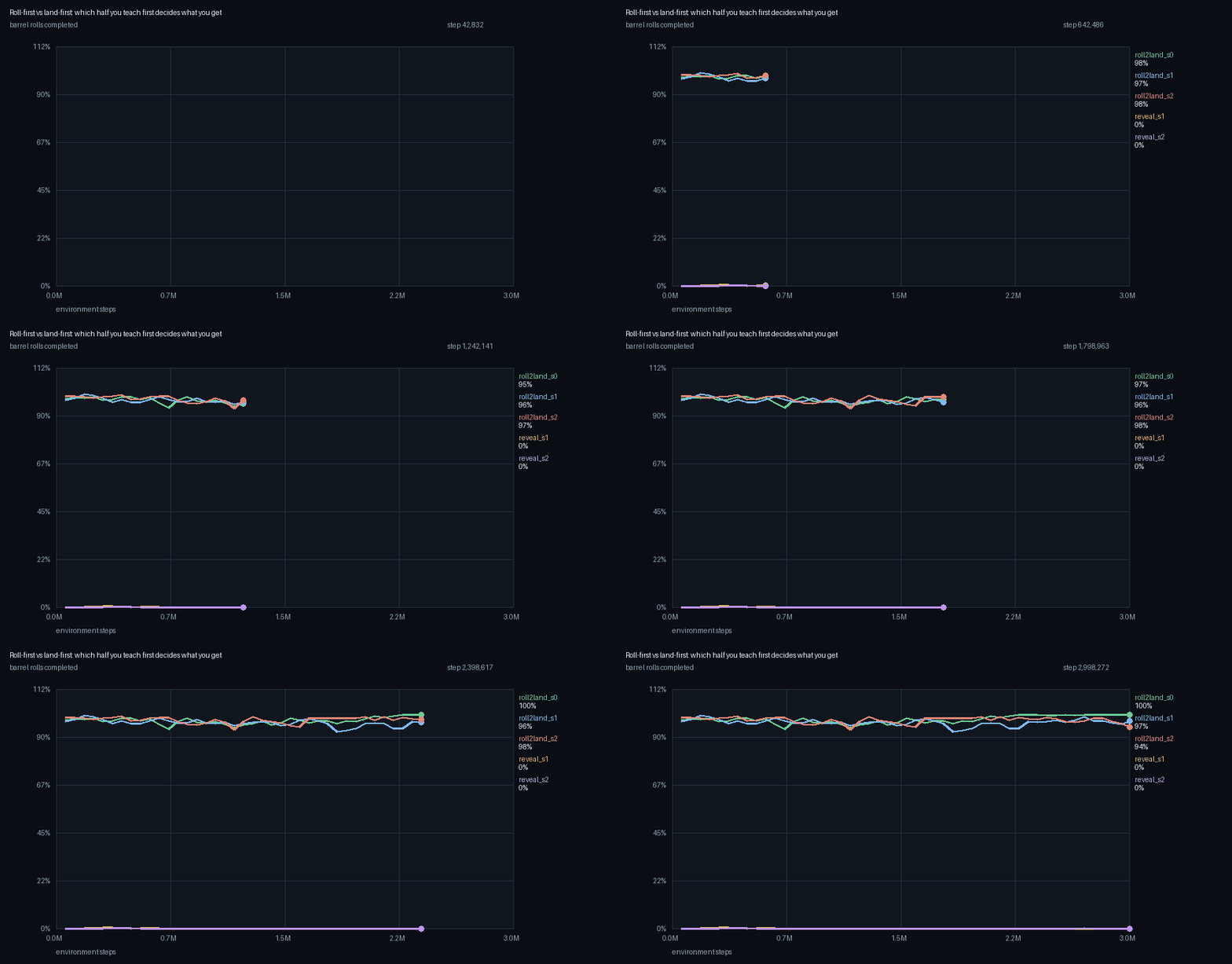
The three rising curves are roll-first; the two flat on zero are land-first. Roll completion for the land-first policies never leaves 0.0% at any checkpoint across 3M steps.
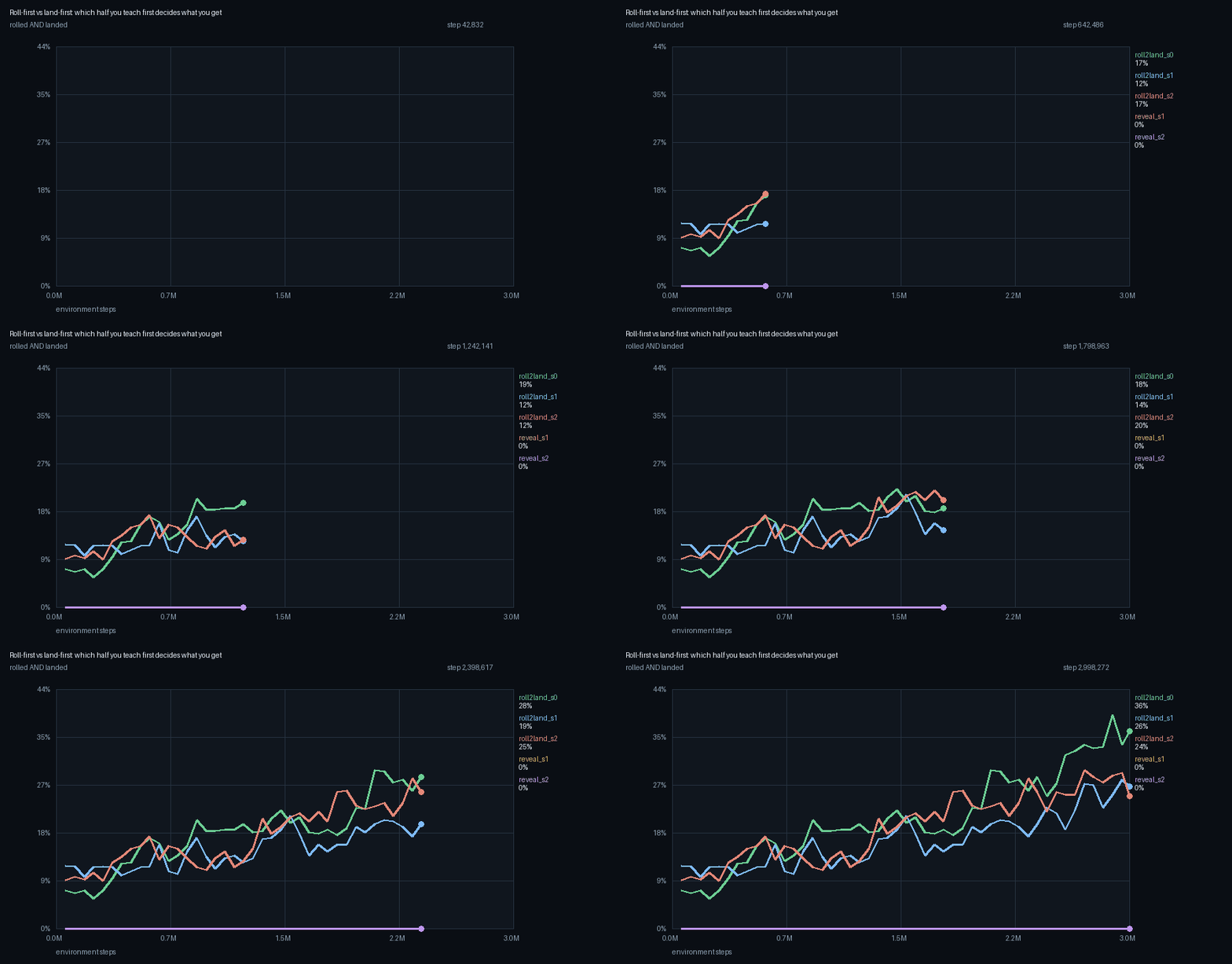
Why the asymmetry. A landing prior is the reflex null the body rates. Handed a car spinning at 2.6 rad/s it kills the rotation in about 0.3 s — before enough roll accumulates for the shaping to pay anything — so the roll is never attempted and never appears in a single training batch. No data, no gradient, regardless of budget. A rolling prior is do not fight the rotation, which costs the landing nothing: the car still has 5.6 s of clock after the turn, and landing is the half lab 1 already proved learnable.
Roll-first transfers. Land-first does not.
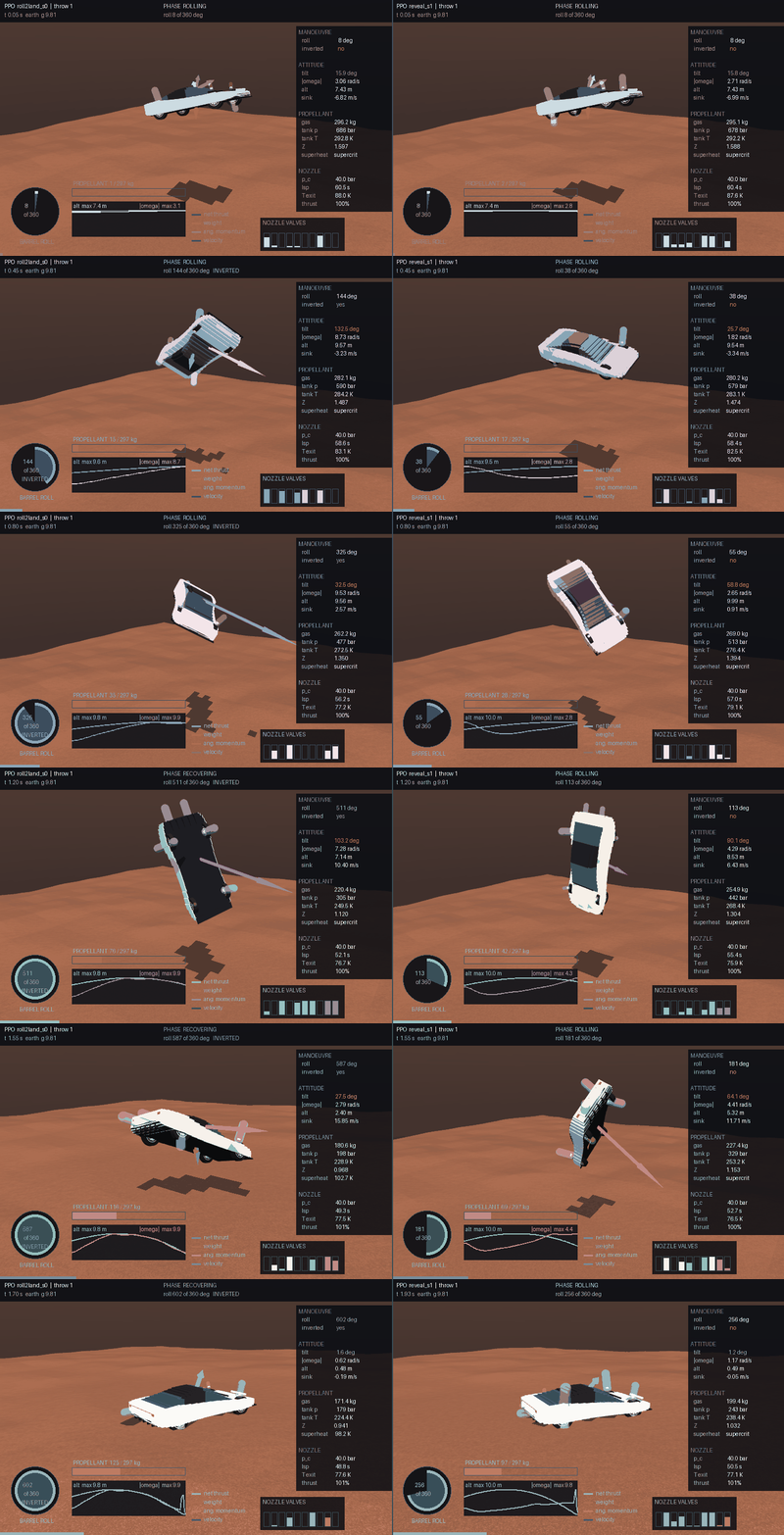
Left: roll-first. Right: land-first. Identical seed, so identical attitude, tumble and velocity — the only difference is which half each policy was taught first. The left car turns over; the right one cancels the rotation it was given and lands flat, taking the −20. Two more throws (11 MB) →
Reward design
Most of the work in this lab was not training — it was discovering that the car was being paid, by accident, to do the wrong thing. Three times.
Each of these produced a confident, stable, wrong policy. The optimiser was correct every time; the question it was asked was not.
Shaping that paid for stalling. Potential-based shaping adds
γΦ(s′) − Φ(s), which provably leaves the optimal policy unchanged. The
theorem is about the optimum; with γ below 1 the sign of Φ decides whether
loitering is pleasant. Holding station collects (γ−1)·Φ per step, so a
negative potential is a standing subsidy. At Φ ≈ −15 that was +0.075
per step — about +60 per episode for free. Roll completion fell from
21% to 12% while timeouts climbed to 86%. Shifting Φ non-negative flips
the subsidy into a clock.
A consolation prize for not attempting the task. Landing without rolling was priced at +10, on the reasoning that a safe landing beats a crash. True, and beside the point: it made declining worth a guaranteed +28 against an unknown gamble, and a warm-started policy refused to roll on 94.8% of throws. It is now −20.
Partial credit before the task was attempted. With a gentle no-roll landing at −20 and a hard one at −5, landing badly scored better than landing well — and 44.5% of episodes became deliberate hard landings. Any landing without the roll is now one flat price.
The measured breakdown of where reward actually comes from is in lab 1;
the same --reward-audit tooling applies here.
Prior work — the method here is not ours
Curriculum learning and learned aerobatics are both well-covered, and the flip in particular has been done on real hardware.
| Bengio, Louradour, Collobert & Weston (2009), Curriculum Learning, ICML · doi:10.1145/1553374.1553380 | The original argument that presentation order changes what a learner can reach at all. This lab's entire finding is a sharp instance of their claim. |
| Narvekar, Peng, Leonetti, Sinapov, Taylor & Stone (2020), Curriculum Learning for Reinforcement Learning Domains: A Framework and Survey, JMLR · arXiv:2003.04960 | The RL-specific treatment, including transfer between curriculum stages. |
| Lupashin, Schöllig, Sherback & D'Andrea (2010), A Simple Learning Strategy for High-Speed Quadrocopter Multi-Flips, ICRA | A real quadrotor learns a triple flip at 1,600°/s in about 40 iterations, by policy-gradient refinement of a first-principles model. The manoeuvre predates this lab by fifteen years. |
| Kaufmann, Bauersfeld, Loquercio, Müller, Koltun & Scaramuzza (2023), Champion-level drone racing using deep reinforcement learning, Nature 620 · doi:10.1038/s41586-023-06419-4 | Aggressive learned flight at the limit, against human world champions. |
What this lab adds
A clean order ablation with the budget held fixed. Teaching the landing first and warm-starting the roll gives 0% across two seeds and 3M steps; teaching the roll first and warm-starting the landing gives 95%. Same algorithm, same reward, same total steps — only the order moves.
The mechanism is worth the page: a landing reflex learned first makes the roll unlearnable, because a policy that has learned to stay upright will not initiate a tumble. A prior can be worse than no prior, and from-scratch beat warm-started 95% to 0% on the roll. That is a concrete counterexample to the intuition that pre-training is free, not a new method.
Limitations
What this lab does not show, stated plainly.
- Landing after the roll is worse than the engineered controller, 26% against 50%, intervals disjoint. The best seed ties it at 39% on 58% of the gas, but the seed spread is 18 / 21 / 39 and three seeds is few.
- Seed variance is large. The pooled figure is the honest one.
- The purity hypothesis could not be tested with a learned controller, because the zero-purity rigs cannot be trained to land at all.
- One rig carries the headline.
revealonly; the rest are covered by the engineered controller. - The best seed was still improving at 3M steps (32% → 39% over the last 400k). This is a budget result, not a ceiling.
- The terrain is nearly flat where the car lands, as in lab 1.
What transfers
| Curriculum order is not a detail | the same two halves, same budget, same reward: 0% one way round, 100% the other |
| A prior can be worse than no prior | the landing reflex made the roll unlearnable; from scratch beat warm-started on the roll, 95% against 0% |
| A behaviour absent from the batch cannot be learned | 35,000 gradient steps over data where the roll never occurred |
| Potential-based shaping is sign-sensitive | the optimality theorem says nothing about whether loitering pays, and at γ below 1 a negative Φ subsidises it |
| Do not pay for declining the task | +10 for a safe non-attempt bought a 94.8% refusal rate |
| Judge a plateau by the known breakout, not the budget you can afford | five configurations were declared dead at 800k; the reference run breaks out at 1.4M |
Where this goes next
The order result is the portable one. Any task that decomposes into sub-skills — walk then carry, grasp then lift, roll then land — has a teaching order, and this lab shows the two orders are not merely different in speed. One of them made the second skill unlearnable at any budget, because the first skill's reflex removed the evidence the second needed from every training batch.
The cheap diagnostic is worth keeping: if a sub-skill's success rate sits at exactly 0.0% across millions of steps while everything else improves, the problem is almost never the budget. It is that the behaviour never occurs in the data, and no amount of gradient descent learns from evidence that is not there.