Evoformer: the memory wall ZeRO cannot move
The result this architecture produced
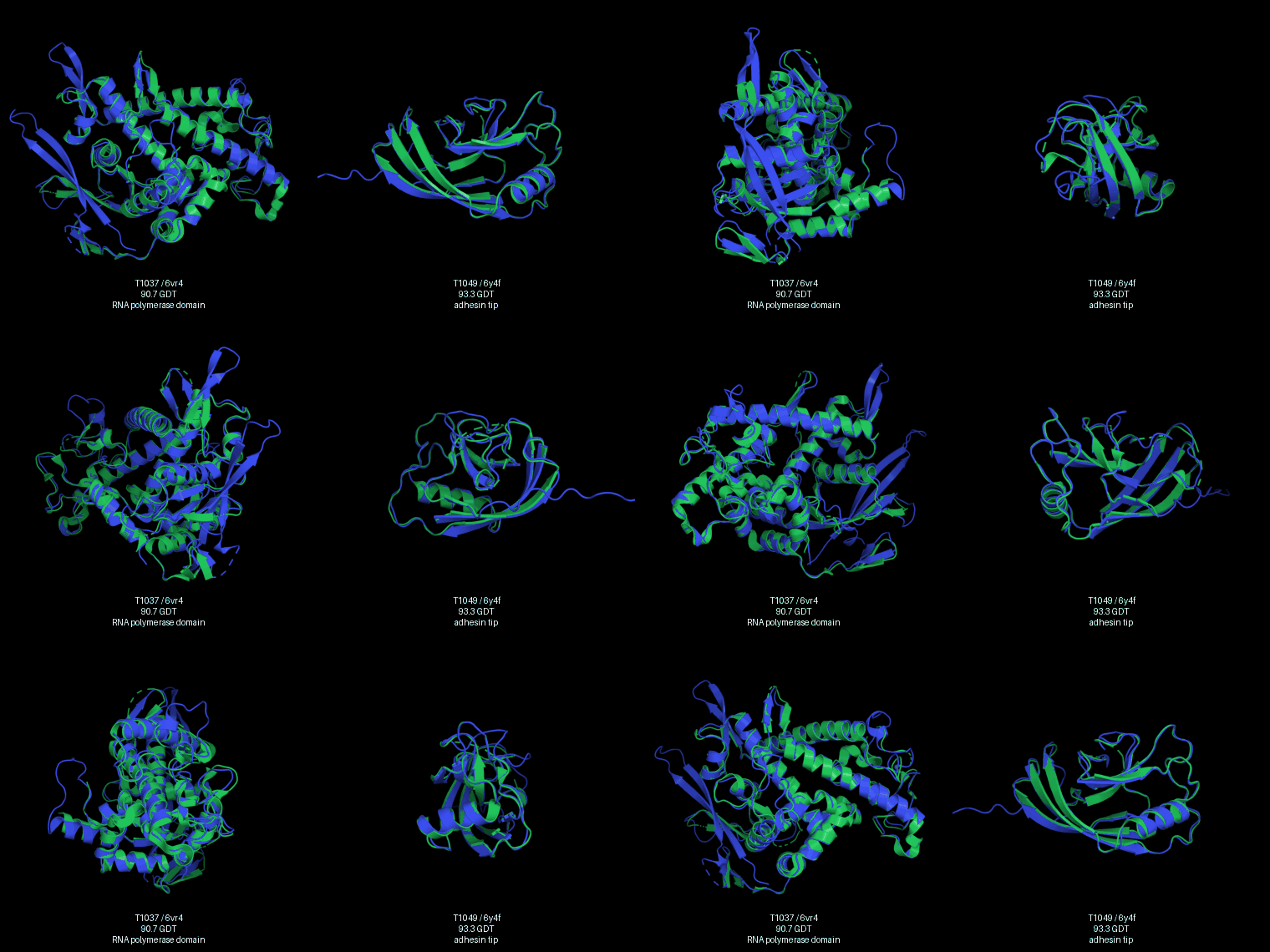
Green is the experimental crystal structure. Blue is AlphaFold2's prediction.
Left is CASP14 target T1037 (a domain of the crAss-like phage RNA
polymerase, PDB 6vr4) at 90.7 GDT; right is T1049 (an adhesin tip,
6y4f) at 93.3 GDT. This is the 2020 result that ended a fifty-year
problem, and the trunk on this page is the part of the model that produced it.
Both halves of this figure are public files, which is worth knowing:
- the experimental structures come from RCSB (
6VR4,6Y4F); - the predictions come from the CASP14 prediction archive, where
AlphaFold2 competed as group 427. The file is literally
T1049TS427_1— submitted model 1.
So the script downloads the atoms DeepMind rendered and superimposes them. Re-running ColabFold instead would give a prediction, not the prediction: different MSAs, no CASP-condition templates, different seeds, and a GDT near but not equal to the published numbers.
The superposition is PyMOL's super (RMSD 0.84 Å for T1037, 0.51 Å for
T1049). The camera is ours — DeepMind's orientation was chosen by hand and
cannot be recovered from the published image. Everything else is theirs.
uv run scripts/make_casp14_figure.py                     # for the book
uv run scripts/make_casp14_figure.py --bg light          # the published look
uv run scripts/make_casp14_figure.py --frames 48         # smoother
It also writes a four-view sheet per target, because a single still can't show whether the agreement survives rotation:
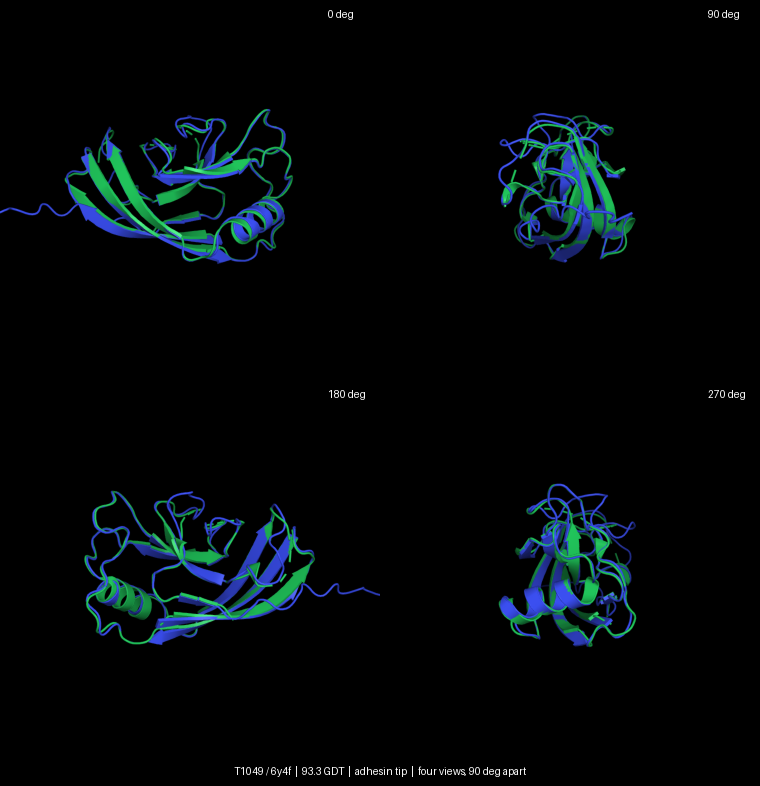
The stray blue loop with no green beneath it is not an error. AlphaFold2 predicted a terminal segment the crystal never resolved — the model has an opinion about residues the experiment could not see.
Where the memory goes
If you have not read what goes in and what comes out, the shapes below will land better after it — particularly
pair_rep, which is the tensor this whole page is about.
Every other topic in this course has its memory problem in the parameters. Weights, gradients, optimizer state — that is what ZeRO shards, and by now "it does not fit, raise the stage" is a reflex.
AlphaFold2's trunk breaks the reflex. Its trunk here is about 100,000 parameters and it will still exhaust a 24 GB card, because the thing filling the card is an activation that grows with the cube of the protein length.
Neither is a parameter. No ZeRO stage touches either. Every rank materialises the cubic tensor in full, every step.
That is why DeepSpeed ships a kernel for this model family rather than another sharding strategy.
The two tensors
What the pair representation is a picture of
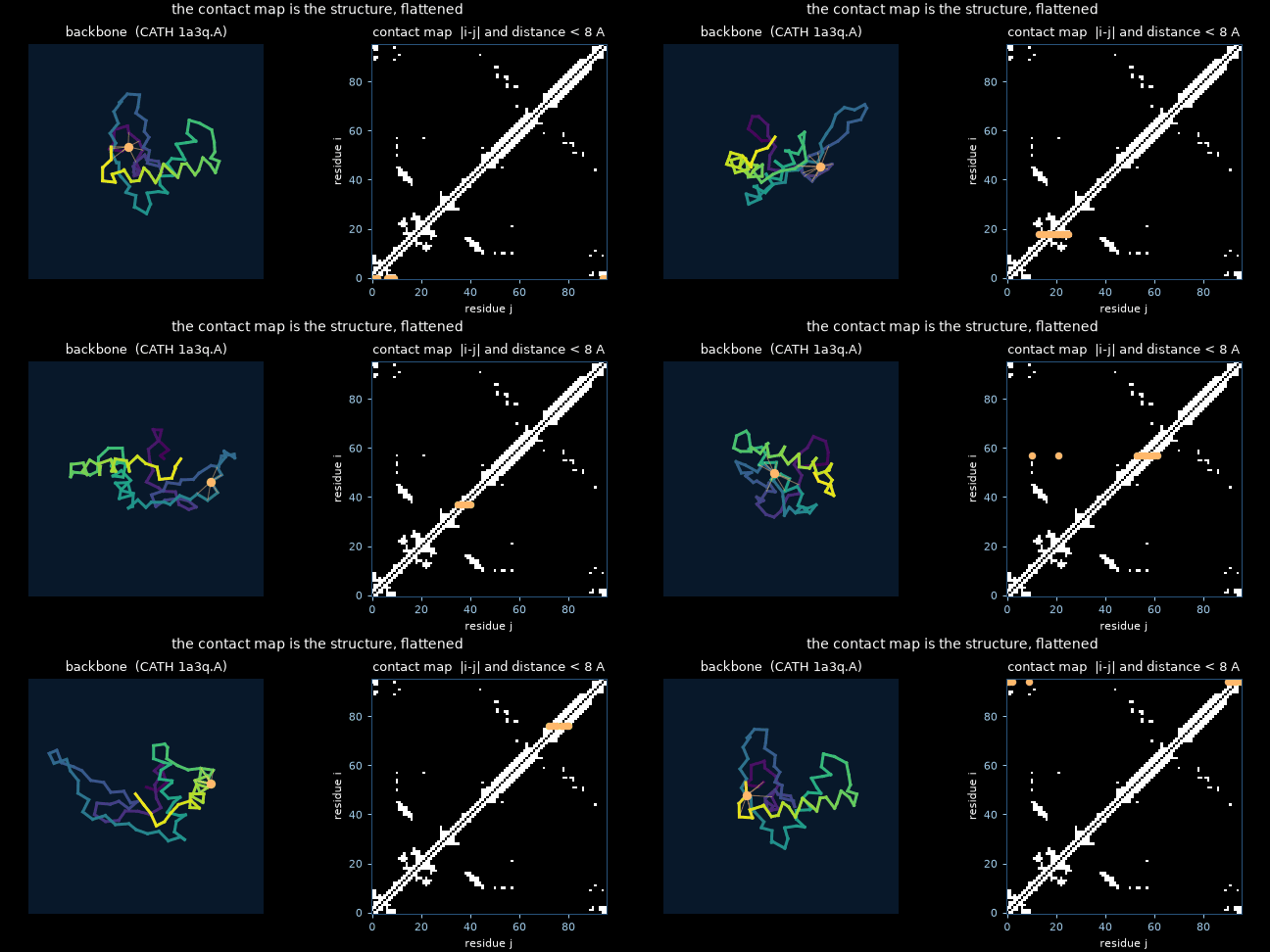
A real CATH chain on the left, the contact map it produces on the right. The orange residue walks the chain; the orange lines are every residue it touches in 3D, and the orange dots are those same contacts in the matrix.
The point is that these are the same object. A contact map is not a summary of a structure — it is very nearly the structure itself, written as a matrix. The band along the diagonal is the chain touching its own neighbours, which is trivially true of any chain and therefore carries no information (which is why the labs exclude it). The off-diagonal blobs are where the fold brings distant parts of the sequence together, and those are the entire prediction problem.
uv run scripts/make_protein_animations.py --only contact-map
Printed by uv run evoformer.py, at AlphaFold2's real c_z=128, 4 heads, bf16:
| N_res | pair rep | triangle logits | ratio |
|---|---|---|---|
| 128 | 4.2 MB | 16.8 MB | 4.0× |
| 256 | 16.8 MB | 134.2 MB | 8.0× |
| 512 | 67.1 MB | 1073.7 MB | 16.0× |
| 1024 | 268.4 MB | 8589.9 MB | 32.0× |
Two of those per block, 48 blocks in AlphaFold2 proper.
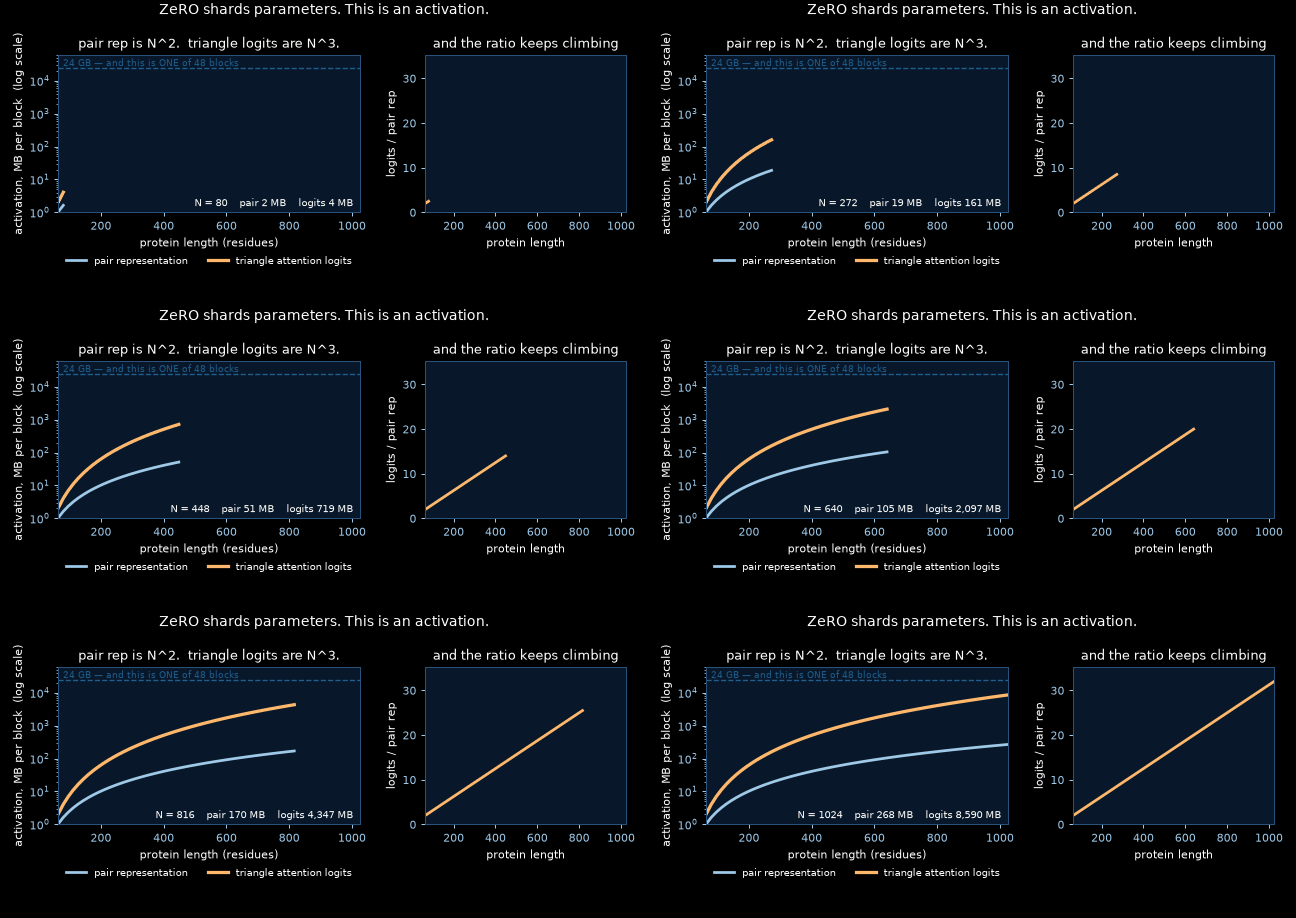
Both curves on a log scale, so a straight line is a power law and the steeper line has the larger exponent. The pair representation (pale) is quadratic; the triangle attention logits (orange) are cubic. The right-hand panel is the ratio between them, and it is the part worth watching — it does not settle, it climbs. At 128 residues the logits cost 4× the pair representation; by 1024 they cost 32×.
That is what makes this a wall rather than a constant. You cannot buy your way out with a slightly bigger card, because the term that dominates grows eight times faster per doubling than the one you were budgeting for.
uv run scripts/make_protein_animations.py --only memory-wall
The three operations
Triangular multiplicative update is the cheap one, and it is where the geometric reasoning happens. To update edge , look at every third residue :
A constraint on – and a constraint on – become a constraint on –. That is a triangle, and it is why the trunk can reason about shapes it was never shown. O(N³) time, but only O(N²) memory — the sum over contracts as it goes.
Triangle attention is the same triangle with chosen by attention rather than summed uniformly. The logits cannot be contracted away, so this one is O(N³) in memory too. This is the wall.
Outer product mean is the bridge from evolution to geometry: average the outer product of MSA columns and over all sequences. Positions that covary across homologs light up. This is the only place the alignment reaches the pair representation.
Why MSAs at all
Coevolution. Residues that touch in 3D mutate together, because a mutation at one must be compensated at the other for the fold to survive. That covariance is the only evidence AlphaFold has about contacts.
The synthetic data in this lab plants exactly that structure — and ships a
counterexample with none. Measured by uv run synthetic_msa.py, using
APC-corrected mutual information, precision at K, base rate 0.014:
| coupling | prec@K | depth | prec@K | |
|---|---|---|---|---|
| 0.00 | 0.000 | 1 | 0.077 | |
| 0.25 | 0.385 | 2 | 0.000 | |
| 0.50 | 0.923 | 8 | 0.462 | |
| 1.00 | 1.000 | 32 | 1.000 |
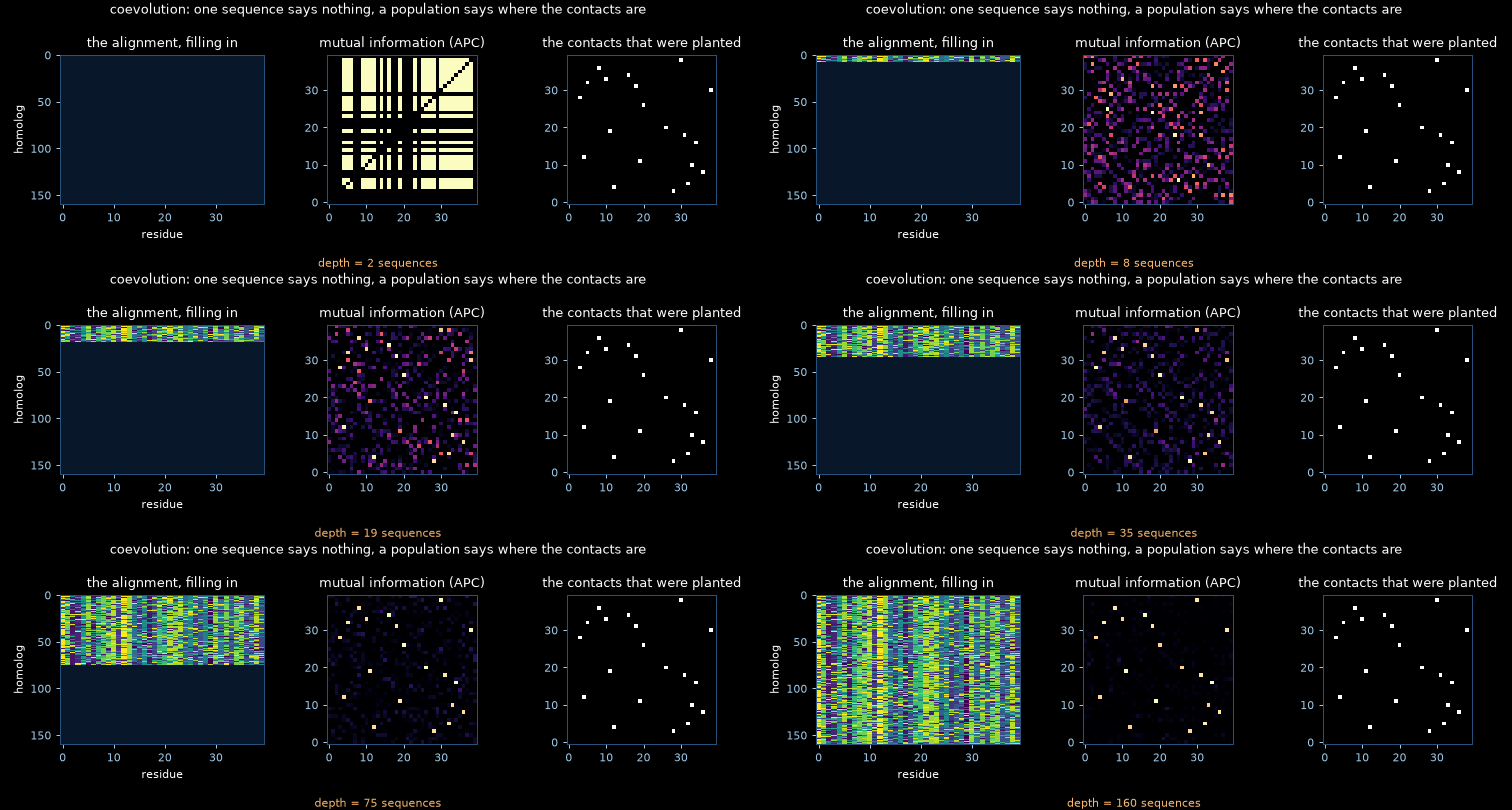
Left: the alignment filling in, one homolog at a time. Middle: APC-corrected mutual information between every pair of columns, recomputed at each depth. Right: the contacts that were actually planted.
Watch the middle panel. At two or three sequences it is noise — there are no statistics to measure. As the depth grows, bright spots sharpen out of the background and land exactly on the planted contacts. Nothing about the query sequence changed; the only thing that arrived was a population to compare it against.
uv run scripts/make_protein_animations.py --only coevolution

# bigger: 128 residues, 1024 sequences. This is the one a GPU accelerates --
# a [128, 128, 20, 20] joint distribution per frame.
uv run scripts/make_protein_animations.py --only coevolution \
    --quality high --device cuda
The right-hand column is the one to sit with. At perfect coupling, a depth-1 "alignment" is still unlearnable — coevolution is a property of a population, not of a sequence. That is why MSAs exist, and it is why ESMFold dropping them was a surprising result rather than an obvious one.
What DeepSpeed does about it
DS4Sci_EvoformerAttention, from the DeepSpeed4Science × OpenFold
collaboration, tiles the attention and never materialises the cubic tensor.
Reported at 13× peak memory reduction for OpenFold, ~15% faster training
and up to 4× faster inference.
from deepspeed.ops.deepspeed4science import DS4Sci_EvoformerAttention
It needs CUDA ≥ 11.3, compute capability ≥ 7.0, fp16 or bf16 — there is no fp32 path — and it JIT-compiles CUTLASS on first call.
uv run deepspeed --num_gpus=1 train_evoformer_ds.py
uv run deepspeed --num_gpus=1 train_evoformer_ds.py --ds-evoformer-attn
uv run deepspeed --num_gpus=1 train_evoformer_ds.py --deepspeed_config ds_config_z3.json
Make all three runs. The third is the important one: ZeRO-3 shards ~100k parameters and does essentially nothing for peak memory. Seeing the familiar answer fail is worth more than being told it would.
On 1 × RTX 3080 Ti Laptop (16 GB, compute 8.6), torch 2.11.0+cu128, deepspeed 0.19.7, defaults, three seeds:
| precision@K | 0.992 (0.992 / 0.980 / 0.999) |
| base rate | 0.013 |
| ZeRO-1 peak | 0.65 GB |
| ZeRO-3 peak | 0.62 GB — 4.6%, for 1.5× the communication |
The ZeRO-3 comparison nearly shipped backwards. The two configs initially
differed in more than the stage — ZeRO-1 left reduce_bucket_size unset, so
DeepSpeed defaulted it to 500 MB against ZeRO-3's 16 MB — and the comparison
read 1.58 GB vs 0.62 GB, appearing to prove stage 3 saves 2.5×. If a
controlled experiment has two knobs, it is not a controlled experiment.
The fallback is verified — the run completes and reports
FELL BACK (0/4 modules) rather than claiming success. The kernel's own
memory reduction is not measured, and no number for it appears anywhere in
this course.
The blocker is nvcc. The card is compute 8.6 and CUTLASS is uv-installable,
but the PyPI nvidia-cuda-nvcc-cu12 wheels ship ptxas and headers
without the nvcc driver binary (checked 12.1 → 12.9), so a root-level CUDA
toolkit install is required. The folder README gives the full recipe for
anyone who has one.
Two properties the tests assert
Both are the kind that a shape assertion passes and a wrong implementation survives.
Residue-permutation equivariance. Relabel the residues and the contact map
must permute identically. A model reading residue order instead of residue
content scores well on a fixed ordering and generalises to nothing — and at
training time, order is label order. 02_intermediate/04_groupwise_ranking
shipped exactly this bug, with a permutation error of 1.5e-01, and only the
property test caught it.
Non-query MSA row invariance. The order homologs arrive in carries no information. Asserted in both directions: permuting rows 1.. must change nothing, and permuting the query row must change something — otherwise a model that ignores the MSA entirely passes the first half.
And the counterexample that makes the closure check mean something:
TriangleMultiplicativeUpdate(broken_no_third_index=True) replaces the sum
over with an elementwise product. It runs, it trains, it returns the right
shape, and it has no triangle in it. Measured separation: correct
9.495e-01, broken 0.000e+00.
Watching it actually learn
Every figure above draws a quantity that was computed analytically. This one runs the real thing:
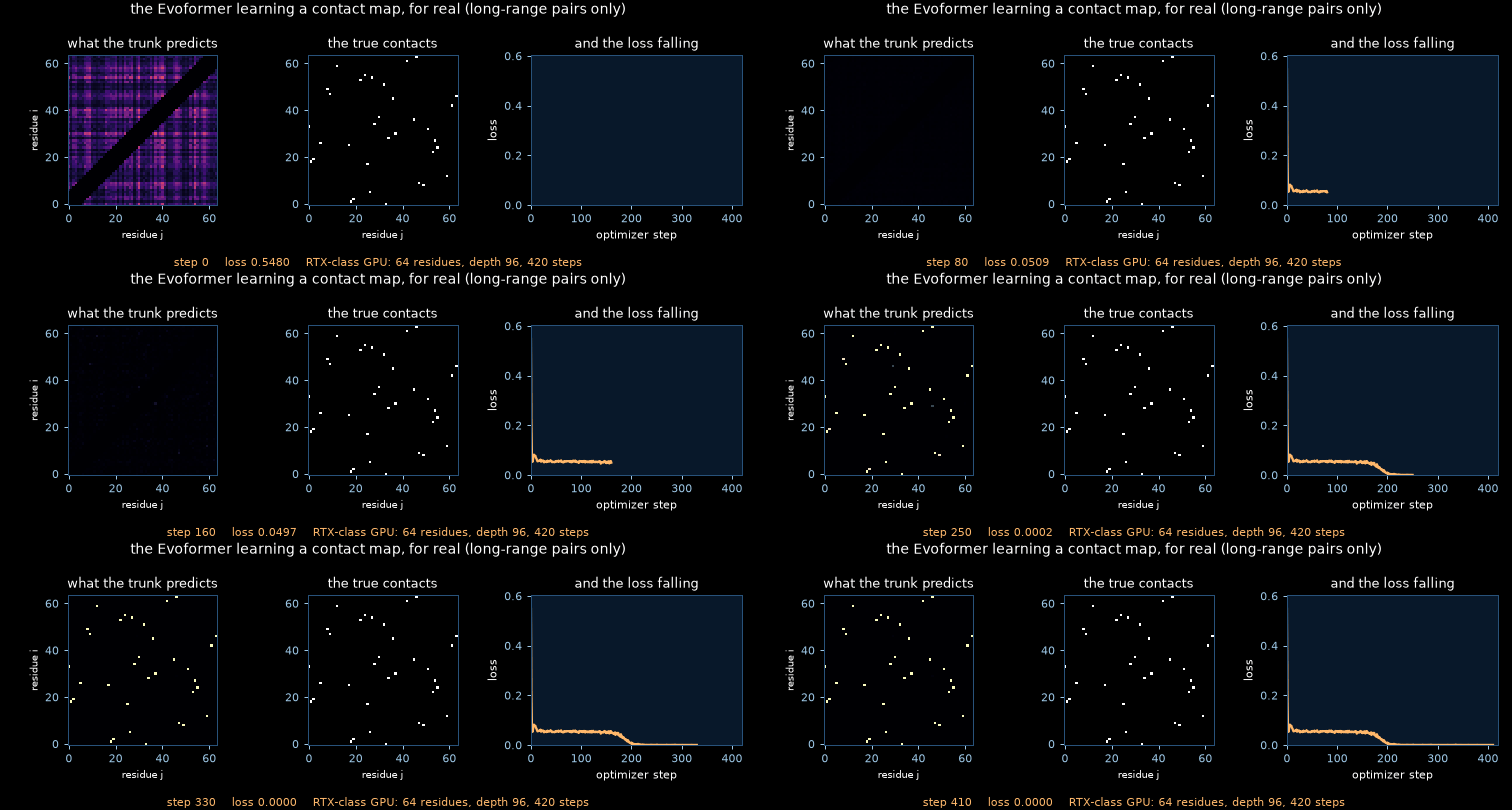
EvoformerStack — the same class the lab trains — doing several hundred real
forward and backward passes, with the predicted contact map captured as it
goes. Left is the prediction, middle is the truth, right is the loss.
Two details that are not decoration:
- Only long-range pairs are shown. The near-diagonal band is excluded from the loss, so the model is free to output anything there and does. An earlier version of this figure displayed the raw prediction, complete with a bright diagonal the truth does not have — which reads as "the model is wrong" when it actually means "this region was never asked for". Showing an unscored region as a prediction is a lie by omission.
- The loss has a visible step down around 200. That is the model going from predicting the base rate everywhere to actually resolving individual contacts.
This is the figure that demonstrates the repository is GPU-ready, because the work on the card is the repo's own model rather than a rendering trick.
uv run scripts/make_protein_animations.py --only trunk-refinement
It runs without a GPU too — it drops to a smaller protein and fewer steps, and says so on the figure, so a reduced render can never be mistaken for the full one.
Where this sits
Sections 04 and 05 argued that every frontier technique is a memory technique. ZeRO shards what the model is; token compression shrinks what it looks at; STAR memory bounds what it retains. Here the currency changes once more: the memory is the reasoning itself, and the only way to shrink it is to avoid writing it down.
Next: Pairformer deletes the MSA representation from the trunk entirely. The interesting part is what does not change — the triangle operations survive byte-for-byte, so the saving is a real 24% at 384 residues and shrinks to 11% at 1024. A constant, not the asymptote.